father
St. Gregory the Wonderworker, Bishop of Neo-Caesarea
A disciple of Origen who as bishop found his see with seventeen Christians and left it with seventeen pagans, having converted the city by miracles, by teaching, and by a creed received in vision from St. John the Theologian.
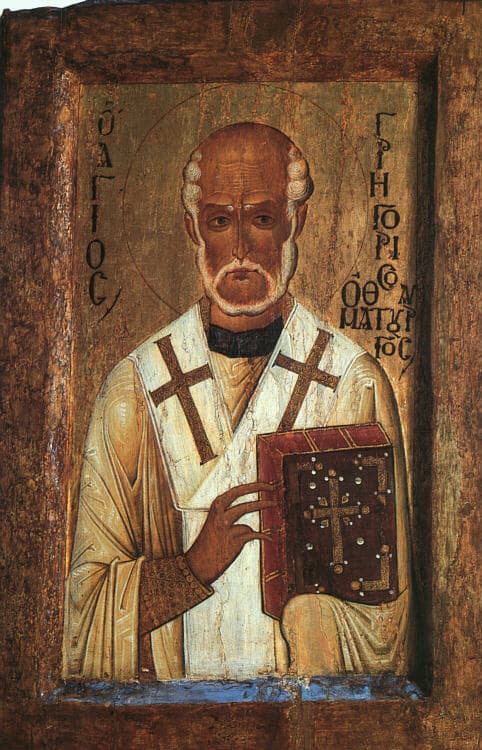
Saint Gregory the Wonderworker — Public domain. Via Wikimedia Commons.
Life
Theodore — who would be called Gregory ("the watchful") after his consecration as bishop — was born around 213 in the city of Neocaesarea in Pontus (modern Niksar in north-central Turkey), into a pagan family of the local nobility. His parents were wealthy by provincial standards; both reposed before he reached his teens, leaving him and his younger brother Athenodorus a substantial inheritance and the running of the family estate. The two boys were placed under the guardianship of an uncle who, in keeping with the family's expectations, sent them at the standard age of fifteen for higher education abroad.
They were dispatched first to Caesarea in Palestine — the great administrative city of the Roman province, with a Greek philosophical school of significant reputation — and then on to Berytus (modern Beirut), the seat of the empire's principal school of Roman law, where their guardian had decided they should train for the legal profession. They were studying at Beirut around 232 when news came that the great Christian scholar Origen, exiled from his native Alexandria, had opened a small Christian school at Caesarea in Palestine. The brothers, on a brief visit back, met Origen and were so impressed by him that they abandoned their legal studies, returned to Caesarea, and spent the next five years as Origen's full-time disciples.
The decision was Theodore's. Athenodorus, the younger, followed because his older brother had decided. Theodore was about twenty when he met Origen and about twenty-five when he left. The five years (around 232-237) were the formative experience of his life. Origen — by the surviving account, in Gregory's own farewell speech delivered at the school's leave-taking — gave him a complete classical education in Greek philosophy, then a thorough systematic training in Christian theology built on the foundations of Greek logic and metaphysics. Origen baptized Theodore at the end of the period and gave him the new name Gregory.
The brothers returned to Pontus around 240. Gregory had at first planned a quiet retirement to study and write, but the Bishop of Amasea (the metropolitan bishopric of Pontus), Phaedimus, recognized in him the gifts of a missionary bishop and pressed him to accept consecration. Gregory fled into the mountains. Phaedimus, by an unusual canonical procedure, consecrated him bishop in absentia and sent men to bring him back. Gregory accepted the consecration when he saw it was the Lord's will. He was about thirty.
He was made Bishop of Neocaesarea — his hometown — around 244. The city had at his consecration seventeen Christians, all known to him personally. He served as its bishop for the next thirty years, transforming the city and the surrounding Pontic countryside almost completely.
His methods were unusual for the period. He combined careful patient catechesis — he wrote and used a creed of his own composition, given to him (as the surviving tradition has it) in a vision of the apostle John under the guidance of the Theotokos — with substantial public miracle. The miracles are extensively documented in the contemporary accounts. He commanded a great rock to move itself out of the way for a road; the rock moved. He prophesied the eruption of a flood at a certain river; the flood came. He healed the sick who came to him by the dozen at a time. He had visions of the saints. He cast out demons. The hagiographic tradition is unusually rich and is the source of his epithet "Thaumaturgus" — the Wonderworker.
The combination of miracle and catechesis was particularly effective. By the time of his repose around 270, the city of Neocaesarea had seventeen pagans and the rest of the population was Christian. The mathematical inversion of the numbers at his consecration and his repose is one of the standard data-points of the patristic historiography of the third century. He had also founded substantial Christian communities at every smaller town in Pontus and had introduced an annual festival of the local martyrs of the previous Roman persecutions — a practice that would shape the Byzantine calendar through the next several centuries.
His writings have survived in part. The most important are: the Farewell Speech to Origen (the autobiographical account of his student years that is the principal source of our knowledge of Origen's pedagogy), the Confession of Faith (the trinitarian creed received in vision), the Canonical Epistle (a brief practical guide to the pastoral care of those who had compromised in the persecutions), the Metaphrasis of Ecclesiastes (a paraphrase of Ecclesiastes in elevated Greek prose), and the Sermon on the Annunciation (one of the earliest sustained Marian sermons in Christian literature).
He reposed around 270 at Neocaesarea, at perhaps fifty-seven. He was buried in the cathedral. His relics were translated in part to Calabria in southern Italy in the seventh century and rest in part at the church of San Gregorio Magno in Rome; substantial portions remain at the church of Saint Gregory Wonderworker in Niksar. He is the patron of teachers, of those struggling against demonic temptation, of farmers (for his control of the floods), and of every late-vocational Christian who has come to the faith through study rather than family tradition. He is also — significantly — the spiritual ancestor of Basil the Great's family: Macrina the Elder, Basil's grandmother, was a disciple of Gregory and brought his catechesis into the family that would in the next generation produce the three Cappadocian Fathers. His feast is November 17.
Traditions
Feast day
November 17
Topics
Works in library