saint
St. Helen, Equal-to-the-Apostles
Mother of the emperor Constantine, who in her old age went to the Holy Land in search of the True Cross and the holy places. Through her labor the Cross was recovered, the great Church of the Resurrection built over the empty tomb, and the basilicas of Bethlehem and Olivet established. The icon of the imperial city of God.
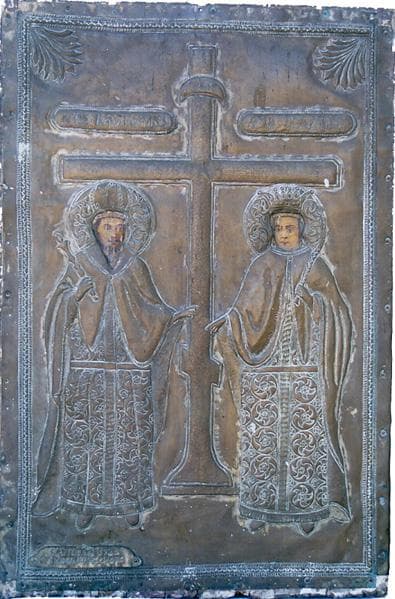
Saints Constantine and Helen — Public domain. Via Wikimedia Commons.
Life
Helena was born around 248 in Drepanum in Bithynia (a small town later renamed Helenopolis in her honor by her son), of obscure background — Eastern sources call her the daughter of an innkeeper. As a young woman she met Constantius Chlorus, then a rising officer of the Roman army, and they lived together for some years; their only child was the future Constantine the Great, born around 272. When Constantius was raised to the rank of Caesar in 293, the rigid politics of the Roman court forced him to put Helena aside and marry the daughter of the senior emperor; Helena retired into private life with her son, who was about twenty.
For some decades nothing is heard of her. When her son Constantine — by then sole emperor of the West — defeated Maxentius at the Milvian Bridge in 312 and granted toleration to the Christians the next year, she emerged from retirement, embraced the faith with extraordinary fervor (Eusebius records her as already a believer, perhaps for some years), and was granted the title Augusta. She was about sixty-five.
Around 326, by then in her late seventies, she undertook the great pilgrimage to the Holy Land that fixed her name forever in Christian memory. She was given imperial funds without limit and an imperial commission to identify, mark, and build churches over the holy places — sites that for two centuries had been deliberately desecrated by pagan temples to obscure their veneration. The cave of the Nativity at Bethlehem and the Mount of Olives were uncovered first; the great church of the Holy Sepulchre over Calvary and the Tomb was begun under her supervision.
The recovery of the True Cross was the high point. On Golgotha she had Hadrian's temple of Venus pulled down and excavations made beneath it. According to Rufinus and the church historian Socrates (within a generation of the event), three crosses were found in a cistern. To determine which was the Lord's, Macarius bishop of Jerusalem ordered each in turn brought to the bedside of a dying woman of the city; the third, touched, restored her instantly. The Cross was lifted up before the people on September 14, 326, in the event the Church remembers each year as the Universal Exaltation of the Precious Cross.
Helena returned to Constantinople with portions of the Cross and the nails and reposed there around 330, at the age of nearly eighty. Her son had her body translated to Rome and laid in the imperial mausoleum on the Via Labicana, where her great porphyry sarcophagus still stands in the Vatican Museums. She is the patroness of pilgrims, of archaeologists, of converts late in life, and (with Constantine) of every Christian sovereignty in the Eastern tradition.
Traditions
Feast day
May 21
Topics
Works in library