saint
St. Hilarion the Great
Disciple of Anthony who brought the monastic life into Palestine, founded the first lavra in Gaza, and traveled through Syria, Egypt, and Cyprus to escape the crowds that sought him. Subject of one of Jerome's lives.
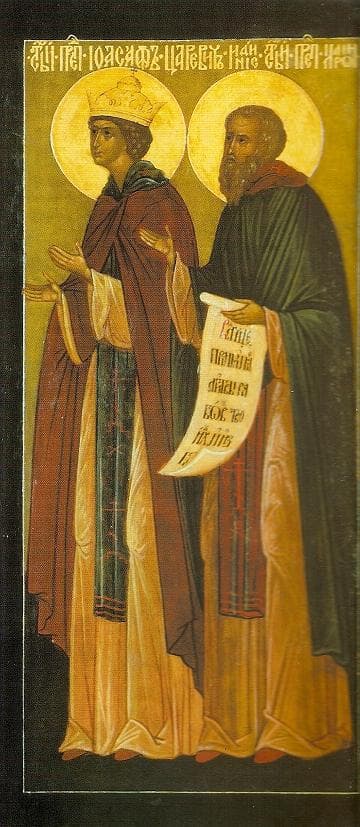
Hilarion the Great — Public domain. Via Wikimedia Commons.
Life
Hilarion was born around 291 in the small village of Tabatha in the Roman province of Palestine — about five miles south of the coastal city of Gaza, in the Negev borderlands between the Mediterranean and the Sinai desert. His parents were pagan Egyptian-Palestinian farmers of moderate means; the family had been settled at Tabatha for several generations. The boy was sent at fifteen to Alexandria for higher studies — the standard path for a promising son of moderately prosperous provincial parents.
At Alexandria he attended the great catechetical school of the city, then in the period after the Diocletianic persecution had ended (313). He was baptized at sixteen or seventeen, around 308. He heard reports of the desert hermit Anthony at his mountain near the Red Sea; he traveled out to visit Anthony briefly, then returned to Tabatha at the news of his parents' deaths.
He distributed his inheritance — partly to his siblings, partly to the poor of his native village — and withdrew at eighteen to the desert wilderness around Maiumas, near the coastal port of Gaza. His hermit-cell was a small reed-and-mud hut three miles from the sea, in a thicket of tamarisks and acacias near a brackish spring. He lived there alone for the next twenty-two years (310-332) in the strictest ascetic discipline he could devise — eating only figs and the bread of a few villagers who knew his hut, sleeping on the bare ground, keeping the standard monastic offices alone in his hut.
By his late thirties his reputation had spread across Palestine. Disciples began to come. Two or three at first, then a dozen, then a hundred. By 340 he had perhaps three hundred monks in a loose network of cells around his original hermitage — the first true monastic community of Palestine. He served as the elder of the community for the next ten years.
The monastic life at Maiumas was shaped on the Egyptian-Anthonine pattern Hilarion had observed at Anthony's mountain: solitary cells, manual labor in basket-weaving, weekly communal Liturgy on Saturday and Sunday at a small central church, the standard daily monastic offices in each cell. The Palestinian variation was the introduction of substantial almsgiving as a regular part of the monastic discipline — the Maiumas monks practiced systematic charity to the poor of the Gaza region in a way that the more isolated Egyptian Anthonine monks did not.
Hilarion was a wonder-worker on the scale of his master Anthony. The records describe healing of sicknesses, raising of the dead, the casting out of demons, the multiplication of bread, the calming of storms at sea. The miracles drew crowds; the crowds disturbed Hilarion's preferred solitude. By his late fifties he had become so famous across the eastern Mediterranean that his hermitage was constantly besieged by visitors.
In 356, on the death of Anthony at his mountain (and the immediate publication of Athanasius's Life of Anthony, which made the entire desert tradition known across the empire), Hilarion at sixty-five fled his community to escape the increased flood of visitors. He went south to Egypt, then east to Babylon (Mesopotamia), then back through Syria to the Greek-speaking coast. He spent his last fifteen years (356-371) as an itinerant ascetic, moving from one short-term hermitage to another in an attempt to live the quieter life he had originally chosen.
His final years were spent on Cyprus, at the small mountain hermitage of Paphos at the western edge of the island. He arrived there around 364 with a single disciple, Hesychius, and lived in the cave-hermitage that has been continuously venerated as the cave of Hilarion ever since. He reposed there on October 21, 371, at eighty.
His body was taken back by Hesychius to Maiumas in Palestine for burial in the original community he had founded. His relics were translated to Constantinople in the Byzantine period and rest at the Church of the Theotokos in Constantinople, with substantial portions at the cave-hermitage on Cyprus (which remains a major pilgrimage site).
The "Life of Hilarion" written by Jerome of Stridon (around 391) is the principal source for his biography — Jerome had been in the Palestine region during Hilarion's last years and had gathered the standard oral traditions of the community. Through Jerome's Latin biography, Hilarion's pattern of organized Palestinian monastic life was carried to the Latin West and became one of the formative influences on the rise of Western monasticism in the fifth and sixth centuries.
He is the foundational father of Palestinian monasticism, in the sense that everyone after him in the Palestinian tradition is in some way his lineal heir. The lineage runs: Hilarion → Euthymius the Great (who was tonsured by Hilarion's disciples) → Sabbas the Sanctified (under Euthymius) → Theodosius the Cenobiarch and John the Hesychast (under Sabbas) → the broad Palestinian monastic tradition through Byzantine and modern times. He is the patron of hermits living in coastal-desert environments, of itinerant ascetics seeking solitude, and of every Christian who is fleeing his own holiness. His feast is October 21.
Traditions
Feast day
October 21
Topics
Works in library