father
St. Hilary of Poitiers
Bishop of Poitiers and Doctor of the Church — called "the Athanasius of the West" for his exile to Phrygia under Constantius II and the Trinitarian theology he brought home to the Latin Church. His twelve books On the Trinity remain the foundational Western answer to Arianism before Augustine.
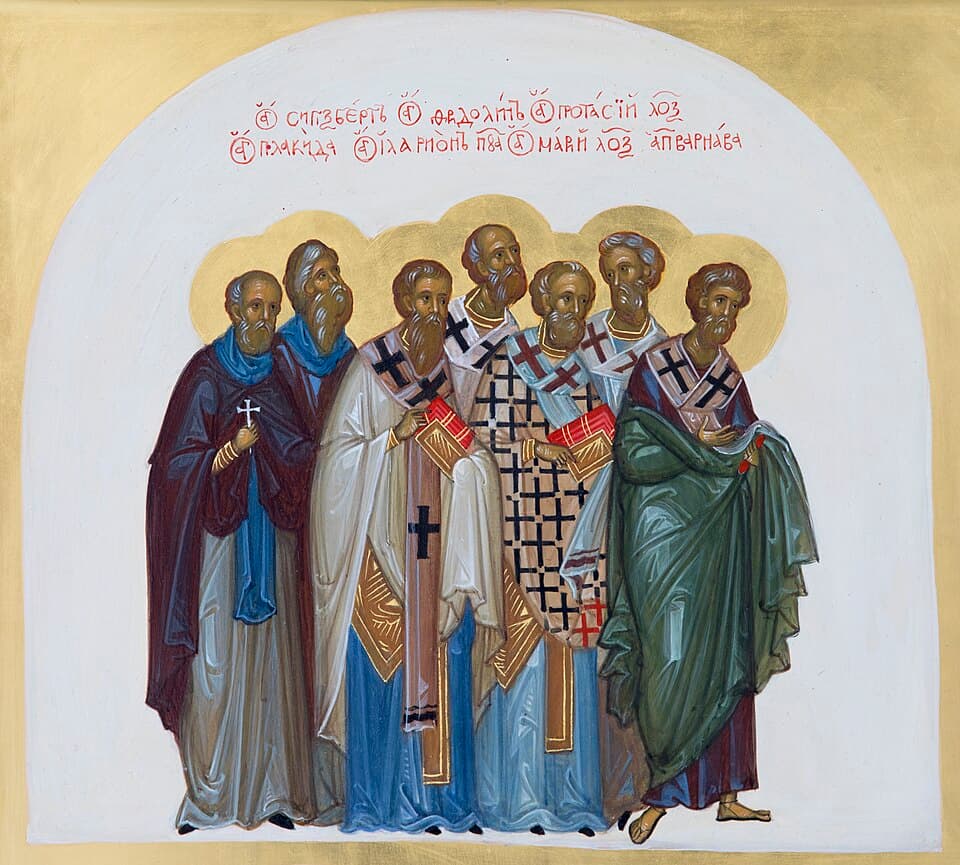
Hilary of Poitiers — CC BY 4.0. Via Wikimedia Commons.
Life
Hilary was born around the year 315 in Poitiers in Gaul, to a pagan family of some social standing, and converted to Christianity as an adult after reading the prologue to the Gospel of John. Elected bishop of Poitiers around 350, he entered the episcopate at the height of the Arian crisis in the West, when the Emperor Constantius II was systematically pressuring Western bishops to condemn Athanasius and endorse Arian or semi-Arian formulas. Hilary's resistance earned him exile to Phrygia in 356 — an exile that proved providential, because it brought him into direct contact with the full Greek Trinitarian theology he had not previously encountered.
In exile he composed his masterwork: the twelve books On the Trinity (De Trinitate), the most comprehensive Latin treatment of Trinitarian doctrine before Augustine, and a work of both impressive learning and genuine theological force. Drawing freely on Athanasius, Origen, and other Greek sources, Hilary made the substance of the Eastern doctrinal debates available to the Latin West at a critical moment. He was recalled from exile around 360 and continued his resistance to Arianism until his death in 367 or 368. He was also a hymn-writer of importance, one of the earliest Latin composers of liturgical poetry.
He is venerated as a saint in the Orthodox Church; his feast falls on January 13 in some traditions. The nickname "the Athanasius of the West" captures his role precisely.
Traditions
Feast day
January 13
Topics
Works in library
Readings and commentaries
Catena Aurea by Aquinas
Commentary on Matthew
Commentary on Matthew verse
Homilies
Letters
On the Councils
On the Trinity
On the Trinity, Book 8, Sections 13 and
The Trinity
Tractates
Treatise on Psalm
Untitled commentary
Homilies on the Psalms
Hilary's psalm-by-psalm commentary, dependent on Origen and the Greek tradition but transposed into the Latin Church's understanding of the Psalter as Christological prayer. Only selected psalms are preserved.
On the Councils (De Synodis)
A theological history of the fourth-century Trinitarian councils, written from Hilary's eastern exile — his attempt to translate the Eastern semi-Arian creeds into Latin and to show his Gaulish brothers what the controversy actually was.
On the Trinity (De Trinitate)
Twelve books — the foundational Western Trinitarian treatise before Augustine. Hilary wrote it in exile in Phrygia and brought Latin theology into the conversation that Athanasius, Basil, and the Cappadocians were having in the East.