father
St. Hippolytus of Rome
Roman presbyter, antipope, and martyr — author of the Apostolic Tradition (foundational text for the ancient Roman rite of ordination and baptism), the Refutation of All Heresies (a sweeping doxography of Greco-Roman religion and gnostic sects), and one of the earliest Christian commentaries on Daniel. Reconciled with Rome before his martyrdom in the Sardinian mines.
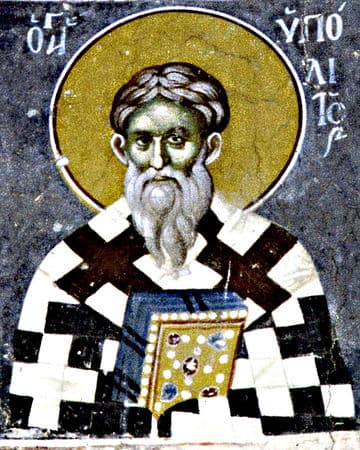
Hippolytus of Rome — Public domain. Via Wikimedia Commons.
Life
Hippolytus was born around the year 170, likely in the eastern part of the empire, and came to Rome, where he sat under Irenaeus of Lyons and became a leading presbyter and teacher in the Roman church. He is the earliest Christian writer of whom we have a substantial surviving body of work in Greek from the Roman church, and his learning and polemical gifts made him a formidable figure in an age of controversy.
His most important works are the Refutation of All Heresies (also called the Philosophumena) — a massive ten-book survey of every philosophical school and Gnostic sect, tracing heresy to its pagan philosophical roots — and a commentary on Daniel, the oldest extant Christian commentary on any book of Scripture. The work known as the Apostolic Tradition, long attributed to him, contains some of the earliest detailed descriptions of Christian initiation rites, the ordination prayer for bishops, and the daily prayer of the Church; though scholars debate the attribution, the text's immense liturgical significance is unaffected.
During the pontificates of Zephyrinus and Callistus I, Hippolytus grew into a sharp critic of the Roman bishops for what he saw as laxity in doctrinal and penitential discipline. The controversy led to a schism in which he was elected as a rival bishop of Rome — the first antipope in history. The schism ended providentially: in the persecution of Maximinus Thrax in 235, both Hippolytus and the legitimate pope Pontian were exiled together to the mines of Sardinia. Before his death there, Hippolytus was reconciled with the Church he had divided. Their bodies were returned to Rome in 236 and buried on the same day, as confessors of a common faith. He is honored as a martyr; his feast falls on August 13.
Traditions
Feast day
August 13
Topics
Works in library
Readings and commentaries
Against Gaius
Against Noetus
Against Plato, On the Cause of the Universe
Commentary of Dionysius Barsalibi on the Apocalypse
Commentary on Daniel
Dionysius Bar Salibi quoting Hippolytus on Revelation
Dubious and Spurious Pieces
Dubious Hippolytus Fragments
Exegetical Fragments
Fragments
Hippolytus Dogmatical and Historical Fragments
Hippolytus Dogmatical and Historical Fragments - The Discourse on the Holy Theophany
Hippolytus Exegetical Fragments
Hippolytus Exegetical Fragments - Commentary on Genesis
Hippolytus Exegetical Fragments - Doubtful Fragments on the Pentateuch
Hippolytus Exegetical Fragments - Of the visions of Daniel and Nebuchadnezzar
Hippolytus Exegetical Fragments - On Genesis
Hippolytus Exegetical Fragments - On Susannah
Hippolytus Exegetical Fragments - Scholia on Daniel
Hippolytus Exegetical Fragments - Six Days' Work
Hippolytus Fragments - Dogmatic and Historical
Hippolytus Refutation of All Heresies Book
Hippolytus Refutation of All Heresies Book IX
Hippolytus Refutation of All Heresies Book V
Hippolytus Refutation of All Heresies Book VI
Hippolytus Refutation of All Heresies Book VII
Hippolytus Refutation of All Heresies Book VIII
Hippolytus Refutation of All Heresies Book X
On Christ and Antichrist
On Matthew
On the Antichrist
On the Blessings of Isaac and Jacob
On the Blessings of Issac and Jacob
On the Blessings of the Isaac and Jacob
On the End of the World
On the Gospel of John and the Resurrection of Lazarus
On the Holy Theophany
On the Theophany
Refutation of All Heresies
St. Jerome, Commentary on Daniel, CHAPTER NINE
The Blessings of the Patriarchs
The Discourse on the Holy Theophany
The Refutation of All Heresies
The Refutation of All Heresies Book
The Refutations of All Heresies Book VIII
Treatise on Christ and Antichrist
Treatise on the Song of Songs
Expository Treatise Against the Jews
Brief anti-Jewish polemical treatise arguing from Old Testament prophecy that Jesus is the Messiah. Like other patristic adversus Iudaeos works, requires careful editorial framing in modern reception.
Against the Heresy of One Noetus
Refutation of the modalist monarchian Noetus of Smyrna, defending the distinct hypostatic existence of the Son alongside the Father. An important early Greek anti-modalist text.
Against Plato on the Cause of the Universe
Short philosophical treatise against Platonic cosmology, defending creation ex nihilo against the eternity of matter.
Treatise on Christ and Antichrist
Hippolytus's classic treatment of the figure of the Antichrist, working through Old Testament prophecies (especially Daniel) and Pauline eschatology. The earliest extended Christian work on this subject.
On the Seventy Apostles
Pseudonymous list-text catalog of the Twelve Apostles and the Seventy Disciples, with brief notes on each one's later mission and traditional place of death.
Treatise on Christ and Antichrist (On the End of the World)
Pseudonymous eschatological treatise attributed to Hippolytus but generally regarded as later in composition. Treats the second coming and the end of the age.
Exegetical Fragments
Surviving fragments of Hippolytus's biblical commentaries on Genesis, Exodus, Numbers, Psalms, Proverbs, Ecclesiastes, the Song of Songs, Daniel, and other Old and New Testament books.
Discourse on the Holy Theophany
Homily for the Feast of the Theophany (Baptism of Christ), expounding the theological meaning of Christ's baptism in the Jordan and its bearing on the baptismal liturgy.
The Refutation of All Heresies
Hippolytus's major work, a ten-book exposé of Gnostic and other heretical systems — by far the fullest surviving 3rd-century catalog of pre-Nicene heresies, preserving substantial verbatim quotations from the Gnostic teachers themselves. Books 1, 4 through 10 survive (Books 2 and 3 are lost). Often known as the Philosophumena.