father
St. Ignatius Brianchaninov
Bishop of the Caucasus and of the Black Sea, who from a noble military family entered monasticism and gave the modern Russian Church its most luminous teacher of prayer. His Arena and other writings translate the spirit of the desert fathers into the language of nineteenth-century seekers.
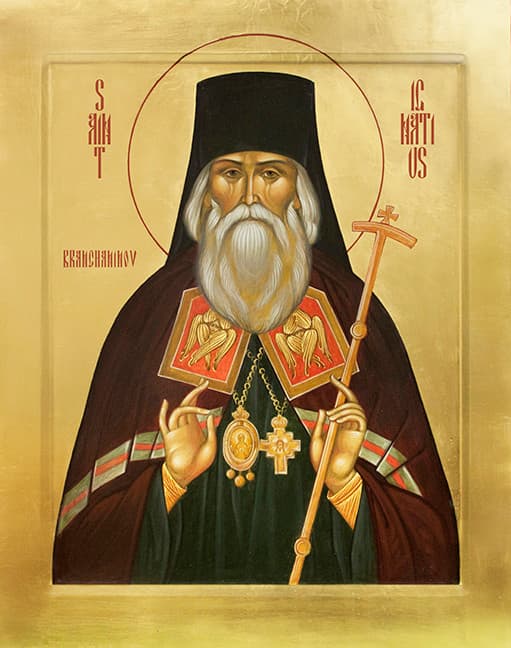
Ignatius Brianchaninov — Hand-curated icon.
Life
Dmitri Alexandrovich Brianchaninov was born on February 5, 1807, on his family's estate at Pokrovskoye in the Vologda province of northern Russia, into a noble military family with substantial landholdings. He was the eldest son of Alexander Brianchaninov, a retired colonel of the imperial guard; his mother Sophia was a pious noblewoman of the older Muscovite type. Dmitri was raised in the family tradition: French-Russian bilingual education, German tutor for science, careful catechesis in the Orthodox faith, and from age fourteen the standard military preparation expected of an officer's eldest son.
He was sent in 1822 to the Imperial Military Engineering School in St. Petersburg — the elite training academy for the corps of engineers, where Russia's military aristocracy sent its most promising sons. He distinguished himself in the technical sciences; his draftsmanship was exceptional. He took his examinations in 1826 at nineteen and was commissioned as a junior engineering officer of the imperial army, with a clear path ahead to senior staff appointments.
The decisive turn came during his examination at the school. The Emperor Nicholas I came in person to congratulate the top three graduates. Dmitri, as the top of his class, was greeted by the Emperor and told that he was destined for great things in the imperial service. Dmitri, who had been struggling for several years with a private desire for the monastic life, took the Emperor's enthusiastic words as the final external sign that the world was claiming him. He went home, prayed, and submitted his resignation to the imperial guard within the week. The Emperor was furious — military resignations of high-ranking nobles were tightly controlled, and Nicholas I personally tried to dissuade Dmitri, then to compel him. Dmitri held his ground; he was allowed to resign at the end of 1827.
He entered monastic life at twenty-one (1828) at the Optina Hermitage, then under the direction of Elder Leonid (Lev) Nagolkin — the first of the great Optina elders. He stayed at Optina for about six months but found it not yet ready to receive him as a full monk (he was a high-ranking noble who would have stood out from the simple peasant monks of the period; the abbot was concerned about the political risk). He moved to a succession of smaller monasteries — Aleksandro-Svirsky, the Tikhvin community, the Lopotov Pelageyev Hermitage — and was finally tonsured Ignatius in 1831 at the Lopotov.
He was ordained priest in 1833 and almost immediately appointed by the imperial command of Nicholas I (who had not forgotten his protege) to be the abbot of the Sergiev Hermitage near St. Petersburg, with the rank of archimandrite. Nicholas, having lost him to monasticism, intended to keep him close to the capital. Ignatius served at the Sergiev Hermitage for twenty-four years (1833-1857), reforming the monastery, attracting a substantial community, and producing the body of writing that would make his name.
In 1857 he was consecrated Bishop of the Caucasus and the Black Sea — the diocese covering the Russian-Caucasian frontier, then in the midst of the long Caucasian Wars. He served there for four years (1857-1861), surveying the diocese, reorganizing the diocesan administration, and finding the climate increasingly hostile to his health. He resigned in 1861 and retired to the Nikolo-Babaevsky Monastery on the upper Volga, where he spent his last six years in seclusion.
His writings constitute the most systematic body of nineteenth-century Russian ascetic theology. The principal works are: The Arena (a practical manual of the spiritual life for monks and laypeople, drawing on the desert fathers and the Byzantine hesychasts); On the Prayer of Jesus (a study of the Jesus Prayer practice); Ascetic Sermons (homilies of his Sergiev years); the Letters (a vast correspondence with spiritual children and seekers); the unfinished Patericon (a Russian translation and commentary on the Sayings of the Desert Fathers).
His distinctive contribution was the rigorous insistence on guarding the practice of the Jesus Prayer from spiritual delusion (prelest). He warned constantly against the romantic and the imaginative in prayer, against seeking spiritual experiences for their own sake, against any practice that was not grounded in deep humility and continual sacramental confession. His position was somewhat in tension with the more experiential approach of Theophan the Recluse (his slightly younger contemporary), and the debate between the two — about how much warm spiritual feeling should be sought or allowed in prayer — has continued in Russian Orthodox thought.
He reposed at the Babaevsky Monastery on April 30, 1867, at sixty. He was buried at the monastery; his relics were uncovered in 1988 by the Russian Orthodox Church on his glorification (the millennium of the baptism of Rus') and rest at the Tolga Convent in Yaroslavl. He is the patron of military officers who have entered monastic life, of translators of patristic texts, and of every Christian who must navigate the inner life with theological precision. His feast is April 30.
Traditions
Feast day
April 30
Topics
Works in library