father
St. Ignatius the God-bearer
Disciple of the apostle John, third bishop of Antioch after Peter, condemned to the lions in Rome under Trajan. On his way from Antioch to martyrdom he wrote seven letters to the churches that mark the earliest pattern of the Church's life — the threefold ministry, the bishop as the icon of the Father, the Eucharist as the medicine of immortality.
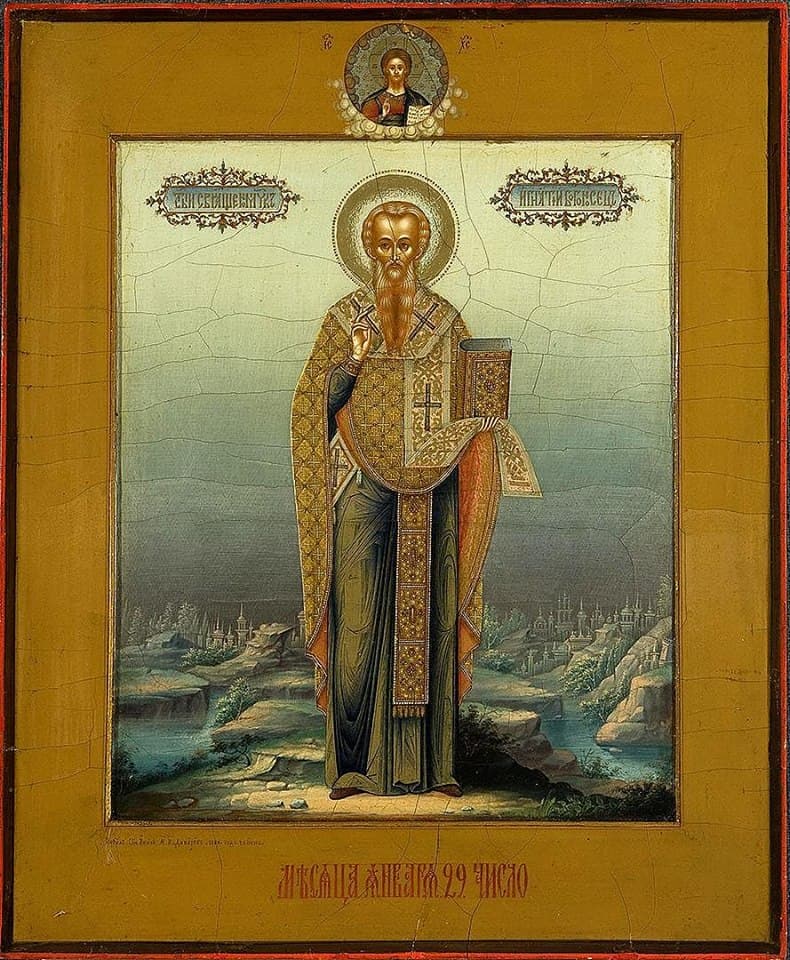
Saint Ignatius of Antioch — Public domain. Mikhail Ivanovich Dikarev. Via Wikimedia Commons.
Life
Ignatius was born around 35 in Roman Syria — tradition says he was the very child whom the Lord set in the midst of His disciples and said, "Of such is the kingdom of heaven." He was a disciple of the apostle John, and around the year 70 (after the death of Peter) he became the third bishop of Antioch, the first imperial city to be evangelized after Jerusalem and the place where the disciples were first called Christians.
For nearly forty years he led the great Antiochene Church through the difficult second generation after the apostles — when the eyewitnesses were dying out and the gnostic teachers were beginning to spread alternative gospels. About 107 he was arrested during the persecution of the Emperor Trajan and condemned to be sent to Rome to be torn by beasts at the games. Ten Roman soldiers — "ten leopards," he called them, who grew worse the more kindly he treated them — escorted him by ship and overland the eight hundred miles to the capital.
At the seven cities of Asia Minor where the prisoner-train stopped along the way, the local churches came out in deputations to greet him. At Smyrna he met Polycarp; at Troas he wrote five of his seven letters. The letters are to the churches of Ephesus, Magnesia, Tralles, Rome, Philadelphia, Smyrna, and to Polycarp personally. They contain the earliest references in Christian literature to the three-fold ministry of bishop, priest, and deacon, the earliest description of the Eucharist as the "medicine of immortality," and the earliest extended use of the word Catholic — "where Christ is, there is the Catholic Church."
The letter to the Romans begs the Roman Christians not to use their influence to spare him from the beasts: "Let me be the food of the wild animals, through whom I can find God. I am God's wheat, and I am ground by the teeth of wild beasts that I may become a pure loaf for Christ." His wish was granted; he was thrown to the lions in the Colosseum on December 20, around 107 or 108. Only the harder bones were found afterward and brought back to Antioch; in 637, before the city's fall to the Saracens, they were translated to Rome. The Church remembers him on December 20 (his martyrdom) and January 29 (the translation of his relics back to Antioch in the fourth century).
Traditions
Feast day
December 20 and January 29
Topics
Works in library
Readings and commentaries
Epistles
Origen's Homilies on Luke
Second Epistle of Ignatius to the Ephesians
Syriac Second Epistle of Ignatius to the Ephesians
Epistle to Polycarp
Personal pastoral letter from Ignatius to the young Polycarp, bishop of Smyrna — fatherly counsel to a fellow disciple of John, who would himself be martyred c. 155.
Epistle to the Ephesians
The longest and theologically richest of Ignatius's seven authentic letters — twenty-one chapters on unity with the bishop, the divinity of Christ, and the Eucharist as "the medicine of immortality" (§20).
Epistle to the Magnesians
Letter on unity with the bishop and against Judaizing Christians — among the earliest extant arguments for the threefold ministry of bishop, presbyter, and deacon.
Epistle to the Philadelphians
Letter on schism and unity — Ignatius urges the Philadelphians to be united with their bishop and to flee division.
Epistle to the Romans
Letter to the church at Rome pleading that they not intervene to prevent his martyrdom — "I am the wheat of God, and am ground by the teeth of the wild beasts, that I may be found the pure bread of Christ."
Epistle to the Smyrnaeans
The first extant Christian text to use the phrase "Catholic Church" (§8). A strong anti-docetic confession ("truly suffered, truly rose") and a foundational text for Orthodox sacramental and ecclesiological doctrine.
Epistle to the Trallians
Brief letter against docetic Christology — Ignatius insists that Christ was truly born, truly suffered, and truly rose.
The Martyrdom of Ignatius
The "Antiochene Acts" of Ignatius's martyrdom — narrating his interrogation by Trajan, the journey from Antioch to Rome, and his death by wild beasts in the Colosseum. One of the foundational Christian martyrdom narratives.
The Spurious Epistles
Inauthentic letters falsely attributed to Ignatius — fourth-century forgeries (Tarsians, Antiochians, Hero, Philippians, Mary at Cassobela, and others) included in ANF Vol. 1 for scholarly completeness. NOT to be cited as Ignatian.