saint
St. Innocent, Enlightener of the Aleuts and Apostle to America
John Veniaminov, a married parish priest of Irkutsk who in 1824 set out for Russian Alaska with his wife and children, learned Aleut and Tlingit, translated the Gospel and the liturgy into them, and after his wife's repose returned as bishop. Ended his life as metropolitan of Moscow.
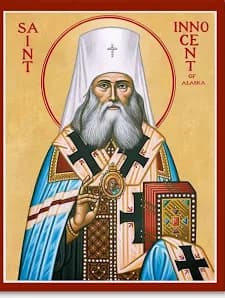
Saint Innocent of Alaska — Hand-curated icon.
Life
Ivan Evseyevich Popov-Veniaminov was born on August 26, 1797, in the village of Anginskoye in the Irkutsk diocese of eastern Siberia, into a poor Russian Orthodox family — his father a parish reader, his mother the daughter of a country deacon. Ivan was orphaned at six and was raised by his uncle, a parish priest who recognized in the boy a quick intelligence and a deep piety. He was sent to the Irkutsk seminary in 1806, where he distinguished himself in languages — he learned Latin, Greek, and a smattering of English from a passing British missionary — and in the mathematical sciences. He took his graduating examinations in 1817 at the age of twenty.
He was ordained a married parish priest in 1821 (after marriage to Ekaterina Sharin, daughter of a local deacon) and assigned to a poor parish in Irkutsk. He served there for two years; in 1823 he was selected to lead a mission to the new Russian American Company colony of Unalaska in the Aleutian Islands of Russian Alaska. The post had been vacant for some years; no priest from Irkutsk had volunteered; the local bishop spoke privately with Ivan about it. He went home that night and told his pregnant wife Ekaterina that he had been called to the islands. They went.
The mission party — Father Ivan, Ekaterina, their three small children, his mother, and his brother — arrived at the Aleutian island of Unalaska in July 1824 after a ten-month sea journey from Irkutsk via the Pacific coast. He spent the next ten years on Unalaska. He built the first cathedral church there with his own hands (he had learned carpentry as a boy and was a competent woodworker). He learned the Aleut language well enough to translate the Catechism, the Gospel of Matthew, and a number of liturgical texts; the alphabet he devised for the Aleut language is still in use. He performed his first baptism of an Aleut convert in 1825 and continued in active mission work through his decade there.
In 1834 he was transferred to Sitka (New Archangel), the capital of Russian America, as principal priest of the territory. He worked there for five years, extending his learning to the Tlingit language and visiting the Aleut, Athabaskan, and Tlingit communities of the territory by boat and by foot. He compiled a Tlingit-Russian-English dictionary in those years and prepared the first Tlingit liturgical translation.
In 1839 his wife Ekaterina died, leaving him alone with five children. The Holy Synod recalled him to Russia for the funeral and a leave of absence. While in Moscow he met Metropolitan Filaret (Drozdov) — the great Russian theologian of the period — who recognized in him the maker of a new bishopric. After three months in Moscow he was tonsured a monk with the name Innocent (after his predecessor as Apostle of Eastern Siberia, the eighteenth-century Bishop Innocent of Irkutsk) and was consecrated bishop on December 15, 1840, as the first Bishop of Kamchatka, the Kuril Islands, and the Aleutians — a new see covering all of Russian America and the eastern Pacific frontier of Russia.
He served as bishop of the new see for twenty-six years, traveling its vast distances by ship, by sled, by foot, and by canoe. He extended the work to Kamchatka itself, to the Kuril Islands, to the Russian Far Eastern mainland; he founded the first cathedral at Petropavlovsk-Kamchatsky and the first cathedral at Sitka in their present forms. He maintained throughout this period the same direct concern for the welfare of the native peoples that had characterized his work as a parish priest. He continued the linguistic work — by his repose he had completed translations of the principal liturgical texts into Aleut, Tlingit, Kuril, Yakut, and several Tungusic languages.
In 1858 he was advanced to archbishop and given the additional see of Yakutsk in eastern Siberia; in 1868, at seventy-one, he was recalled to Russia to become Metropolitan of Moscow and All Russia, the successor of Filaret who had recognized him in his middle age. He served as Metropolitan of Moscow for eleven years, the last position in the Russian Church. He continued to write — his pastoral letters to the Alaskan mission of his successors, and his theological works on Christian instruction, are among the finest of the nineteenth-century Russian episcopate.
He reposed in Moscow on March 31, 1879, on Holy Saturday, after a long illness. He was eighty-one. He was buried at the Trinity-Sergius Lavra near Moscow. His relics were uncovered in the Soviet period and are now at the Lavra. He was glorified by the Russian Orthodox Church Outside Russia in 1977 and by the Moscow Patriarchate in the same year — one of the first joint glorifications of the two Russian jurisdictions, recognized then as now as the apostle of America and one of the great missionary bishops of any age. His feasts are March 31 (repose) and October 6 (joint feast with the apostles of America).
Traditions
Feast day
March 31 and October 6
Topics
Works in library