father
St. Irenaeus of Lyons
Bishop of Lyons and disciple of Polycarp, who received the faith in an unbroken chain from the Apostles; his Against Heresies is the first systematic refutation of Gnosticism and the foundational witness to apostolic tradition.
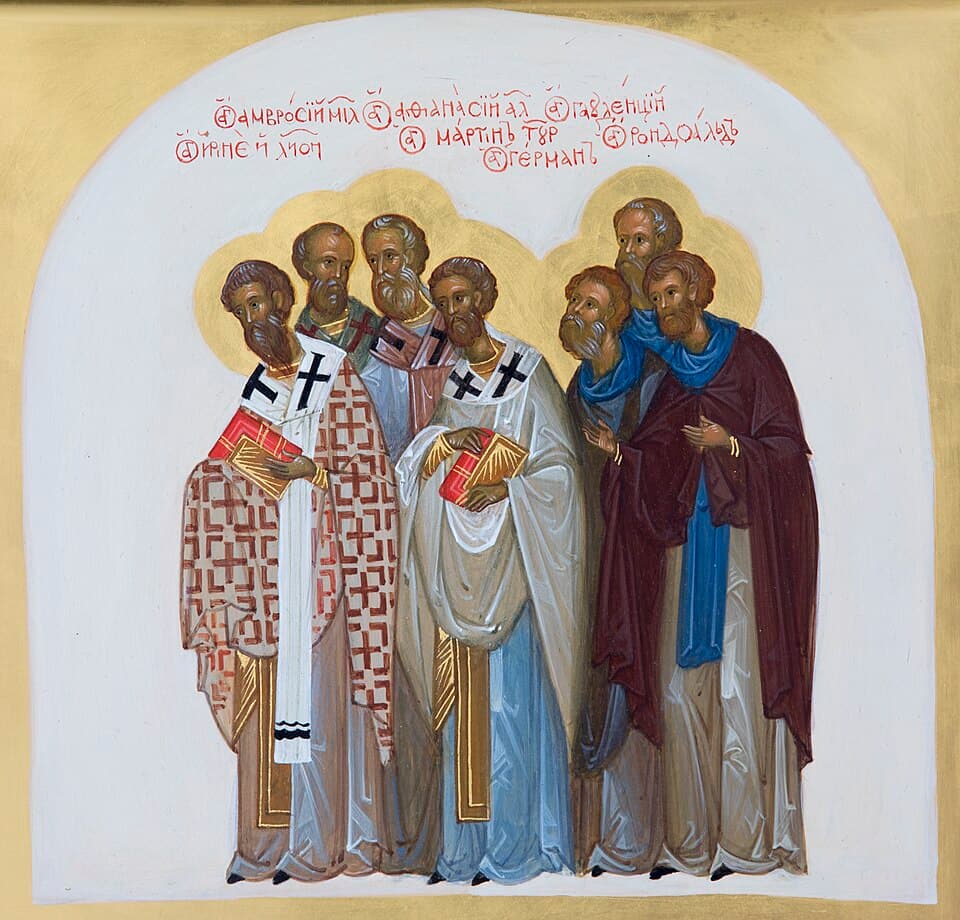
Irenaeus of Lyons — CC BY 4.0. Via Wikimedia Commons.
Life
Irenaeus was born around the year 130, most likely in Smyrna in Asia Minor, and as a boy he heard the bishop Polycarp preach — Polycarp who had himself received the faith directly from the apostle John. This chain — from the apostle to his disciple to the young Irenaeus listening in the congregation — became the foundation of everything he later wrote: the faith is not hidden or esoteric, but delivered openly from Christ through the apostles to the churches they planted, and through those churches to us.
He moved westward, eventually coming to the church at Lugdunum — present-day Lyon in Gaul — where he served as presbyter and then bishop. In 177 he was in Rome carrying letters when the great persecution swept Lyon, claiming nearly fifty of the congregation including the bishop Pothinus. On his return he was elected to succeed Pothinus.
The defining labor of his episcopate was the refutation of Gnosticism. The Gnostic teachers — Valentinus, Marcion, Basilides — taught that the Creator of the material world was a lesser or evil deity, that Christ had not truly become flesh, and that salvation consisted of secret knowledge reserved for an enlightened few. Against all of this Irenaeus wrote his great work Adversus Haereses (Against Heresies) in five books. But he did not merely refute: he was the first theologian to articulate the "recapitulation" of all things in Christ — that the Son of God, by taking on the whole of human life from birth to death, summed up and healed what Adam had broken, restoring humanity's original vocation to grow into the divine likeness.
Irenaeus reposed around the year 202, and he is venerated as a martyr, though the circumstances of his death are unrecorded. His other surviving work, the Demonstration of the Apostolic Preaching, is the earliest extant catechetical summary of the Christian faith addressed to those outside the Church. His feast in the Orthodox Church falls on August 23.
Traditions
Feast day
August 23
Topics
Works in library
Readings and commentaries
Against Heresies
Against Heresies Book
Against Heresies Book 1, Preface.1
Against Heresies Book I
Against Heresies Book II
Against Heresies Book III
Against Heresies Book IV
Against Heresies Book V
Fragments
Irenaeus Against Heresies Book
The Demonstration of the Apostolic Preaching
The Proof of the Apostolic Preaching
The Demonstration of the Apostolic Preaching
Irenaeus's catechetical companion to Against Heresies — a positive exposition of the rule of faith in one hundred short chapters, addressed to a Christian named Marcianus. Lost in Greek for seventeen centuries and rediscovered in 1904 in a single Armenian manuscript; this is J. Armitage Robinson's 1920 translation, the standard public-domain English edition.
Fragments from the Lost Writings of Irenaeus
Thirty-five surviving fragments preserved by later writers from Irenaeus's lost works. Includes the famous Letter to Florinus (Fragment 2), in which Irenaeus recalls his boyhood discipleship under Polycarp — the primary textual witness for the John → Polycarp → Irenaeus apostolic chain. Fragment 3 (Letter to Victor) records his irenic intervention in the Paschal Controversy with Rome.
Against Heresies
The foundational anti-Gnostic patristic treatise. Five books in which Irenaeus describes the Gnostic systems of his day (Book I), refutes them by reason (II), defends the apostolic Rule of Faith and the four-fold Gospel canon (III), unfolds the recapitulation of Adam in Christ (IV), and argues for the bodily resurrection and eschaton (V). 173 chapters total.