father
St. Jerome
Doctor of the Church and translator of the Vulgate — the Latin Bible that shaped the Christian West for a thousand years. Ascetic of Bethlehem, fierce controversialist, and the most prolific letter-writer of the patristic age. Commemorated with St. Augustine on June 15 in some Orthodox calendars.
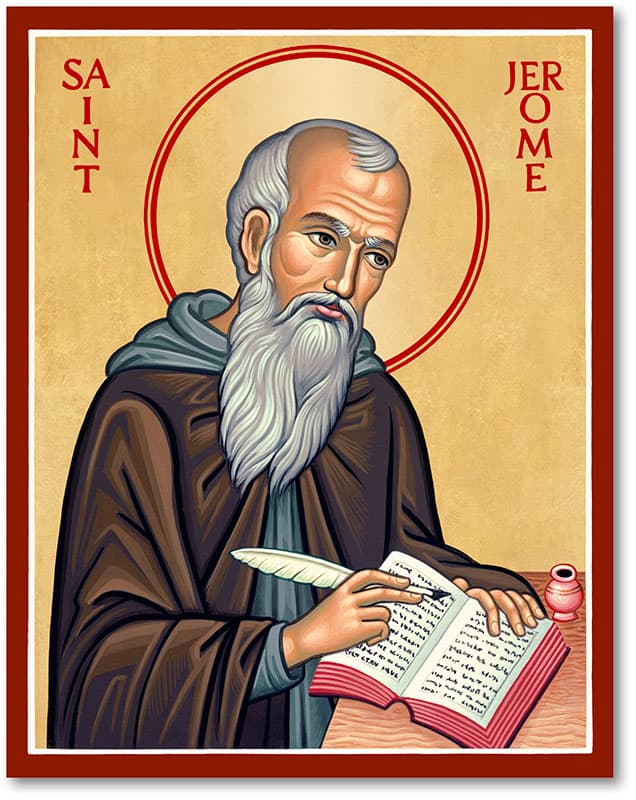
Jerome — Hand-curated icon.
Life
Eusebius Sophronius Hieronymus was born around the year 347 at Stridon, on the border of Dalmatia and Pannonia. He was sent to Rome for his education, studying grammar, rhetoric, and philosophy and immersing himself in the Latin classics; he was baptized there as a young man. After travels through Gaul he spent some years in a circle of ascetic friends at Aquileia, then resolved to go to the East. In the Syrian desert near Chalcis he lived as a hermit for several years, learning Greek and — taming, as he put it, the pride of a Latin rhetorical education — beginning to study Hebrew from a Jewish monk, an acquisition that would change the history of the Western Church.
He was ordained presbyter at Antioch, studied at Constantinople under Gregory of Nazianzus, and came to Rome where Pope Damasus made him his secretary and set him to the task that would occupy the rest of his life: a new Latin translation of the Scriptures from the original Hebrew and Greek. The version he produced — what would become the Vulgate — was the Bible of the Western Church for a thousand years. He also served in Rome as spiritual director to a circle of aristocratic women, most notably Paula and her daughter Eustochium, who would eventually follow him to the East.
When Damasus died in 384 Jerome left Rome for the Holy Land, eventually settling in Bethlehem, where Paula used her considerable wealth to found a monastery for men, a convent for women, and a hospice for pilgrims. There Jerome lived for the last thirty-five years of his life, completing the translation of the Old Testament from Hebrew, writing commentaries on nearly all the prophetic books, producing Latin translations of Origen and Eusebius, and maintaining a vast polemical correspondence. His temper was volcanic — "a man who cannot be angry does not know how to reproach," he wrote — but his scholarship was incomparable and his ascetic seriousness was total. He reposed in Bethlehem on September 15, 420. The Orthodox Church honors him on June 15.
Traditions
Feast day
June 15
Topics
Works in library
Readings and commentaries
Against Helvidius
Against John of Jerusalem
Against John of Jerusalems
Against Jovinian
Against Jovinianus
Against Rufinus
Against the Pelagians
Against the Pelagians 1. PROLOGUE.
Against Vigilantius
Augustine Letter
Book on Hebrew Names, On the Acts of the Apostles, B
Brief Commentary on Psalm
Brief Commentary on Psalms
Catena Aurea by Aquinas
Commentariorum In Epistolam Beati Pauli Ad Ephesios, Book 2, on Ephesians
Commentarium in Evangelium Lucae, PL
Commentary on Amos
Commentary on Daniel
Commentary on Ecclesiastes
Commentary on Ephesians
Commentary on Ezekiel
Commentary on Galatians
Commentary on Habakkuk
Commentary on Haggai
Commentary on Hosea
Commentary on Isaiah
Commentary on Jeremiah
Commentary on Joel
Commentary on Jonah
Commentary on Malachi
Commentary on Matthew
Commentary on Micah
Commentary on Nahum
Commentary on Obadiah
Commentary on Philemon
Commentary on the Song of Deborah
Commentary on Titus
Commentary on Zechariah
Commentary on Zephaniah
De Viris Illustribus
Dialogue Against the Luciferians
Epistles
For unless there were also false justice, the justice of God would never be referred to as true justice. Against the PELAGIANS
Hebrew Questions on Chronicles
Hebrew Questions on Genesis
Hilarion
Homiles on the Psalms
Homilies
Letters
Life of Malchus
On Illustrious Men
On Lazarus and Dives
On the Epiphany and Psalm
On the Nativity of the Lord
On the Psalms
Preface on Job
Preface to Isaiah
Prologue to Chronicles
Sermons
Six Books on Jeremiah
St. Jerome, Commentary on Daniel
St. Jerome, Commentary on Daniel, CHAPTER EIGHT
St. Jerome, Commentary on Daniel, CHAPTER ELEVEN
St. Jerome, Commentary on Daniel, CHAPTER FIVE
St. Jerome, Commentary on Daniel, CHAPTER FOUR
St. Jerome, Commentary on Daniel, CHAPTER FOURTEEN
St. Jerome, Commentary on Daniel, CHAPTER NINE
St. Jerome, Commentary on Daniel, CHAPTER ONE
St. Jerome, Commentary on Daniel, CHAPTER SEVEN
St. Jerome, Commentary on Daniel, CHAPTER SIX
St. Jerome, Commentary on Daniel, CHAPTER TEN
St. Jerome, Commentary on Daniel, CHAPTER THIRTEEN
St. Jerome, Commentary on Daniel, CHAPTER THREE
St. Jerome, Commentary on Daniel, CHAPTER TWELVE
St. Jerome, Commentary on Daniel, CHAPTER TWO
The Dialogue Against the Luciferians
The Histories of the Monks
The Perpetual Virginity of Mary
To Pammachius Against John of Jerusalem
Tractates
Untitled commentary
To Pammachius Against John of Jerusalem
Polemical treatise during the Origenist controversy — Jerome's break with his former friend John, bishop of Jerusalem, over the orthodoxy of Origen.
Against Jovinianus
Two-book defense of the ascetic life and the superiority of virginity to marriage against the Roman monk Jovinianus, who argued for the spiritual parity of all baptized states.
The Dialogue Against the Luciferians
Dialogue defending the reception of repentant Arian-baptized clergy into the Church against the rigorist Luciferian schism — a pastoral case study in how the post-Nicene Church re-integrated those compromised by the controversy.
Dialogue Against the Pelagians
Three-book dialogue against Pelagian teaching on the possibility of sinlessness apart from grace — written from Bethlehem during the late phase of the controversy in which Augustine was the primary Western voice.
Against Vigilantius
Polemical pamphlet against the Gallic presbyter Vigilantius, who had attacked the veneration of relics, vigils at martyrs' shrines, and clerical celibacy — a sharp witness to fourth-century ascetic piety.
Apology against the Books of Rufinus
Three-book defense of Jerome's own role in the Origenist controversy — a polemic against his old friend Rufinus of Aquileia that effectively ended their relationship.
De Viris Illustribus (Illustrious Men)
One hundred and thirty-five short biographical notices of Christian writers from the apostles to Jerome's own contemporaries — the earliest systematic bio-bibliography of Christian literature.
Letters
The most prolific patristic letter collection — 131 letters spanning Jerome's life, from his early ascetic experiments in Antioch to the cell in Bethlehem. Includes the famous letters to Eustochium on virginity, to Paula and her daughters, to Pammachius, to Marcella, and to Augustine.
The Life of St. Hilarion
Jerome's biography of Hilarion the Great, disciple of Antony and founder of Palestinian monasticism — a foundational text in the Christian hagiographical tradition.
The Life of Malchus the Captive Monk
Short hagiographical romance about a monk taken captive by Saracens, preserving his chastity through a marriage in name only — a tale of providence in captivity.
The Life of Paulus the First Hermit
One of the earliest Latin monastic biographies — Jerome's literary portrait of Paul of Thebes, the legendary first Christian hermit, visited by Antony in his final days.
The Perpetual Virginity of Blessed Mary (Against Helvidius)
Foundational Mariological treatise — defending the perpetual virginity of the Theotokos against Helvidius, who read the "brothers of the Lord" of the Gospels as Mary's biological children.
Prefaces to the Vulgate
Prefaces Jerome wrote to accompany his Vulgate translations of individual biblical books — primary documents in the history of the canon, full of his arguments for the Hebrew text and against the apocryphal expansions.