father
St. John Cassian
Founder of the Abbey of Saint Victor at Marseilles; the bridge between the Egyptian desert and Latin monasticism. His Institutes and Conferences brought the spiritual experience of the Desert Fathers to the West and shaped both the Rule of St. Benedict and the perennial Eastern reading of the ascetic life. The Conferences are still read at meals in Orthodox monasteries.
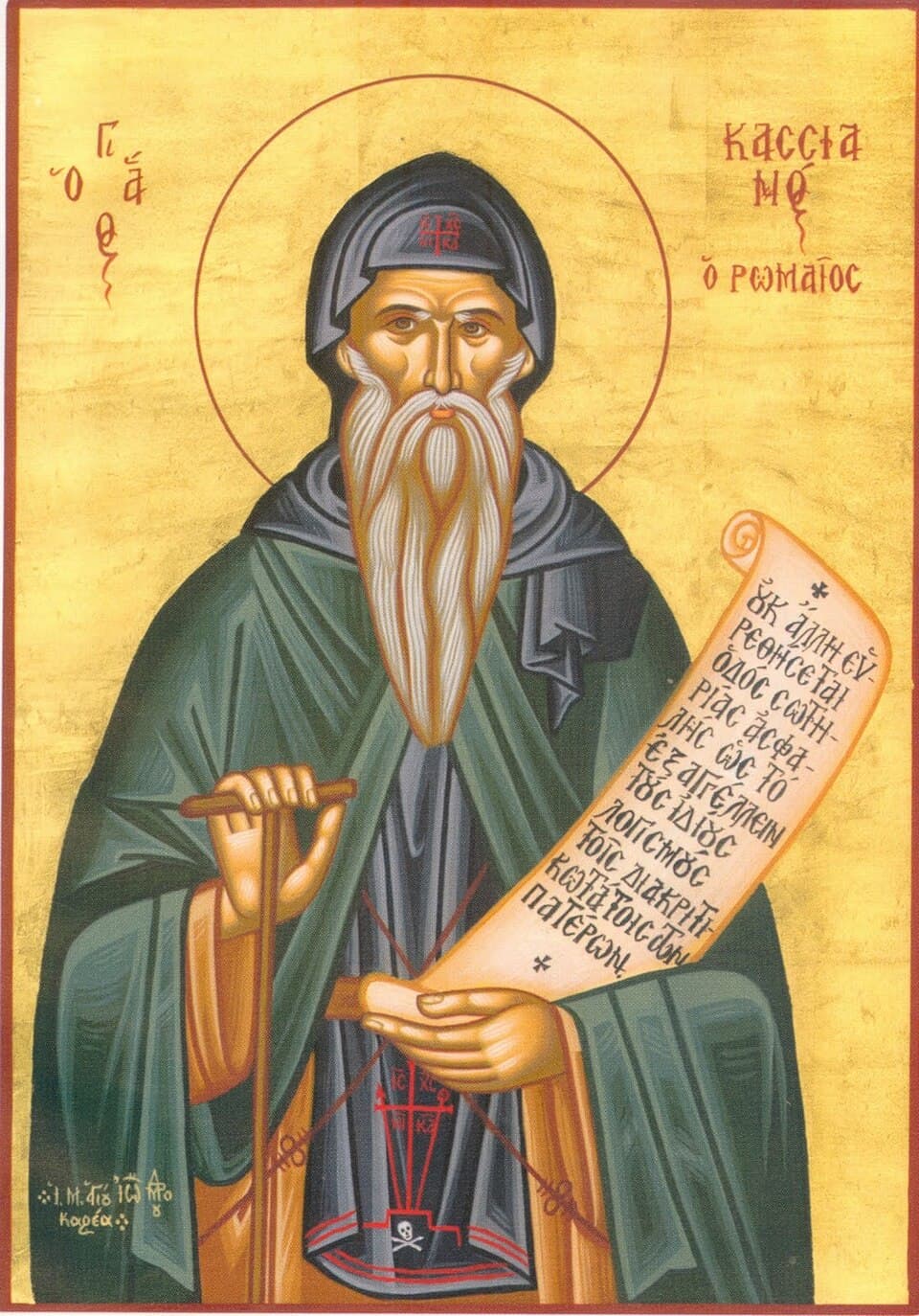
John Cassian — Public domain. Via Wikimedia Commons.
Life
John Cassian was born around 360, very probably in Scythia Minor (modern Dobruja, on the western shore of the Black Sea where Romania and Bulgaria meet today), to a Christian family of some means and Latin culture. With his lifelong friend Germanus he entered a monastery at Bethlehem in his late teens, but the two were quickly seized by the desire to learn from the great Egyptian monastic fathers. About 385, with leave from their Bethlehem abbot, they crossed over to Egypt and spent the next fifteen years traveling from one desert to another — Nitria, Kellia, the desolate inner deserts of Scetis (Wadi al-Natrun) — collecting the conferences of the elders that he would later commit to writing.
The Origenist controversy at the very end of the fourth century — Theophilus of Alexandria's violent expulsion of intellectual monks from Egypt in 399-400 — drove Cassian and Germanus out. They went to Constantinople, where they attached themselves to St. John Chrysostom; Cassian was ordained deacon by Chrysostom and was one of those sent by the city's clergy to plead Chrysostom's case at Rome after the unjust deposition of 404. He spent the next decade in Rome, where he was eventually ordained priest, before settling in his final home: the Greek-influenced city of Marseilles in southern Gaul.
There, around 415, he founded two monastic houses — the Abbey of St. Victor for men, the smaller Abbey of St. Saviour for women — and there he composed his two great works for the Latin-speaking West. The Institutes set out the external life of the cenobitic monk — the habit, the rule of prayer, the disposition of the day, the eight principal vices and their remedies. The Conferences, set as a series of dialogues with the great Egyptian elders, set out the inner life — discrimination, ceaseless prayer, the perfection of love. Together they became the textual bridge by which the experience of the Egyptian desert reached the West; St. Benedict, in his Rule a century later, quotes Cassian by name and orders him read at meals.
He died at Marseilles around 435 and was buried in his own abbey of St. Victor, where his head is still venerated. In the East he is honored as a Father without qualification; in the West his reputation was clouded for centuries because of a posthumous quarrel with the late Augustine over grace and free will (the so-called "semi-Pelagian" controversy), but he was never formally condemned, and modern Catholic and Orthodox alike now reckon him among the great teachers of the spiritual life. The Orthodox Church keeps his feast on February 28 (or February 29 in leap years).
Traditions
Feast day
February 29
Topics
Works in library
Readings and commentaries
Conferences (Collationes)
Twenty-four conversations with the great Egyptian Desert Fathers — the most influential monastic text after the Rule of St. Benedict. Cassian's account of pure prayer in Conferences 9 and 10 became foundational for the hesychast tradition; his treatment of grace in Conference 13 lit the long Augustinian dispute in the West.
Institutes of the Cœnobia (De Institutis Coenobiorum)
Twelve books on monastic life — the first four on practical observance (clothing, daily prayer, the canonical hours, novitiate), the last eight on the cure of the eight principal vices. The foundational rule-book of Western cenobitic monasticism; recommended by St. Benedict and read in Orthodox monasteries.
On the Incarnation of the Lord (Against Nestorius)
Seven books written at the request of Pope Leo, then archdeacon — Cassian's anti-Nestorian Christology, the late fruit of his Eastern formation now wielded in defense of Cyrilline orthodoxy in Latin.
Catena Aurea by Aquinas
Conference
Conference 12:7.4–5
Conference 14:11.2–3
Conference 23:9.2–3
Conference 7:5.8–9
Conference of Abbot Paphnutius
Conferences
Incarnation of the Lord, Against Nestorius
Institutes
On the Incarnation of the Lord Against Nestorius
On the Institutes
Second Conference of Abbot Nesteros
Third Conference of Abbot Chaermeon
Untitled commentary
On the Holy Fathers of Sketis and on Discrimination
St. John Cassian · On the Holy Fathers of Sketis and on Discrimination — as included in the Philokalia.
On the Eight Vices
St. John Cassian · On the Eight Vices — as included in the Philokalia.
St. John Cassian — Introductory Note (Philokalia)
Editorial introduction to the Philokalic selections of St. John Cassian.