father
St. John Chrysostom
Archbishop of Constantinople whose homilies combine doctrinal clarity with pastoral directness.
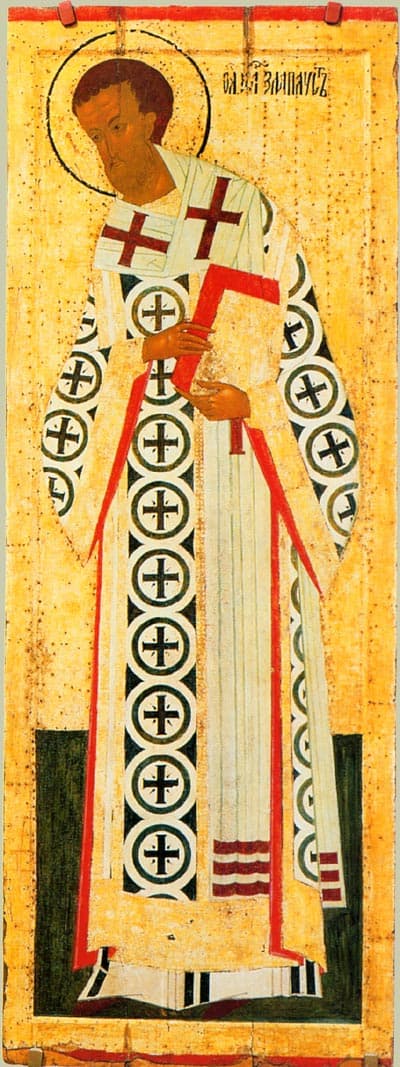
Saint John Chrysostom — Public domain. Dionisius. Via Wikimedia Commons.
Life
John was born around 347 in Antioch, the son of an upper-class Greek family of the city — his father, Secundus, a military officer, died when he was very young; his widowed mother Anthousa raised him alone in the faith. He studied rhetoric under the famous pagan Libanius, who is said to have called him the most gifted of all his students and to have wished John to inherit his school (had not "the Christians stolen him"). After his baptism around 367 he took up the ascetic life in the mountains south of Antioch, lived four years with an old Syrian hermit, and then two years in a cave alone — until his health, broken by his austerities (he had memorized the entire New Testament standing in cold water), forced him back to the city.
Ordained deacon in 381 and priest in 386, he was given the preacher's pulpit at the great cathedral of Antioch and held it for twelve years. From it he produced the body of homilies — on Genesis, on the Psalms, on the Gospel and the letters of Paul — that have come down through every century of the Church since. His name, Chrysostomos, "the golden mouth," was given by the people of Antioch for the way he made the Scriptures live.
In 397 the Emperor Arcadius made him, against his wish, Archbishop of Constantinople. The five years of his episcopate were a long battle. He emptied the patriarchal treasury to fund hospitals; he forbade the bishops who came to court to seek their fortunes there; he preached against the gold-laden weddings of the senatorial class and the silver mirrors of the empress Eudoxia herself. The Empress and the archbishop of Alexandria conspired to depose him; at a packed synod at the Oak (a suburban estate) in 403 they pronounced him deposed and exiled. The earthquake that night brought the Empress to her knees and Chrysostom briefly back; within months a fresh quarrel sent him to exile permanently.
He died on the long march toward his second place of banishment in Pontus, falling exhausted at a chapel near Comana on September 14, 407. His last words were the ones he had repeated for years through every storm: "Glory to God for all things." Thirty years later his successor brought his relics back to Constantinople in triumph; the Liturgy that bears his name has been the principal Eucharistic service of the Orthodox Church for every Sunday from that day to this.
Traditions
Feast day
November 13
Topics
Works in library
Readings and commentaries
Discourses Against Judaizing Christians (Adversus Judaeos)
Eight homilies preached at Antioch against Christians who were attending Jewish synagogue services and observing Jewish festivals — Trumpets, the Day of Atonement, Tabernacles. Among Chrysostom's most rhetorically intense works and historically controversial: the polemical language has been gravely misused in later centuries. Read with the modern scholarly caveats summarized in Robert L. Wilken, John Chrysostom and the Jews (1983) and in Roger Pearse's introduction to this edition.
Homily Against Publishing the Errors of the Brethren
Sermon against the public exposure of fellow Christians' sins — counseling instead the patience of fraternal correction.
Commentary on Galatians
Chapter-by-chapter commentary through Galatians — the major patristic exposition of justification, the law, and the inheritance of Abraham.
Correspondence with Pope Innocent I
Letters between Chrysostom in exile and Pope Innocent I of Rome — Rome's defense of Chrysostom against the Eastern synodal proceedings that deposed him.
First Homily on Eutropius
Sermon preached when the imperial eunuch Eutropius — having fallen from power — took refuge at the altar of Hagia Sophia. Chrysostom interceded for his protection from the very emperor he had served.
Homilies on the Acts of the Apostles
Fifty-five homilies preached at Constantinople through the Book of Acts — the only patristic verse-by-verse Acts commentary of this scope.
Homilies on the Epistle to the Colossians
Twelve homilies on Colossians — Christological exposition of Paul's reading of "in him all things hold together."
Homilies on the Epistle to the Ephesians
Twenty-four homilies on Ephesians — major patristic source for Christology, ecclesiology, and the theology of Christian marriage in Ephesians 5.
Homilies on the First Epistle to the Corinthians
Forty-four homilies on 1 Corinthians — pastoral application of Paul's letter to the moral and ecclesial life of Antioch.
Homilies on the First Epistle to the Thessalonians
Eleven homilies on 1 Thessalonians — sustained patristic exposition of the Parousia and the resurrection of the dead.
Homilies on the First Epistle to Timothy
Eighteen homilies on 1 Timothy — pastoral epistles read by a working pastor, with sustained attention to the qualifications of bishops and the order of the church.
Homilies on the Epistle to the Hebrews
Thirty-four homilies on Hebrews — the most extensive patristic commentary on the priestly Christology of the Epistle, read with the experience of having served the altar.
Homilies on the Gospel of John
Eighty-eight homilies on the Fourth Gospel — Chrysostom's most theologically dense Gospel series, sustained exegesis of John's Christology, the bread of life discourse, and the farewell prayers.
Homilies on the Gospel of Matthew
Ninety homilies on Matthew preached at Antioch — verse by verse from the genealogy through the Passion. The longest and most influential patristic commentary on the First Gospel.
Homilies on the Epistle to Philemon
Three homilies plus an introduction on Paul's shortest letter — a remarkable patristic reading of the social ethic of fraternal restoration.
Homilies on the Epistle to the Philippians
Fifteen homilies on Philippians, including extensive treatment of the Christ-hymn of Philippians 2 ("who, being in the form of God").
Homilies on the Epistle to the Romans
Thirty-two homilies on Paul's longest letter — Chrysostom's most theologically sustained Pauline commentary, indispensable for Orthodox readings of justification, grace, and the moral life.
Homilies on the Second Epistle to the Corinthians
Thirty homilies on 2 Corinthians — Chrysostom's reading of Paul's most personal letter, with sustained attention to the ministry of reconciliation.
Homilies on the Second Epistle to the Thessalonians
Five homilies on 2 Thessalonians — Chrysostom's reading of the "man of lawlessness" and the meaning of the restrainer.
Homilies on the Second Epistle to Timothy
Ten homilies on 2 Timothy — Paul's farewell letter read with pastoral urgency.
Homilies on the Statues (Ad Populum Antiochenum)
Twenty-one homilies preached during the Antioch riot of 387, when the city had defaced imperial statues and feared retribution from Theodosius. Chrysostom's pastoral preaching at its most urgent — a window into Christian conduct under civic crisis.
Homilies on the Epistle to Titus
Six homilies on Titus — the third pastoral epistle.
Homily on St. Babylas
Panegyric for Babylas, third-century bishop of Antioch and martyr, defending the cult of relics against the emperor Julian.
Homily on St. Ignatius
Panegyric preached on the feast day of Ignatius of Antioch, the second-century martyr-bishop whose epistles shaped early ecclesiology.
Instructions to Catechumens
Pre-baptismal catechetical homilies — an indispensable witness to the early Christian process of preparing adult converts for baptism at the Paschal vigil.
Letter to a Young Widow
Pastoral letter consoling a young widow and counseling her against remarriage — a window into the early Christian theology of widowhood as a vocation.
Letter to Some Priests of Antioch
Brief pastoral letter from exile to clergy of the church he had served as presbyter before being summoned to Constantinople.
Four Letters to Olympias
Pastoral letters from exile to the deaconess Olympias of Constantinople, his closest friend and defender. Among the most personally revealing of Chrysostom's writings — meditations on providence, suffering, and the patience of saints.
Two Letters to Theodore After His Fall
Two pastoral letters urging Chrysostom's friend Theodore back from a fall into worldly life — written when both men were young monastics, before Chrysostom's ordination.
No One Can Harm the Man Who Does Not Injure Himself
Ethical treatise written from exile, arguing that the soul's freedom belongs to the one who keeps its inner peace — no external loss can wound a person who does not consent to be wounded.
Homily on "Father, if it be possible…"
Christological sermon on the Gethsemane prayer (Matthew 26:39), reading Christ's plea "let this cup pass from me" as evidence of the genuine humanity of the Word — not a weakness in the Godhead.
Homily on "If your enemy hunger, feed him"
Sermon on Romans 12:20 — the practical theology of returning good for evil as the heaping of coals on the enemy's head, read as the kindling of repentance, not vengeance.
Homily Concerning Lowliness of Mind
Sermon on humility as the foundation of the Christian life, framed around Paul's Philippians 2 hymn to the kenosis of Christ.
Homily on the Paralytic Lowered Through the Roof
Sermon on the healing of the paralytic (Mark 2:1–12 / Luke 5:17–26), focusing on the bond of friendship and faith that brought him to Christ.
Three Homilies on the Power of Satan (Adversus Daemones)
Three sermons on spiritual warfare and the divine permission that bounds the activity of demons — including reflections on the trial of Job.
On the Priesthood (De Sacerdotio)
Six books in dialogue with his friend Basil (not the Cappadocian) on the gravity, dignity, and danger of the priestly office. The foundational Christian treatise on ministry and the work that shaped Eastern thinking about the priesthood for centuries.
Second Homily on Eutropius
The famous "vanity of vanities" sermon delivered after Eutropius's fall — a sustained meditation on the impermanence of worldly power, preached over the head of the trembling minister still clinging to the altar.