father
St. John of Damascus
Born of a noble Damascene family, finance minister to the Caliph before becoming a monk at St. Sabbas in Palestine. The decisive defender of the holy icons under the first iconoclasm and author of the Exact Exposition of the Orthodox Faith, the first great systematic theology of the East.
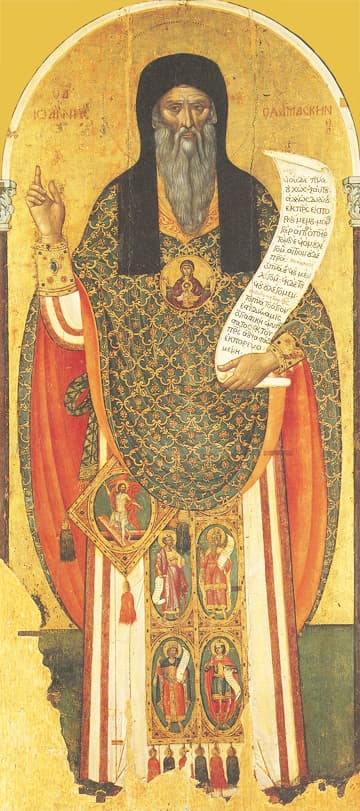
John of Damascus — Public domain. Emmanouel Tzanes. Via Wikimedia Commons.
Life
John was born around 675 in Damascus, the capital of the new Umayyad Caliphate, into a noble Christian family that had served the Byzantine governors of the city for generations. His father — known by the Arabic surname Mansour ("victorious") — held the high office of treasurer under Caliph Abd al-Malik. The young John was given the finest education the East could offer; tradition gives him a tutor named Cosmas (later himself a saint, Cosmas the Melodist of Maiuma), a Greek monk ransomed from Saracen slavers.
He succeeded his father as chief financial officer of the caliphate around 700 — at a time when the Christian East was already losing the political battle against the rising power of Islam, but Christian intellectuals at the Damascene court still held privileged positions. John served in this office for many years and became, in effect, the most senior Christian layman in the Arabian Empire.
About 726 a crisis arose half a world away. The Byzantine emperor Leo III the Isaurian, under Muslim influence, issued the first iconoclast edict — ordering the destruction of all icons in the Eastern Roman Empire. John, from Damascus and therefore beyond Leo's reach, wrote in defense of the icons three great treatises (the Three Apologies Against Those Who Decry the Holy Images) that have shaped every subsequent Orthodox defense of the icon. He had the freedom to write what the imperial Christians of Constantinople could not: the icon is not the worship of created images but the witness that God has truly become man and may therefore be depicted in His humanity.
The legend of his miraculous healing belongs to this period. Leo, furious at John's defense of the icons, is said to have forged a treasonous letter and sent it to the Caliph as if from John, urging him to surrender Damascus to the empire. The Caliph, deceived, had John's right hand struck off and hung in the public square. John retrieved it that night, laid it against the stump while praying before an icon of the Theotokos, and was found in the morning with his hand restored — bearing only a thin line at the wrist where it had been severed. The Caliph, persuaded of his innocence, sought to retain him in service; John instead asked permission to withdraw, gave away his fortune, and retired with Cosmas to the Lavra of St. Sabbas in the wilderness east of Bethlehem.
There — for the last thirty-five years of his life — he wrote the body of work that established him as the last of the Greek Fathers. The Fount of Wisdom (in three parts: Philosophical Chapters, On Heresies, and On the Orthodox Faith) is the first systematic theology of the East — the Eastern equivalent of Aquinas's Summa, written six hundred years earlier. The Octoechos, the eight-week cycle of Sunday and weekday hymnody used in every Orthodox church to this day, was largely his composition. His hymns for Pascha — the canon ("This is the Day of Resurrection, let us be radiant, O peoples!") and the antiphons — are the spine of the Eastern Paschal night.
He reposed at the Lavra of St. Sabbas around 750, having lived nearly seventy-five years. His feast is December 4 — shared with Great-martyr Barbara, who shines on him for the same reason: from the same source, the unyielding witness of the icon. The Seventh Ecumenical Council in 787 vindicated his doctrine and gave the Eastern Church the holy icons as its defining liturgical art.
Traditions
Feast day
December 4
Topics
Works in library
Readings and commentaries
An Exposition of the Orthodox Faith
Barlaam and Ioasaph
Barlaam and Joseph
Catena Aurea by Aquinas
Exposition of the Orthodox Faith
Homilies
On Divine Images
On Divine Images, Second Apology
On Heresies
On the Orthodox Faith
Orthodox Faith
The Canon of Pascha, Ninth Ode
The Orthodox Faith
Three Treatises on Divine Images
Untitled commentary
First Apologia Against Those Who Decry Holy Images
John's first defense of the veneration of icons against the iconoclasm of Emperor Leo III — the longest of the three treatises, grounded in the Incarnation and the Old Testament precedents of God-commanded religious imagery. Closes with a florilegium of patristic witnesses to image-veneration.
Second Apologia Against Those Who Decry Holy Images
The second treatise — a tighter response to specific iconoclast arguments, with a second patristic florilegium. Written after the first round of imperial measures against icons.
Third Apologia Against Those Who Decry Holy Images
The most systematic of the three. John defines what an image is, distinguishes the kinds of images and the kinds of veneration (proskynesis vs latreia), and rounds out with the largest of the three florilegia. The intellectual backbone of the Sunday of Orthodoxy.
First Sermon on the Dormition of the Theotokos
John's first sermon on the Dormition (kοίμησις) of Mary — dogmatic-narrative in shape, telling the event of the Theotokos's repose.
Second Sermon on the Dormition of the Theotokos
The longest of the three Dormition sermons — sustained Mariological reflection on the meaning of the Theotokos's death and assumption.
Third Sermon on the Dormition of the Theotokos
Festal exhortation on the Dormition — a shorter, more pastoral homily for the August 15 feast.
An Exposition of the Orthodox Faith (De Fide Orthodoxa)
The first systematic summa of Eastern Christian theology — four books on God and the Trinity, creation and the human person, the Incarnation, and the sacraments and last things. The third part of John's trilogy The Fountain of Knowledge; the foundational text of Byzantine dogmatic theology.