saint
St. John of Kronstadt
A married parish priest of the naval cathedral of Kronstadt outside St. Petersburg, whose daily celebration of the Liturgy and tireless almsgiving to the poor and intemperate of the city made him perhaps the most-loved Russian pastor of the modern era. His diary My Life in Christ records his inner conversation with the Lord.
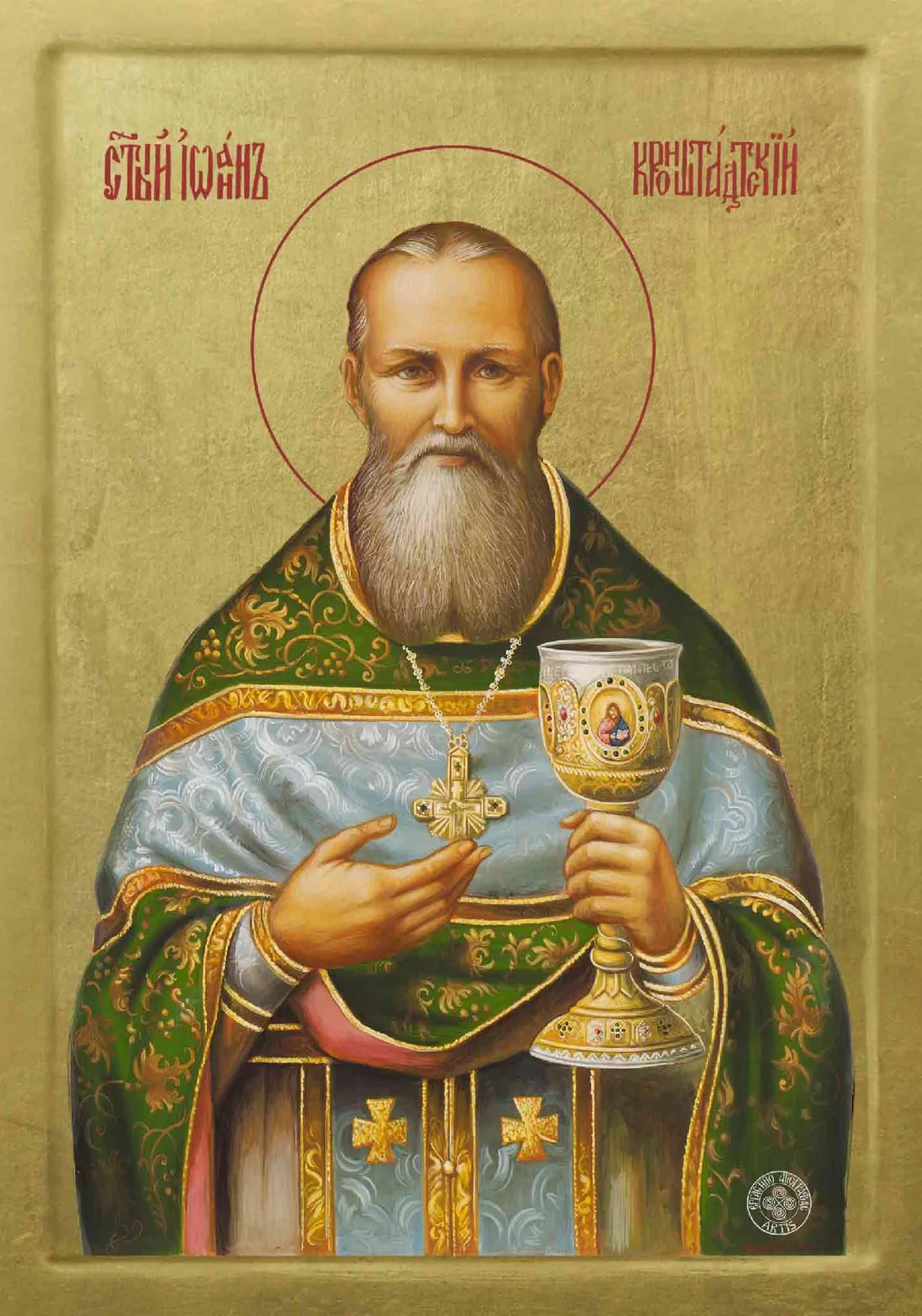
John of Kronstadt — Hand-curated icon.
Life
Ioann Ilyich Sergiev was born on October 19, 1829, in the village of Sura on the Pinega River in the far north of European Russia (Arkhangelsk province), the son of a poor sacristan of the village church. He was a frail and slow-learning child, struggling at the parochial school in Arkhangelsk until a sudden breakthrough in his eleventh year that he later attributed to a night of weeping prayer; from that moment he was the foremost of his year. He completed his seminary studies at Arkhangelsk and was admitted, the only one of his cohort, to the St. Petersburg Spiritual Academy on a full state stipend.
Upon graduation in 1855 he was offered an academic career and a parish in the capital; instead he chose, in obedience to a dream of his student years, the small naval-fortress parish of St. Andrew's Cathedral on the island of Kronstadt in the Gulf of Finland — twenty miles west of St. Petersburg, the principal Russian naval base, and a place of exile for vagrants, alcoholics, and petty criminals deported from the capital. He was ordained priest on December 12, 1855, married to Elizaveta Konstantinovna Nesvitskaya (a chaste marriage by mutual agreement — they had no children), and assigned to St. Andrew's where he would serve for the next fifty-three years.
His pastoral work transformed the desperate population of Kronstadt within a decade. He served the Divine Liturgy daily — every morning of the year except those when illness forbade — and over the decades developed a particular charism of confession and intercessory prayer that drew the sick and the desperate from all over Russia. By the 1880s thousands traveled to Kronstadt each year to be heard by him in confession; the post office of Kronstadt eventually carried more mail addressed to him than to all the other inhabitants of the island combined. His charitable foundations — schools, workhouses, hostels, a House of Industry for the Kronstadt poor — were among the first of their kind in the Russian Empire. The Tsar called him to St. Petersburg in October 1894 to attend the deathbed of Alexander III at Livadia.
Throughout the years he kept a detailed spiritual diary, which he published serially beginning in 1893 as Moia zhizn' vo Khriste (My Life in Christ). The work — a sequence of short numbered entries on the Liturgy, the priesthood, the sacraments, repentance, the inward life, and the encounter with God — became one of the most widely-read Russian religious books of the late Imperial era and was almost immediately translated into English, French, German, and Greek. He published throughout his life: sermons, occasional pieces, additional volumes of the diary, a series of meditations on the Lord's Prayer and the Beatitudes.
He reposed at Kronstadt on December 20, 1908, at age seventy-nine, having predicted the day of his death the year before. His funeral procession through Kronstadt and St. Petersburg drew enormous crowds. He was buried at the convent he had founded at Karpovka in St. Petersburg, where his relics rest. He was glorified by the Russian Orthodox Church Outside Russia in 1964 and by the Moscow Patriarchate in 1990, after the fall of Soviet power. His feast is December 20 (repose) and October 19 (birth, in some calendars); his patronage extends to seamen, the poor, and those struggling with addictions.
Traditions
Feast day
December 20
Topics
Works in library