saint
St. John (Maximovich) of Shanghai and San Francisco
A small, lame, stuttering hierarch who served the Russian diaspora from Shanghai through the Philippines to Paris and San Francisco, slept on the floor for forty years, and was constantly visited by miracles in his life and after his death.
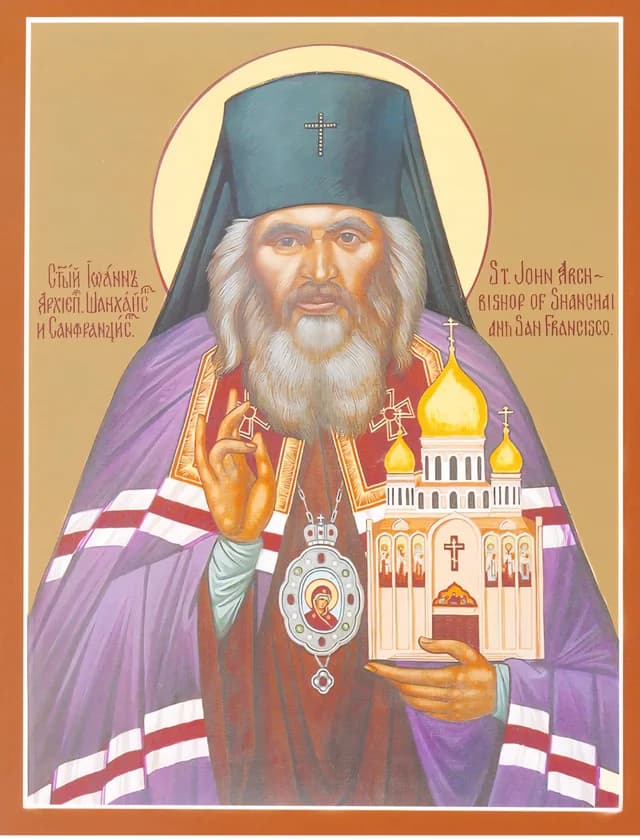
Saint John of Shanghai and San Francisco — Hand-curated icon.
Life
Michael Maximovich was born on June 4, 1896, at Adamovka in Kharkov province in Russia, into a noble family that had given many bishops and priests to the Church. He was a sickly, slight, slightly clumsy child who walked with a limp and was given to long silences. He had a defect of speech which never left him — he stuttered slightly in his preaching and chanting all his life. From his earliest years he was given to long prayer and to the lives of the saints, and his family destined him for the law.
He took his law degree from Kharkov University in 1918, just as the Russian civil war was breaking over the south. He served in the White army's medical corps, and emigrated with the remnants of Baron Wrangel's army to Yugoslavia in 1921. There — in the new Russian seminary at Bitolj, which Bishop Nikolai Velimirović was assembling out of refugee monks and seminarians — he studied theology, was tonsured as a monk in 1926 with the name John (after his ancestor the holy Metropolitan John of Tobolsk), and ordained priest.
In 1934 — at thirty-eight — he was consecrated bishop of Shanghai. The diocese had been formed from the considerable Russian colony scattered across China after the Revolution: as many as a quarter-million Russians had fled into Manchuria, North China, and Shanghai in the early 1920s. John found the colony in chaos — divided between rival jurisdictions, with most of the children unbaptized and most of the adults catechumens in name only. He gave the rest of his life to them.
He served the Liturgy daily, slept on the floor (he never lay in a bed for the next forty years), kept the canonical fasts even when desperately ill, traveled the colony's far corners on foot, founded orphanages (where his ability to find homes for unwanted children in Shanghai is the stuff of dozens of recorded miracles), kept a tireless schedule of confessions and home visits. He had the gift of clairvoyance, the gift of healing, and the gift of bilocation — he was repeatedly attested to be present in two places at once. He was also famous for being slightly comic: his vestments were always too long, his slow ungainly walk and slight stammer made him an awkward figure at the city's fashionable cathedrals. The Soviets and the Chinese (after 1949) both watched him constantly; he was untouchable because of his standing among the people.
In 1949, after the Communist victory, John led the Russian colony out of China. The American government refused them visas; he flew personally to Washington and, after a long delay, secured them. He brought five thousand Russians from Shanghai through the Philippines to the United States. After their resettlement he was assigned successively to Brussels (1951), Paris, and finally San Francisco (1962), where the Russian Cathedral of the Theotokos Joy-of-All-Who-Sorrow was nearing completion under his predecessor Archbishop Tikhon. The diocese was in disarray, the building project deadlocked, and a great lawsuit pending. John straightened it all out by labors that were already those of an old man at the limits of his strength.
He reposed at his bedroom in Seattle on July 2, 1966, while traveling with the Kursk-Root icon of the Mother of God to a parish there. He was sixty-nine. His body remained at his cathedral in San Francisco; the open sarcophagus at the cathedral was the site of constant pilgrimage from his repose. When his relics were uncovered in 1993, after twenty-seven years, his body was found incorrupt. He was canonized by the Russian Orthodox Church Outside Russia in 1994 and by the Moscow Patriarchate in 2008. His feast is July 2.
Traditions
Feast day
July 2
Topics
Works in library