saint
St. John the Russian, Confessor
A Russian soldier of Peter the Great taken captive by the Ottomans at the Pruth and sold into slavery in Cappadocia, where he refused conversion to Islam, slept with the master's horses, and gave away his bread to the poor. His incorrupt relics are venerated on the Greek island of Euboea.
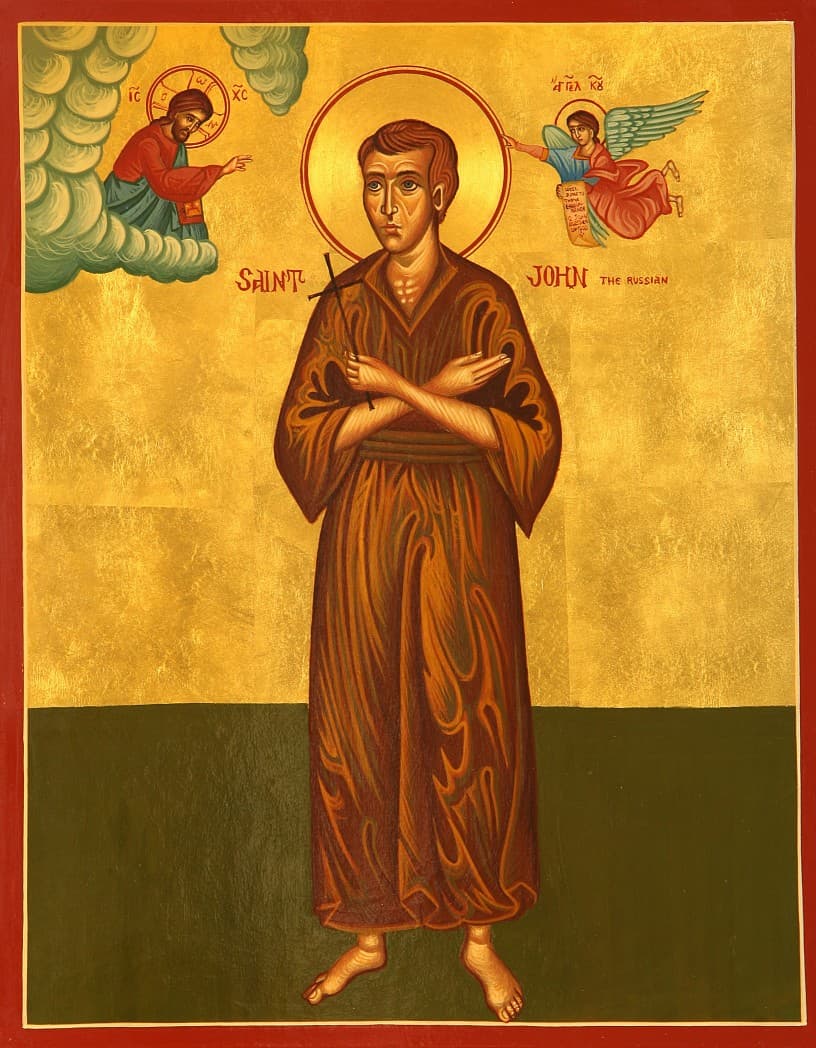
Saint John the Russian — Hand-curated icon.
Life
Ivan was born around 1690 in the small village of Anastasevsk (now part of central Ukraine), in the Russian-controlled Ukrainian provinces, into a poor Cossack family of soldier-peasants. His parents were free smallholders of the Orthodox peasant class. He was educated at the standard village level — the basics of literacy in Slavonic, the catechism, the daily monastic offices, the work of the small family farm. He was conscripted into the imperial Russian army at perhaps twenty, in the wave of recruitment that Peter the Great's wars with the Ottoman Empire required.
He was assigned to a Cossack cavalry regiment serving on the southwestern frontier. In the catastrophic Pruth Campaign of 1711 — Peter's failed attempt to break the Ottoman hold on the lower Danube — the Russian army was surrounded by Ottoman forces at the Pruth River. The standard treaty allowed for the safe withdrawal of the Russian troops (Peter himself escaped), but a substantial number of soldiers were captured by the Ottoman forces during the chaotic retreat. Ivan was among them.
He was taken in chains across Anatolia to the inland Cappadocian town of Prokopion (modern Ürgüp in central Turkey), about a hundred and fifty miles south of Ankara, in the territory of the Janissary captain Ağa — a wealthy Ottoman Turk who had bought a number of Russian prisoners as field-slaves. Ivan was assigned to the Ağa's stables, with the work of caring for the master's horses.
His captor expected, in keeping with the standard Ottoman practice, that Ivan would convert to Islam to escape the worst conditions of his slavery. The standard route — declared shahada, change of name, formal adoption into the master's household — was held out to him on multiple occasions. Ivan refused. He continued to identify himself as a Christian. He continued the practice of his faith insofar as he could: the morning and evening prayers, the long Russian fasts, the standing prayer-vigils on the nights of the great feasts.
The Ağa, frustrated but eventually impressed, took to calling him in the local Turkish "Ali Pasha" — a name half-mocking, half-respectful, calling him a "pasha" because of the standing he held among the other Russian prisoners and a Christian among the master's household. Ivan tolerated the nickname but never accepted the implication of conversion.
He worked at the Ağa's stables for the next twenty years (1711-1731). He slept in the straw with the horses. He ate the master's leavings. He gave away the bits of bread that came his way to the poor of the town and to other Christian slaves. The master allowed him to keep the Sunday and the great feast days unstabled, and Ivan spent them at the small Russian Christian community that existed at Prokopion — a community of perhaps fifty Russian Orthodox prisoners and freed-slaves who had remained in the town after the Ottoman wars. He served as their lay reader at the small Russian chapel.
The miracles attributed to him during this period were striking. The Ağa's expedition to Mecca for the hajj in about 1725 produced one of the standard later stories: the Ağa's wife, in conversation with Ivan, expressed her regret that her husband could not eat his favorite dish (a rice pilaf with pieces of lamb) at Mecca, where they had not the means to prepare it. Ivan brought a covered dish of the prepared pilaf to her and asked her to send it. She demurred; he insisted. The dish arrived at the Ağa's tent at Mecca on the same evening — exactly as Ivan had prepared it, the rice still hot. The Ağa returned home and reported the marvel; the local Muslims of Prokopion began to recognize Ivan as a holy man even within the Ottoman framework.
He reposed in his stable at the Ağa's house on May 27, 1731, at forty-one. He had been ill for some weeks; he received the Russian Christian last rites from the local Greek priest of Prokopion and gave up his soul in the night. His body was claimed by the Russian Christian community of the town and buried at their small chapel-graveyard.
The Russian community continued to live at Prokopion through the next two centuries. Ivan's grave was venerated locally as a miracle-working tomb. When his body was exhumed in 1733 (two years after his repose) to be moved to a more dignified grave, it was found incorrupt and exuding fragrance. His relics were placed in a glass-fronted reliquary at the Prokopion chapel.
The Russian population of Prokopion was expelled in the Greek-Turkish population exchange of 1923. The relics were carried by the departing Russian community to Greece, where they were placed at the Greek Orthodox church of John the Russian at New Prokopion on the island of Euboea — a town founded specifically by the Prokopion refugees and named for their old home. The relics are still there, and the church is a major modern Greek pilgrimage site.
He was glorified by the Russian Orthodox Church Outside Russia in 1962 and by the Moscow Patriarchate in 1989. He is the patron of Russian Christians abroad, of prisoners of war held in foreign territory, of those who suffer for refusing to convert under pressure, and of every layman who lives a holy life in a hostile environment. His feast is May 27.
Traditions
Feast day
May 27
Topics
Works in library