saint
St. Joseph the Betrothed
A righteous man of the house of David, betrothed to the Virgin and guardian of the Lord in His childhood. He led the Holy Family into Egypt and back to Nazareth, taught the Child his trade, and reposed before the Lord's public ministry. Patron of carpenters, fathers, and silent obedience.
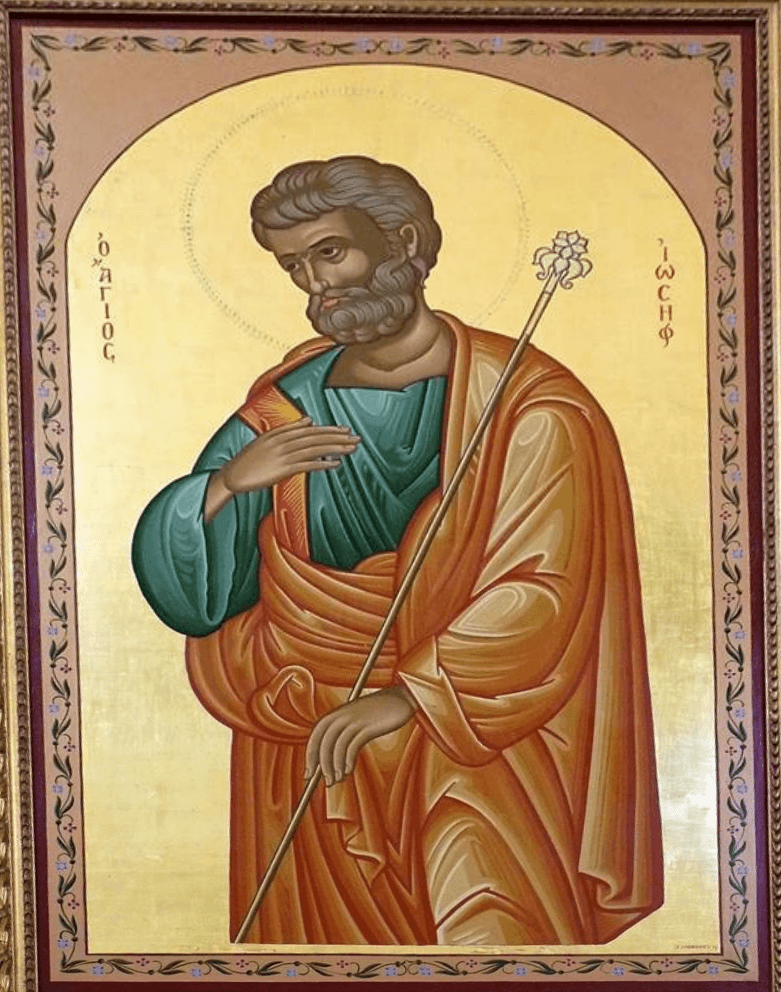
Joseph the Betrothed — CC BY-SA 4.0. Asia. Via Wikimedia Commons.
Life
Joseph was born around 90 BC in the Galilean village of Bethlehem (the smaller northern Bethlehem in the territory of Zebulun, not to be confused with the Bethlehem in Judea — though some traditions place his birth at the Judean Bethlehem). He was of the royal house of David, in the direct line of the kings of Judah through Solomon, though the family had long since lost any active royal claim — they were by the first century BC a family of small landowners and craftsmen in the Galilean north. The Davidic descent was carefully preserved in the family records, since Jewish messianic expectation was concentrated on the house of David.
He learned the carpenter's trade — a broader trade in the ancient world than today, including stonework, woodwork, and the construction of small houses and tools — from his father, whose name the Gospels do not preserve. He married young (probably around twenty) a woman of the village of Nazareth, by whom he had four sons (James, Joses, Simon, and Jude — the "brothers of the Lord" of the New Testament Gospels) and several daughters, traditionally named Esther and Tamar in the early Christian sources.
His first wife died after perhaps forty years of marriage. Joseph remained a widower for some years and was already an old man — in his eighties by the most traditional reckoning, or in his seventies by some — when the priests of the Jerusalem Temple summoned him to a meeting. The Virgin Mary had been raised in the Temple precinct from the age of three; she was now fourteen and could no longer be kept there. The priests had sought a guardian for her from among the remaining widowed kinsmen of her family. By tradition, the priests asked each kinsman to bring a rod; the rod that should bud miraculously would identify the appointed guardian. Joseph's rod budded, and a dove came out of it.
He took the Virgin into his house at Nazareth as his betrothed wife. The arrangement was understood as a guardianship, not as a marriage in the carnal sense — Mary continued in the virginity she had vowed in the Temple, and Joseph (already a grandfather by his first marriage) served as her protector. Six months later the archangel Gabriel came to her at her loom with the word of the Annunciation. When Joseph saw that she had conceived, he was deeply troubled and resolved to put her away privately, rather than expose her to public shame; the angel of the Lord came to him in a dream and explained the conception. He took her into the inner part of the house and waited with her.
When the census of Caesar Augustus required him to go to Bethlehem in Judea to be registered (since he was of the house of David), he made the long journey south with his betrothed, who was near her time. The Lord was born in the cave near Bethlehem; Joseph went out to find a midwife (whose name the early traditions give as Salome) and was the first witness of the birth and the angelic singing of the shepherds in the fields. He named the Child as the angel had directed him — Yeshua, Joshua, "the Lord saves" — at the circumcision on the eighth day, and presented Him with Mary in the Temple at forty days.
When Herod's slaughter of the innocents threatened the Child, the angel of the Lord again came to Joseph in a dream and bade him take the Child and His mother into Egypt. The Holy Family fled by night. They lived perhaps two or three years at the Egyptian town of Matarea (now a suburb of Cairo, where a tradition of their household survives at the church of the Holy Family). After Herod's death the angel came again to Joseph, and the family returned to Nazareth.
There Joseph raised the Lord, teaching Him the carpenter's trade and the daily life of a Galilean village. He was present at the finding of the twelve-year-old Lord in the Temple. After that — between the Lord's twelfth and thirtieth years, the long silence of the Gospels — Joseph reposed at Nazareth. The most common tradition gives his repose at the age of approximately one hundred ten years, with the Lord and Mary at his side.
He was buried in the small family burial-cave at Nazareth. His relics have not been preserved in any continuous way; the church of the Holy Family at Matarea claims a portion. He is remembered chiefly in the icon and in the prayers of the Church, where his quiet, obedient faithfulness — the man who "did as the angel of the Lord had bidden him" without recorded word of his own — is the model of every Christian father, every protector of those entrusted to him.
His feast is the Sunday after the Nativity (December 26 or the following Sunday), kept jointly with King David and James the Brother of the Lord. He is one of the patrons of carpenters, of fathers (especially of step-fathers and adoptive fathers), of the dying (since he is traditionally believed to have died in the company of the Lord and the Theotokos and so is a model of the good death), and of every quiet servant of God's plan.
Traditions
Feast day
Sunday after Nativity and December 26
Topics
Works in library