saint
St. Joseph the Hymnographer
Sicilian monk exiled to Constantinople by the Arab conquest who became the most prolific hymnographer of the Byzantine Rite, composing the canons of the Octoechos and hundreds of Menaion canons that are still sung daily in the Orthodox Church.
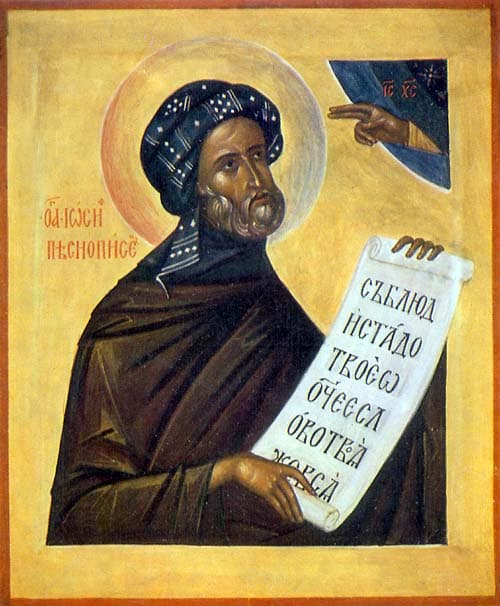
Saint Joseph the Hymnographer — Public domain. Via Wikimedia Commons.
Life
Joseph was born around 810 in Sicily of pious Christian parents, who fled with him as a child to Greece during the Arab conquest of Sicily. He entered monastic life as a young man at a monastery in Thessalonica and was later sent to Constantinople by his abbot. He came to the capital just at the beginning of the second iconoclast period and aligned himself at once with the iconodule party led by the Studite monks.
For his defense of the icons he was imprisoned, scourged, and exiled to Crete; he spent several years in this captivity, during which (the synaxarion records) the apostle Bartholomew appeared to him in a vision and gave him a small scroll on which to write — the gift of liturgical poetry. When he was eventually released and returned to Constantinople after the restoration of the icons in 843, Joseph dedicated himself to the composition of liturgical hymns for the saints of the calendar, working through every day of the year.
He composed canons (the elaborated nine-ode hymn-form) for hundreds of saints whose previous offices had been brief or unfinished — particularly the saints commemorated through the Octoechos cycle and the Menaion. His canons remain in the standard service books of the Orthodox Church and are sung every day of the liturgical year. He died at Constantinople in 886. His feast falls on April 4.
Traditions
Feast day
April 4
Topics
Works in library