father
St. Justin (Popović) of Ćelije
Serbian archimandrite, theologian, and confessor of Tito's persecution, whose Dogmatic Theology and writings on the lives of the saints have given the modern Serbian Church much of its theological language.
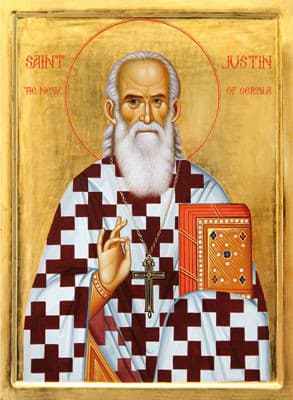
Saint Justin Popovich — Hand-curated icon.
Life
Blagoje Popović was born on March 25, 1894 (the feast of the Annunciation), in the small Serbian town of Vranje (in southern Serbia, near the Macedonian border), into a family of country priests that had served the Serbian Church for several generations. His father, Spiridon Popović, was the parish priest of the village of Vranje; his mother, Anastasia, was the daughter of a deacon. He had several brothers and sisters; the family was poor but pious, of the traditional Serbian rural-clergy type.
He was educated first at the local elementary school, then at the Belgrade theological seminary (which he entered in 1905 at eleven). At the seminary he distinguished himself in the patristic Greek and in the classical Latin; he was one of the top students of his class. He took his graduating examinations in 1914 — at twenty, on the eve of the First World War — and was tonsured a monk in 1916 in the midst of the Serbian retreat through Albania, taking the name Justin (after the second-century Justin the Philosopher, whose works he had read with particular care at the seminary).
The years of the First World War (1914-1918) were the formative experience of his generation. He served as a medical orderly with the Serbian army during the great retreat through Albania in 1915-1916; he survived the catastrophe (over a hundred thousand Serbian soldiers died of cold and starvation during the retreat) and emerged at Corfu with the surviving remnant of the Serbian government and army. He spent the rest of the war at the Serbian theological school at Oxford (where the Serbian government in exile had sent him to continue his studies), then at the Petrograd (St. Petersburg) Theological Academy during the Russian Revolution, then back to Oxford for his doctoral studies.
He completed his doctorate at Athens in 1926 on the theology of Dostoevsky — the dissertation that has become one of the foundational texts of twentieth-century Orthodox engagement with Russian literature. He returned to Serbia immediately afterward and was appointed professor at the Belgrade Theological Faculty, where he taught dogmatic theology for the next twenty years (1926-1945).
His teaching at Belgrade through the interwar years was the formation of an entire generation of Serbian theological leaders. The seminarians he trained included three of the four men who would later become Serbian Patriarchs (Vikentije, German, Pavle), the most senior Serbian bishops of the post-war generation, and a wide pool of clergy and laypeople who would carry the Orthodox tradition through the coming communist persecution. His three-volume Dogmatic Theology, written between 1932 and 1978 (the third volume completed in his final years), is the principal modern Serbian systematic theology and one of the major Orthodox dogmatic works of the twentieth century.
The decisive event of his middle life was the communist takeover of Yugoslavia in 1945. Tito's regime, suspicious of the Serbian Church's anti-communism (the Church had been a major support of the wartime royalist resistance), moved against the senior clergy almost immediately. The Belgrade Theological Faculty was closed in 1946. The remaining theological education was driven underground or into the few surviving monasteries. Justin himself was confined to the small Ćelije Monastery in western Serbia in 1948 — a country house-arrest that lasted for the rest of his life, thirty-one years.
He continued to write through the entire confinement. The relevant manuscripts were smuggled out of Ćelije by the small group of disciples who visited him over those years — visits which were technically illegal but which the local authorities tolerated as long as they were quiet. The works he wrote during the confinement are voluminous: the third volume of the Dogmatic Theology, the long Lives of the Saints (twelve volumes, a Serbian counterpart to the Russian Demetrius of Rostov), the commentaries on the Pauline letters, the dozens of sermons and pastoral letters that were preserved by his disciples.
The most influential of his disciples was the future Bishop Atanasije Jevtić — a young monk who became Justin's principal scholarly assistant at Ćelije in the 1960s, then served as Bishop of Banat and Bishop of Zachlumia-Herzegovina, and was the principal editor of Justin's posthumous works. Through Atanasije and the small circle around him, Justin's theology became the foundation of the post-communist Serbian theological revival of the 1990s and 2000s.
He reposed at Ćelije on April 7, 1979 — the feast of the Annunciation, exactly eighty-five years after his birth on the same feast. He was buried in the monastery cemetery. He was glorified by the Serbian Orthodox Church in 2010. His relics were exhumed in 2014 and translated to a new shrine at the Ćelije Monastery, where they are now venerated by a steady stream of Serbian and international Orthodox pilgrims.
He is the patron of Orthodox theologians, of those who teach and write theology under conditions of state persecution, of monks living under house-arrest, and of every Christian who has had to carry an entire institutional tradition through the long isolation of a hostile age. His feast is April 1 (the day of his repose, by the Julian calendar that the Serbian Church still uses; April 14 by the Gregorian).
Traditions
Feast day
April 1
Topics
Works in library