father
St. Justin the Philosopher
An apologist of the second century who, finding Christ to be the answer his Platonic philosophy had been seeking, opened a school of Christian thought in Rome and gave his life under Marcus Aurelius for the truth he had come to love. Patron of philosophers and seekers.
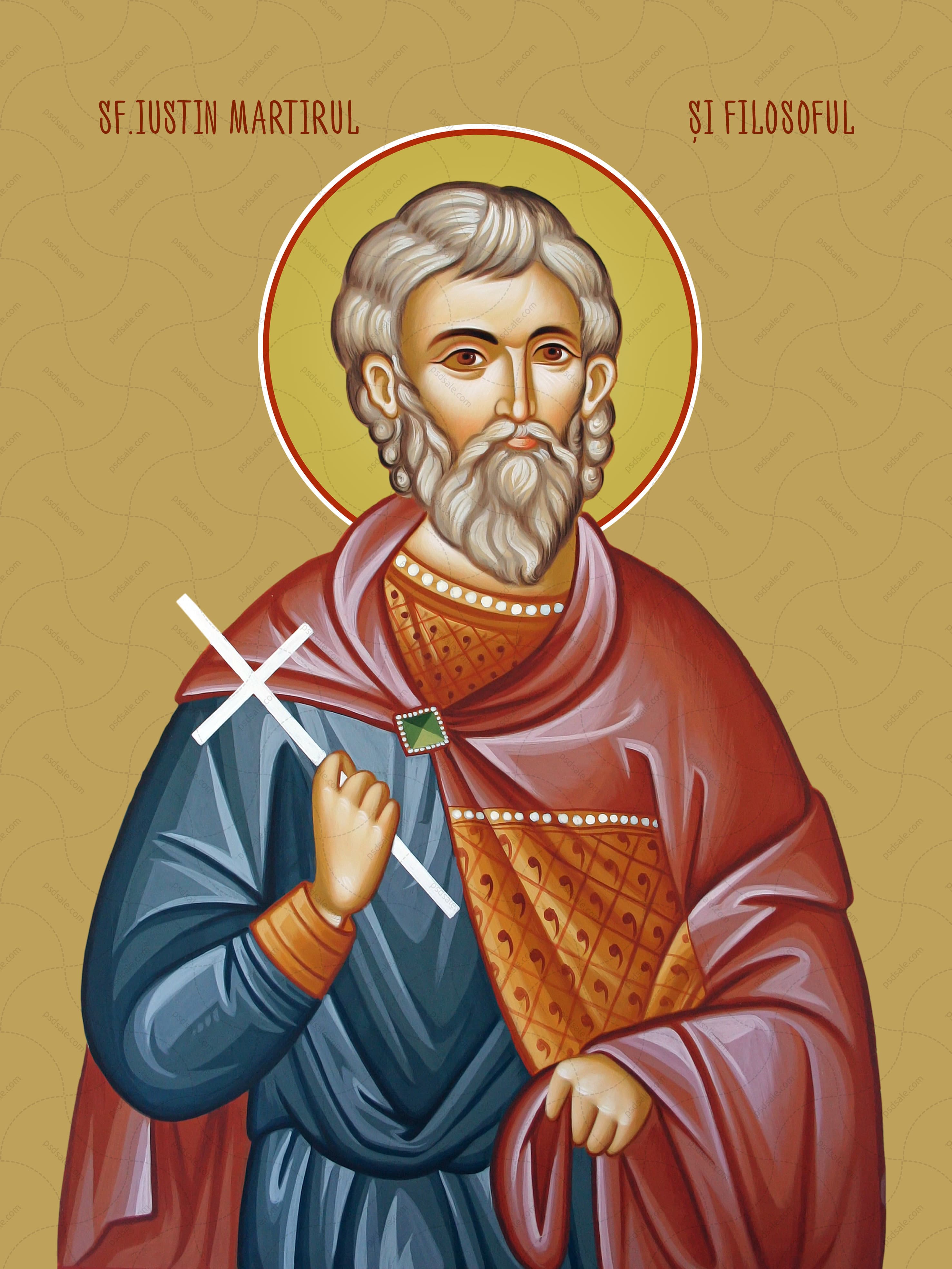
Justin the Philosopher — Hand-curated icon.
Life
Justin was born around 100 in the small town of Flavia Neapolis in the Roman province of Judea (Samaria proper — modern Nablus on the West Bank), into a noble Greek pagan family that had been settled in the country since the founding of the city by Vespasian fifty years earlier. He was given the best Greek education the eastern provinces offered: rhetoric, geometry, music, astronomy, and a thorough grounding in the four schools of Greek philosophy (Stoic, Peripatetic, Pythagorean, and Platonic) that were active in the second-century empire.
He records his own intellectual progress in the long autobiographical opening of his Dialogue with Trypho. He studied first with a Stoic teacher and found him unable to give a satisfactory account of God. He moved to a Peripatetic (Aristotelian), who turned out to be greedy for fees. He tried a Pythagorean, who refused to admit him until he had mastered music, geometry, and astronomy. He finally found a Platonic teacher and was happy there — Platonism, with its emphasis on the eternal Forms behind the changing world of sense, seemed to him the closest the Greek philosophical tradition could come to truth about God.
The decisive conversion came when he was perhaps thirty. He had gone out to a quiet place by the sea — tradition places it on the Mediterranean coast near Caesarea — to read and meditate. An old man met him there and engaged him in conversation. They spoke of philosophy; the old man systematically dismantled Justin's Platonic certainties. When Justin asked him where else one might turn, the old man pointed him to the Hebrew prophets and to Christ. The old man departed; Justin never saw him again. He found a Christian community and was catechized.
His conversion was the conversion of a Greek philosopher, not the conversion of a peasant. He continued to wear the philosopher's pallium (the distinctive cloak of the public philosophical teacher) for the rest of his life — the early Christian tradition saw this as the visible sign that the Christian faith was the true philosophy. He never married. He went to Rome perhaps in his forties and opened a school of Christian instruction, which he ran for the rest of his life out of his rented rooms over the house of one Martinus, near the baths of Timotheus on the Esquiline hill.
He wrote three major surviving works (other pieces have been lost): the First Apology, addressed to the Emperor Antoninus Pius around 155, defending the Christian community against the persecutions of the period; the Second Apology, addressed to the same emperor or his successor Marcus Aurelius, in response to a specific local persecution at Rome; and the Dialogue with Trypho, a long imagined conversation with a Jewish rabbi he had met during a brief sojourn at Ephesus, defending the Christian reading of the Hebrew Scriptures. The First Apology in particular contains the earliest detailed description of the Christian Eucharist (the prayers, the kiss of peace, the distribution of bread and wine, the prayers over the catechumens and the bringing-down of the Logos) that we possess outside the New Testament — a foundational source for any historical understanding of how early Christians worshipped.
His most distinctive theological contribution is the doctrine of the seminal Logos. He taught that the divine Logos (the Word of John 1) was active throughout human history, not only in the Hebrew prophets but also in the great pagan philosophers — Socrates, Heraclitus, Plato — who had spoken pieces of the truth by sharing in the Word. The Christian gospel is the fullness toward which all true philosophy had been groping. This was the patristic foundation of every later Christian reading of pagan philosophy as preparation for the gospel.
In the persecution of Marcus Aurelius around 165, Justin and six of his students were denounced to the city prefect Junius Rusticus (himself a Stoic philosopher of the imperial circle). The brief court transcript survives — one of the earliest authentic Roman court documents on a Christian trial. Rusticus asked Justin where the Christians met; Justin gave the location of his school and the names of the household. Rusticus asked them whether they would sacrifice to the gods. They refused. Rusticus ordered all seven beheaded.
Justin was beheaded at Rome around 165. His relics, recovered by the local Christian community, rest at the church of San Lorenzo in Panisperna in Rome (where they had been moved from the original burial site in the early Middle Ages). He is the founder of Christian philosophy in the technical sense and the first major Christian author to engage paganism on its own ground. His feast is June 1.
Traditions
Feast day
June 1
Topics
Works in library