saint
St. Lawrence the Archdeacon and Martyr of Rome
Archdeacon of Rome under Pope Sixtus II, charged with the Church's treasury. Commanded by the prefect to surrender the wealth of the Church, he brought instead the poor of the city — 'these are the Church's treasures' — and was roasted upon a gridiron for the insult. Patron of cooks, archivists, and the poor.
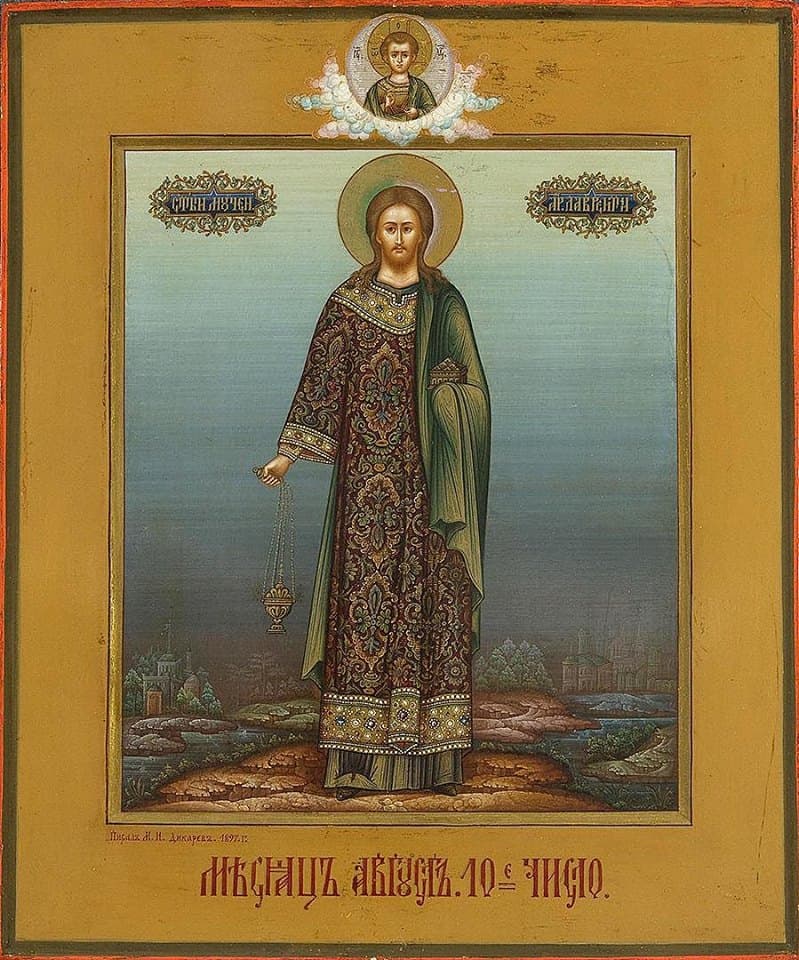
Saint Lawrence the Archdeacon — Public domain. Mikhail Ivanovich Dikarev. Via Wikimedia Commons.
Life
Lawrence was born around 225 in the Roman province of Hispania (modern Spain), traditionally in the small town of Huesca in Aragon. His parents — Orencio and Patientia — were Christians of comfortable means; he had several brothers. As a young man he came to Rome for studies and was attached to the household of the deacon (later Pope) Sixtus II, who was at the time one of the leading Roman ecclesiastics. Lawrence was ordained deacon by Pope Sixtus when he became Bishop of Rome in 257, and was made archdeacon — the senior of the seven deacons of the Roman Church, with particular charge of the city's poor and of the Church's small but already substantial treasury.
His three years as archdeacon (257-258) coincided with the rising persecution of the Emperor Valerian. In June 258 Valerian issued a second, sharper edict against the Christians, ordering specifically the execution of bishops, presbyters, and deacons; he ordered also the confiscation of the property of all Roman senators and equestrians who were Christians. Pope Sixtus was arrested on August 6 while celebrating the Eucharist in the catacomb of Praetextatus on the Via Appia and was beheaded with four of his seven deacons.
Lawrence, who was at the church of San Lorenzo in Lucina at the time of the raid (one of the senior deacons sometimes celebrated separately to disperse the community), encountered Pope Sixtus in custody on his way to execution. Lawrence wept and asked: "Where are you going, father, without your son? Where are you going, holy priest, without your deacon?" Sixtus turned to him and said: "I am not leaving you, my son. After three days you will follow me. Now go and distribute the treasures of the Church to the poor, for the prefect is coming to demand them."
Lawrence went and gathered the gold and silver of the Roman Church — the chalices, patens, candelabra, the substantial alms-fund that had accumulated since the legalization of the Church under Septimius Severus — and distributed it all in three days among the poor of the city. The list of the recipients survived for some years and was used by later Roman bishops as a model of charitable practice.
On the third day after Sixtus's death (August 9) the prefect Cornelius Saecularis demanded that Lawrence produce the treasures of the Church. Lawrence asked for a day to assemble them. He came back the next day at the head of a procession of the poor of Rome — the widows, the orphans, the lame, the leprous, the elderly without family, the abandoned. He led them into the prefect's hall and said: "These are the treasures of the Church."
The prefect, enraged at what he took to be an insult to imperial authority, ordered Lawrence put to a particularly cruel death — not the standard beheading granted to Roman citizens, but slow roasting on an iron gridiron set over hot coals. The death-machine was prepared in the courtyard of the prefect's palace.
Lawrence went to it with prayers. He spent some time on one side of the grid; his flesh charred and the smell of cooking flesh filled the courtyard. He turned to the soldiers attending the execution and said in his serene Latin: "It is well done on that side. Now turn me over and eat." The cheerful jest — recorded in three independent sources of the third century — has fixed his name in the popular memory of every later age. He prayed for the soldiers and for the conversion of the city of Rome (a number of his executioners did convert that night and were themselves later martyred). He gave up his spirit on August 10, 258, at the age of perhaps thirty-three.
His body was recovered by the local Christian community of Rome under a deacon named Hippolytus (later himself a martyr), and was buried in the catacomb on the Via Tiburtina where the church of San Lorenzo fuori le Mura now stands. The relics are still there. He was — already by the time of Constantine — one of the most famous of the Roman martyrs; the basilica at his tomb was one of the seven major churches of medieval Rome. His feast on August 10 has been an obligatory feast in the Roman calendar since the fifth century and is observed in the Eastern Church on the same date.
He is the patron of deacons, of the poor, of cooks (a small irony of his death), of archivists and librarians (for his careful inventory of the Church's wealth), of Spain (his ancestral homeland), and of all who treasure the poor above any other wealth.
Traditions
Feast day
August 10
Topics
Works in library