saint
St. Holy Great Prince Lazar of Serbia
Prince of Serbia who fell with his army on the field of Kosovo on Vidovdan, June 28, 1389, choosing — as the Serbian epic has it — the heavenly kingdom over the earthly. His relics rest at Ravanica, and his cult holds together the memory of Christian Serbia.
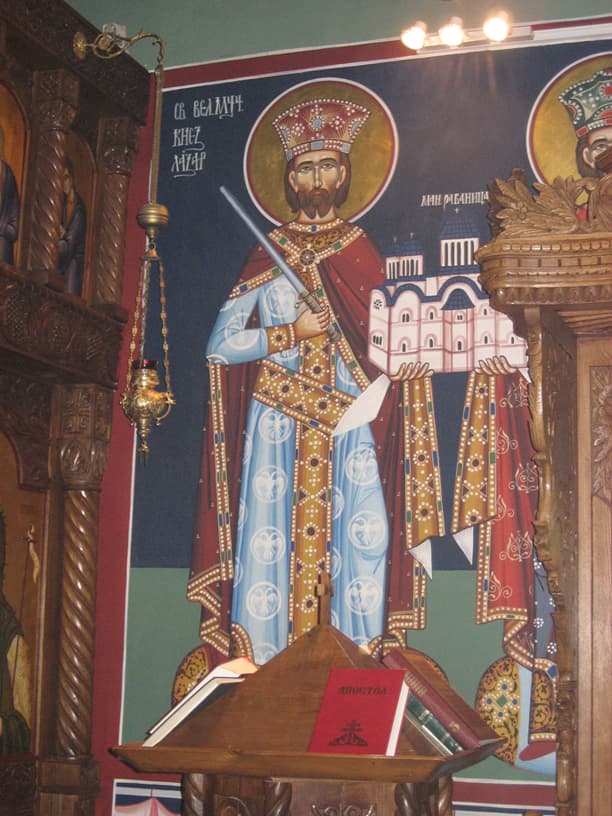
Great Prince Lazar of Serbia — CC BY 2.0. Djuradj Vujcic. Via Wikimedia Commons.
Life
Lazar Hrebeljanović was born around 1329 at Prilepac, a small mountain village in the Rascia region of medieval Serbia (now central Serbia near the modern town of Kruševac). His father, Pribac Hrebeljanović, was a junior member of the Serbian noble service of Stefan Dušan the Mighty (1331-1355), the greatest of the medieval Serbian kings. The family was of substantial but not the highest noble rank — the Hrebeljanović were knights rather than princes, with a small inherited holding in the upland country.
Lazar was raised at the royal court of Stefan Dušan from his boyhood — sent there at perhaps seven or eight as the standard noble custom of placing junior nobles' sons at the court for education and service. He was given the standard medieval Serbian noble education: military training, the basics of administration, the reading of the Slavonic Scriptures and the lives of the saints. He served as a junior page, then as a knight, then (in his twenties) as a senior court attendant. He was personally known to Stefan Dušan and was married, around 1353, to Milica Nemanjić — a noblewoman of the senior Serbian royal house, the Nemanjid dynasty that had ruled Serbia for two and a half centuries.
The marriage to Milica was decisive. It made Lazar (a relatively junior knight) a member-by-marriage of the senior Serbian royal family at exactly the moment when the family was approaching crisis. Stefan Dušan died in 1355 at forty-seven; his weak son Stefan Uroš V (1355-1371) was unable to hold the great Serbian empire together. The empire fragmented into a number of competing principalities ruled by senior nobles. Lazar — by virtue of his marriage to Milica and his administrative competence — emerged as one of the leading nobles of the central Serbian region around Kruševac.
He served as a senior administrator under Stefan Uroš from 1357 onward and was given the formal title of Prince of Moravia (one of the senior Serbian noble titles of the period). When Stefan Uroš reposed without an heir in 1371, Lazar was the leading candidate to inherit the senior royal claim. The other senior princes recognized his claim only partially; he was crowned Prince of Serbia at his own coronation in 1377 but not formally king. The realm he inherited was a fragment of the old Serbian empire — central and northern Serbia, with the southern territories under various other rulers (some of whom had defected to the rising Ottoman Turkish power).
The decisive moment of his life — and of medieval Serbia — was the Battle of Kosovo. The Ottoman Turkish power under Sultan Murad I had been steadily encroaching on the Balkan Christian kingdoms since the 1370s; by 1389 the Ottomans had absorbed Bulgaria and most of southern Serbia and were poised to strike north into the central Serbian heartland. Lazar, with his ally Vuk Branković (the senior prince of Kosovo and his son-in-law) and a contingent of Bosnian troops under Vlatko Vuković, assembled a combined Christian Balkan army of perhaps fifteen to twenty thousand men.
The two armies met on the great plain of Kosovo Polje (the "Field of Blackbirds") on Vidovdan, June 28, 1389 — the feast-day of the prophet Vitus, which the Serbian Church had identified with a much older Slavic festival of midsummer divination. The battle was a savage day-long encounter in which both commanders died. Sultan Murad was killed in his tent (the tradition is that the Serbian knight Miloš Obilić assassinated him by a stratagem); Lazar was captured by the Ottoman bodyguards in the late afternoon and beheaded at the field-altar of the Sultan's son and successor Bayezid I, in retaliation for Murad's death.
The Serbian tradition has built around the battle and the prince's death the great epic cycle of Kosovo. The decisive theme of the cycle is the prince's choice — preserved in the surviving oral epic as the answer he gave the night before the battle, when the Mother of God appeared to him in a dream and offered him the choice between an earthly kingdom (a Christian Balkan kingdom that would defeat the Ottomans and continue) and a heavenly kingdom (the loss of the battle, his own martyrdom, the eventual subjugation of Serbia to the Ottomans for four centuries). The prince — by the epic tradition — chose the heavenly kingdom. The choice has been the central self-understanding of Serbian Orthodox Christianity ever since.
His body was recovered after the battle by the surviving Serbian forces under Vuk Branković and was eventually transferred to the Ravanica Monastery in central Serbia (which Lazar himself had founded around 1377 as his planned burial-place). The relics rested at Ravanica through the next four centuries of Ottoman rule. They were carried at the great Serbian migration of 1690 (when the Patriarch Arsenije III led tens of thousands of Serbs north into Habsburg-Austrian territory) to the Hopovo Monastery in Vojvodina, where they remained until 1942. In that year, in the midst of the Croatian Ustaše's genocide of Serbs, the relics were rescued by Serbian Orthodox monks and brought to the Cathedral of Saint Sava in Belgrade. They were returned to Ravanica in 1989, on the six-hundredth anniversary of the battle.
He was canonized in 1390 — the year following his martyrdom — by the senior Serbian hierarchs, in a ceremony that produced the central liturgical text of the medieval Serbian Church (the "Hymn to Prince Lazar"). He is the patron of Serbia, of every Serbian Christian, of those who choose the heavenly kingdom over the earthly, and of every battle in which the outcome of the day is less important than the steadfastness of the witness. His feast is June 28 (Vidovdan).
Traditions
Feast day
June 28
Topics
Works in library