saint
Righteous Lazarus the Four-Days-Dead
Brother of Martha and Mary, friend of the Lord, raised from the tomb on the eve of the Lord's own Passion. Tradition makes him bishop of Kition on Cyprus, where he served thirty more years and never smiled save once.
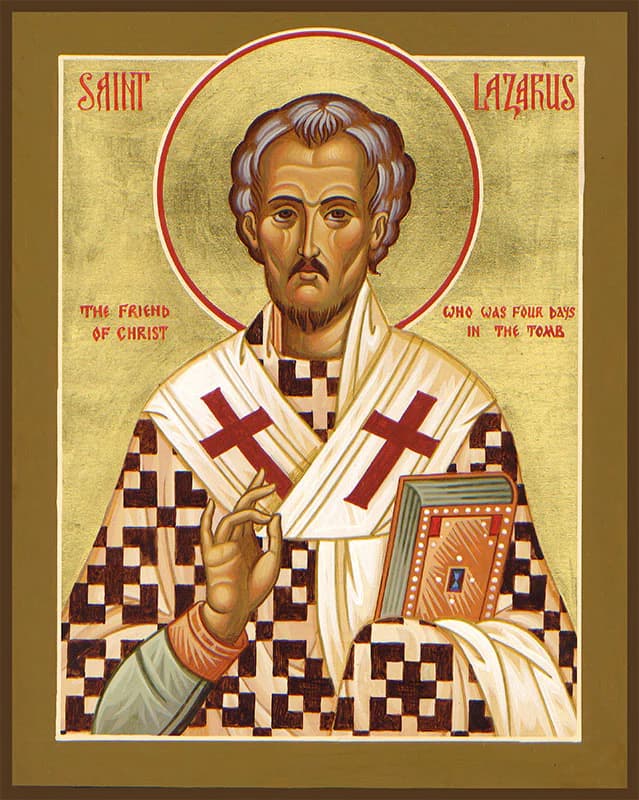
Saint Lazarus of Bethany — Hand-curated icon.
Life
Lazarus was born around the year 1 in the village of Bethany — a small settlement on the eastern slope of the Mount of Olives about two miles east of Jerusalem — to a family of modest means and (it appears from the Gospels) considerable hospitality. He was the brother of Martha and Mary, the women who hosted the Lord on several occasions in their house, and was himself the Lord's friend. The Gospel of John speaks four times of "him whom thou lovest" — the only such mention in the Gospels apart from John himself.
He fell ill in the spring of the year of the Passion. His sisters sent word to the Lord, who was then across the Jordan, that "he whom Thou lovest is sick." The Lord stayed two days longer where He was and arrived at Bethany when Lazarus had been four days in the tomb. By Jewish reckoning a body was decisively dead, beyond any possibility of recovery, after three days; the four-day period made the resurrection an unambiguous miracle of divine power and not the resuscitation of one in a coma. The Lord wept at the tomb, ordered the stone rolled away, and cried, "Lazarus, come forth." Lazarus came out, still bound in his graveclothes. The miracle so threatened the Sanhedrin that they began plotting from that hour to put both the Lord and the resurrected man to death.
Lazarus and his sisters left Judea after the Resurrection. Tradition takes them — Lazarus, Mary Magdalene (often confused with Mary of Bethany by later Latin tradition; the East holds them distinct), Martha, Mary, and several others — by ship to Cyprus, where Lazarus settled at the small Phoenician colony at Kition (modern Larnaca). He served thirty years more as bishop of the Christian community there. The apostle Barnabas, on a missionary journey to Cyprus, found him already established there and ordained him.
He was, by all the accounts, never the same man after his resurrection. The Greek Synaxarion notes: "Lazarus never laughed again for the rest of his earthly life, save once" — when on the road he saw a man stealing an earthen pot, he smiled and said, "The clay stealing clay." Otherwise his face wore the gravity of one who has seen the place from which he had come back.
He reposed peacefully at Kition around the year 63, in his early sixties — what would have been his second death. He was buried in a marble sarcophagus on which his disciples carved the simple inscription: "Lazarus, the four-days-dead and friend of Christ." His relics rest at the Church of St. Lazarus at Larnaca, where the sarcophagus is still visible under the altar. They were translated to Constantinople by Emperor Leo VI the Wise in 898 and to Marseille by the Crusaders in the thirteenth century, but the major share remains at Larnaca.
Lazarus's resurrection is the eve-feast of Pascha — celebrated on Lazarus Saturday, the day before Palm Sunday — and the Church reads the Gospel of his raising as the type of the resurrection that the Lord Himself was about to accomplish. The Western feast is December 17; the Eastern feast of his second repose is October 17.
Traditions
Feast day
Lazarus Saturday and October 17
Topics
Works in library