father
St. Leo the Great
Pope of Rome (440–461) and Doctor of the Church, whose Tome to Flavian was read aloud at Chalcedon and received with the cry, "Peter has spoken through Leo." He turned Attila back from Rome, preserved orthodox Christology at the heart of a collapsing empire, and left a body of liturgical sermons that shaped the Western church year.
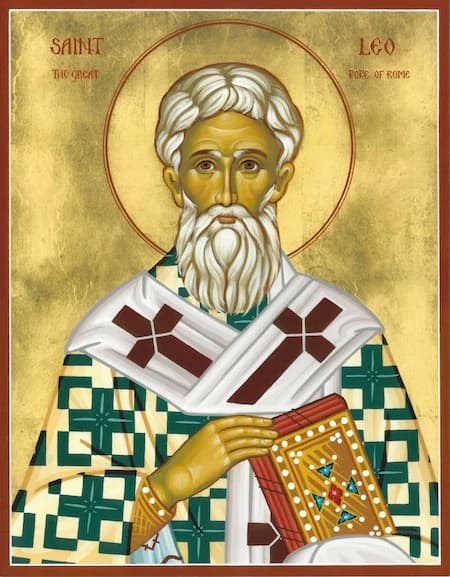
Leo the Great — Hand-curated icon.
Life
Leo, called "the Great," was born around the year 400, likely in Tuscany, and rose through the Roman clergy to become archdeacon — effectively the administrative head of the Roman church — under two successive popes. He was elected bishop of Rome in 440 while on a diplomatic mission to Gaul on behalf of the imperial court: a telling sign of the kind of man he was. His pontificate of twenty-one years was among the most consequential in the history of the ancient Church.
The central theological achievement of his reign was the letter to Flavian of Constantinople known as the Tome of Leo, written in 449 in response to the Monophysite controversy — specifically, the teaching of the monk Eutyches, who held that after the Incarnation Christ had only a single nature. Leo's letter articulated the distinction of the two natures with a precision that the Fathers assembled at Chalcedon in 451 received by acclamation: "Peter has spoken through Leo." The Definition of Chalcedon — "one person in two natures, without confusion, change, division, or separation" — rests on the theological groundwork he laid and remains the common Christological confession of Eastern Orthodoxy, Roman Catholicism, and mainline Protestantism alike.
Two dramatic encounters with barbarian leaders define his place in the wider memory of the West. In 452 he rode out to meet Attila the Hun at the River Mincio and returned with the Scourge of God's promise to spare Italy. Three years later, in 455, he stood before the Vandal Genseric at the gates of Rome and could not prevent the sack but secured the promise that no citizens would be killed and no buildings burned. He reposed on November 10, 461. The Orthodox Church keeps his feast on February 18.
Traditions
Feast day
February 18
Topics
Works in library
Readings and commentaries
Catena Aurea by Aquinas
Epistles
Letters
Sermons
Testimonia
Tome
Untitled commentary
Letters
Seventy-three letters of Pope Leo — including Letter 28, the Tome to Flavian, read at Chalcedon as the doctrinal centerpiece of the Definition of Faith.
Sermons
Forty-eight liturgical sermons spanning the Western church year — Christmas, Epiphany, Lent, Holy Week, Pascha, Pentecost, and the saints' feasts. The architectural template of papal liturgical preaching.