saint
St. Luke (Voino-Yasenetsky) the Surgeon, Archbishop of Crimea
Famous surgeon and bishop of the Soviet era who served Christ from the operating table and the prison cell alike, refused to remove his vestments while operating, and won the Stalin Prize for medicine while in episcopal exile.
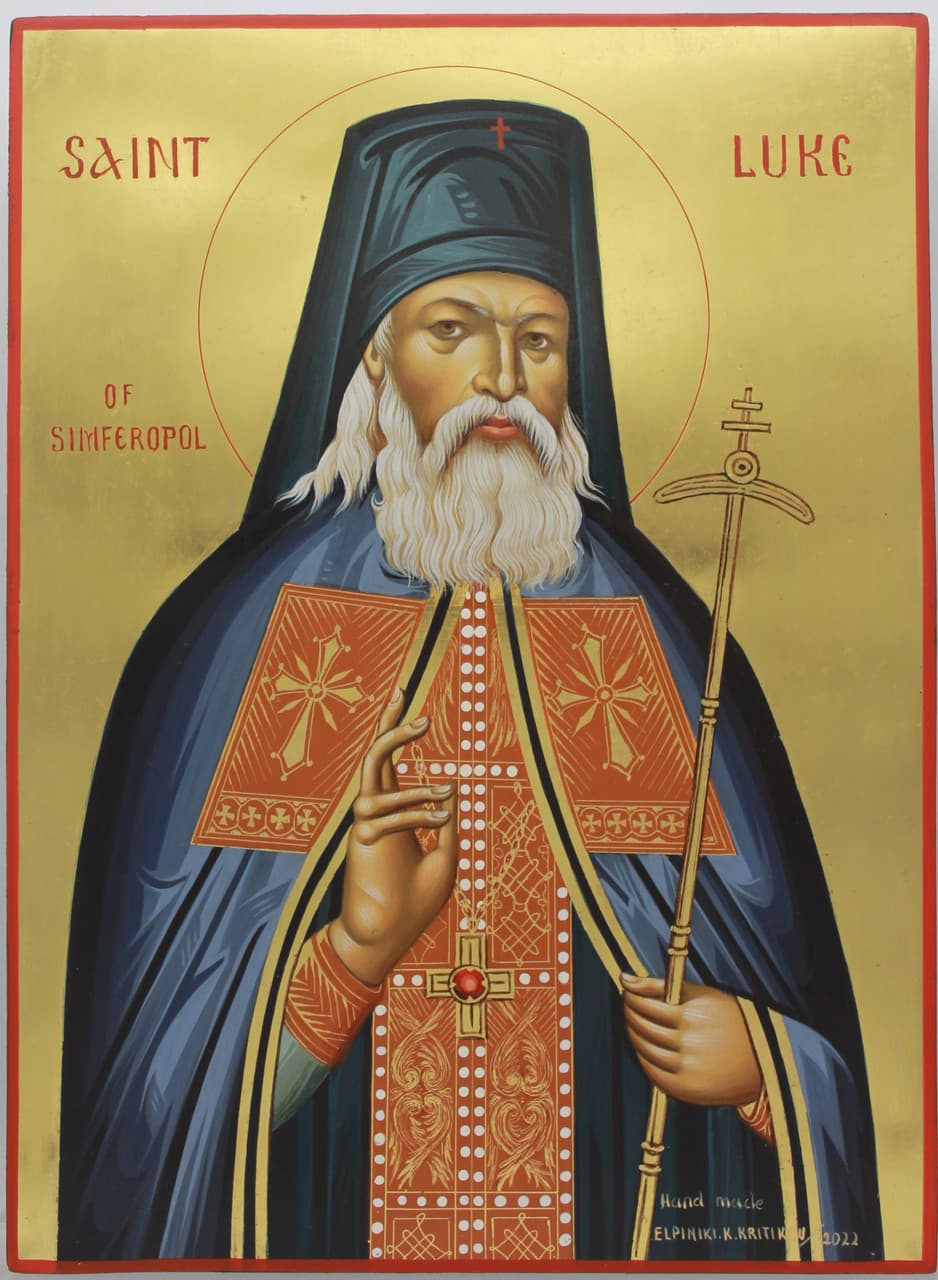
Saint Luke of Crimea — Hand-curated icon.
Life
Valentin Felixovich Voino-Yasenetsky was born on April 27, 1877, in the city of Kerch in Crimea (then the Russian Empire, today contested between Russia and Ukraine), the third of five children of a pharmacist of Polish-Lithuanian Catholic background. The family moved to Kiev when Valentin was a child; his mother, Maria Dmitrievna, was a Russian Orthodox of devout faith who raised the children in her own confession (the father had drifted out of practice). Valentin was a serious, slightly melancholic boy with a strong artistic temperament — he hesitated for some time between a career as a painter and a career in medicine, and only at twenty-one made the final choice of medicine on the moral grounds that he could do more good as a physician.
He took his medical degree from Kiev University in 1903 and went directly into the Russo-Japanese war as a Red Cross surgeon. He served at the great hospital at Chita in eastern Siberia and operated continuously for fifteen months under conditions of extraordinary pressure. He met his future wife, Anna Vasilievna Lanskaya, at Chita — she was a nursing sister at the hospital — and they were married in 1904. They had four children: Mikhail, Elena, Alexei, and Valentin.
After the war he served in a series of small zemstvo (provincial) hospitals across European Russia — at Ardatov in the Penza province, at Romanovka in the Saratov, at Pereslavl-Zalessky north of Moscow. He developed in those years a national reputation in the new field of regional anesthesia (the use of local nerve blocks rather than general anesthesia), publishing the surgical monograph Regional Anesthesia in 1915 which won him the Stalin Prize for medicine in 1944 — though that was many years later.
In 1917, with the country in revolution, Valentin was appointed chief surgeon of the hospital at Tashkent in Russian Turkestan (modern Uzbekistan), where he served through the entire collapse of the imperial state, the Civil War, and the consolidation of Soviet authority. The work in Tashkent was extraordinarily demanding — the city was the major military hospital of Central Asia, the political situation was unstable, and his family was ravaged by tuberculosis. His wife Anna died of TB in 1919, leaving him with four small children. He was thirty-six.
The death of his wife was a turning point. He had been a quiet practicing Orthodox all his life; now he gave himself entirely to the Church. He continued his surgical work, became a noted lecturer at the Tashkent medical school, and in 1921 was ordained priest by the Bishop of Tashkent, Innokenty (who had recognized the layman's deep piety and theological knowledge in their conversations). He continued operating in surgeon's whites with the priestly cross over them. The cross is famous in his iconography.
In 1923 he was tonsured a monk with the name Luke (after the evangelist Luke, who was by tradition also a physician) and was consecrated bishop. The hierarch who consecrated him — Andrew of Ufa — was acting under exceptional war-time canonical procedure; the Soviet state did not recognize the consecration and within weeks Luke was arrested as a "counter-revolutionary." Thus began the eleven years of imprisonment, three separate terms (1923-26, 1930-33, 1937-43), interspersed with forced exile in Siberia. He was tortured in 1937 at Tashkent — a "thirteen-day stand-up interrogation" in which he was forbidden to sleep — to compel him to renounce his episcopal status. He did not.
In the years of his imprisonment he continued to operate. He set up surgical wards in the Siberian camps with the bare materials available, performed operations with carpenter's tools sterilized in vodka, and saved many lives. He published nothing in those years, but he continued to study and to write: his great theological work, Spirit, Soul, and Body — a study of the unity of the human person against Soviet materialism — was composed in the camps.
In 1943, in the depths of the Great Patriotic War, Stalin partly rehabilitated the Russian Orthodox Church and allowed the recall of imprisoned hierarchs. Luke was released and appointed Archbishop of Krasnoyarsk in central Siberia, where he was also surgeon-in-chief of the military hospitals (the only Soviet citizen ever to combine a senior Soviet medical post with the episcopate). In 1944 he was awarded the Stalin Prize for his Essays on the Surgery of Inflammatory Processes — the prize money he gave to orphaned children of the war. In 1946 he was transferred to the Crimea as Archbishop of Simferopol.
His Crimea years (1946-1961) were difficult but somewhat eased. He lost his sight progressively from cataracts and went blind in 1958; he continued to preach, to write, and to administer his diocese after his blindness. His sermons of the late 1950s, secretly recorded and circulated in samizdat, are among the great Russian sermons of the modern period. He reposed at Simferopol on June 11, 1961, eighty-four years old.
His relics, after his exhumation in 1996 by the patriarchate of Moscow, were found incorrupt. They rest at the Cathedral of the Holy Trinity in Simferopol. He was canonized by the Ukrainian Orthodox Church in 1995 and by the Moscow Patriarchate in 2000. He is one of the principal patrons of physicians, of surgeons, of those who suffer from the long ordeal of unjust imprisonment, and of every Russian Christian who came of age under Soviet persecution. His feast is June 11.
Traditions
Feast day
June 11
Topics
Works in library