saint
St. Macarius of Optina
Spiritual son of Leonid of Optina and master of the Russian Philokalic revival, under whose direction the Russian translations of Isaac the Syrian, Symeon the New Theologian, and the desert fathers were prepared at Optina and given to the Russian world.
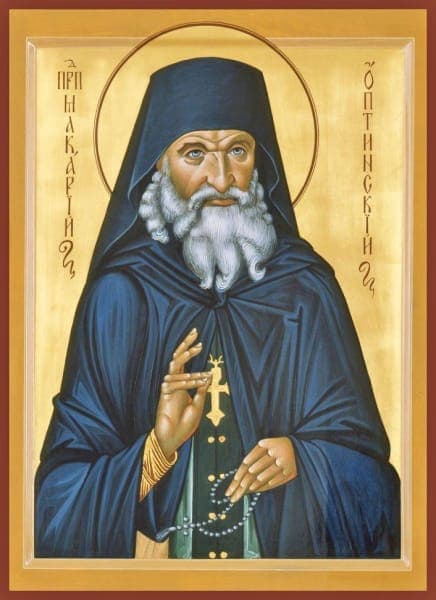
Saint Macarius of Optina — Hand-curated icon.
Life
Michael Nikolaevich Ivanov was born on November 20, 1788, on his family's estate at Schepyatino in the Kaluga province of central Russia, into a noble Russian landholding family of moderate means. His father, Nicholas Mikhailovich Ivanov, was a retired military officer with a small estate; his mother, Elizabeth Alekseyevna, was the daughter of a country priest. The family was deeply pious in the standard older-Russian-noble manner. Michael was the second of three sons; he was educated at home until the age of nine, then sent to the Kaluga province gymnasium for his lower studies, then to a private school at Moscow for his upper studies.
He completed his upper studies at twenty-one and returned to the family estate. His father had reposed in 1809; his mother lived a few more years. He served in the local provincial bureaucracy from 1809 to 1815 in a series of junior administrative posts, then in 1815 at twenty-seven he made the decision to enter monastic life. He chose the Glinskaya Hermitage in the Kursk province — at the time one of the more rigorous monastic houses of central Russia, with a strict cenobitic discipline.
He was tonsured Macarius at Glinskaya in 1817 at twenty-nine, taking the name of the great Egyptian father. He spent his next twelve years at Glinskaya (1815-1827) as a young monk of the standard discipline, with particular attention to the practice of the Jesus Prayer under the elder Athanasius Zakharov — one of the Russian disciples of Paisius Velichkovsky who had returned from Neamț in the 1790s and become a major figure of the Russian spiritual revival.
In 1827, at thirty-nine, he was transferred to the Optina Hermitage in the Kaluga province — closer to his ancestral village of Schepyatino, and at the time the rising center of the Russian starets movement under the senior elder Leonid (Lev) Nagolkin. Macarius served as a junior monk under Leonid from 1827 until Leonid's repose in 1841. He was ordained hieromonk in 1828 and was made the chief of the monastic skete (the smaller community of hermits attached to the main monastery) in 1839.
On Leonid's repose in 1841, Macarius became the second of the great Optina elders. He served as the principal starets of Optina for the next nineteen years (1841-1860). His ministry was the central spiritual ministry of the central-Russian Orthodox world through these decades. Pilgrims came from across the empire — peasants in their thousands per year, but also the senior clergy of the Russian Church and the great writers of the period.
His distinctive contribution to the Russian spiritual tradition was the systematic publication of the Optina patristic translations. Optina had been since the late 1820s a major center for the Russian-language translation of the Greek patristic texts — building on the Slavonic translations of Paisius Velichkovsky and extending them into accessible modern Russian. Macarius supervised the translation project from 1846 to 1860 and saw eighteen major volumes through to publication: the writings of Isaac the Syrian, Symeon the New Theologian, Mark the Ascetic, John Climacus, Theodore the Studite, Maximus the Confessor, and selections from the Apophthegmata Patrum and the older Russian patericons.
The publications were enormously influential. Through them, the Russian-speaking world received its first systematic access in the modern Russian language to the patristic tradition. The Optina translations shaped the Russian theological revival of the next century; they were read with particular care by Dostoevsky (who incorporated Optina monks into the elder Zosima of The Brothers Karamazov), by Tolstoy (who visited Optina three times for spiritual conversation), by the entire generation of Russian religious philosophers (Vladimir Solovyov, Sergei Bulgakov, Nicholas Berdyaev, all of whom had read the Optina translations).
He was also the spiritual father of the third great Optina elder, Ambrose, who had served as his disciple for fifteen years and would succeed him in 1860. The smooth succession Leonid → Macarius → Ambrose gave Optina its three-generation continuity of senior starets ministry — the longest such continuity in Russian monastic history.
He reposed at Optina on September 7, 1860 — the eve of the Nativity of the Theotokos — at seventy-one. He was buried at the Optina cemetery beside Leonid; Ambrose would be buried beside them thirty-one years later. The three graves at Optina became and remained the principal pilgrimage site of the modern Russian spiritual tradition.
He was glorified by the Russian Orthodox Church in 1996 (along with the other Optina elders) as one of the principal saints of the modern Russian Church. His relics rest at the restored Optina Hermitage. He is the patron of translators of patristic texts, of those who supervise long systematic scholarly projects, of monks who succeed great elders without diminution of the ministry, and of every Russian Christian who has read his Russian editions of the Greek Fathers. His feast is September 7.
Traditions
Feast day
September 7
Topics
Works in library