saint
St. Macarius the Great
Disciple of Anthony, the great elder of Scetis whose Fifty Spiritual Homilies have shaped Eastern monasticism. Called 'the youth-elder' for the wisdom God gave him in his youth. Father of innumerable monks of the lower Egyptian desert.
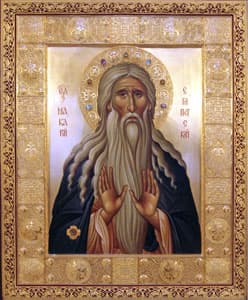
Macarius the Great — Public domain. Via Wikimedia Commons.
Life
Macarius was born around 300 in the village of Shabsheer in the Egyptian Delta, the son of a poor Coptic family. He was named after the Greek word for "blessed" and from his earliest years was so quiet and earnest a child that his neighbors gave him the nickname "old young man." His parents were considerably advanced in years when he was born, and they raised him in deep piety; both eventually entered the monastic life themselves at the urging of their son.
In his youth Macarius worked as a camel-driver, carrying goods between the villages of the Delta and the salt-pans of the Wadi Natrun. The route led him repeatedly through the desert of Scetis — a barren depression about forty miles south of the modern town of El-Alamein on the road from Cairo to Alexandria — and on one of his trips he met an angel (or, in another telling, an old anchorite) at the place that would become his monastery. He returned home, distributed his possessions to the poor, married off his elder sister, and at thirty went into the desert.
He spent his first years of solitude under the guidance of the great Antony at his mountain near the Red Sea, then returned with Antony's blessing to settle for the rest of his life at Scetis, where he became the father of an entire monastic community — the desert houses of Scetis would eventually number some four thousand monks in a great loose lavra spread across the depression. He was ordained priest about 340, against his will, and from then on served the Liturgy for his disciples at a small church at the heart of the community.
He had the gift of clairvoyance and the gift of healing. He was particularly known for the laconic counsel he gave young monks: "Sit in your cell, and your cell will teach you all things." He was reluctant to give discourses; the disciples who came to him for words went away with sayings of two and three sentences which they wrote down and which made up — together with the sayings of his colleagues at Scetis, Sketis, and the Cells — the Apophthegmata Patrum, the great compilation of desert wisdom.
A separate body of writing, the fifty "Spiritual Homilies," has come down under his name — long discourses on the inner life, on the work of the Holy Spirit in the soul, on the goal of theosis. Modern scholarship has questioned whether they are Macarius's own work or are by a slightly later anonymous Syrian author known as "Macarius-Symeon"; the Orthodox tradition has consistently received them as Macarian and as one of the major texts of patristic spirituality. Either way they are the only sustained body of teaching on the inner life surviving from fourth-century Egypt.
He was twice driven into exile by the Arian persecution under the Emperor Valens (the second time onto an island in the Nile), and lived to see the restoration of Orthodoxy at the Second Ecumenical Council of 381. He reposed at Scetis around 391, ninety years old, having served the desert as its father for sixty years. His relics rest at the monastery that bears his name (Deir al-Anba Maqar), still inhabited by Coptic monks today; he is also venerated, in his earlier life, at the cave near his birthplace. His feast is January 19.
Traditions
Feast day
January 19
Topics
Works in library