saint
St. Macrina the Younger
Eldest sister of Basil the Great and spiritual teacher of the great Cappadocian fathers, whose life under her mother Emmelia at Annisi shaped the household from which Basil, Gregory of Nyssa, and Peter of Sebaste came forth. Patron of women, sisters, and Christian education.
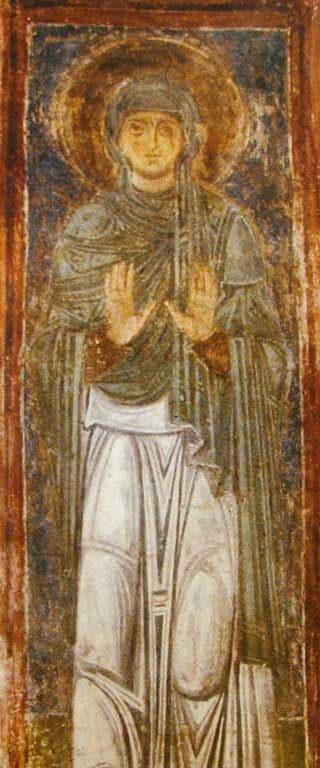
Macrina the Younger — Public domain. Via Wikimedia Commons.
Life
Macrina the Younger was born in 327 in Caesarea in Cappadocia, the eldest of the ten children of the noble Cappadocian Christian family of Basil and Emmelia. She was named for her grandmother Macrina the Elder, who had survived the great persecutions of Maximin Daia by hiding in the Pontic mountains and had taught the family the doctrines she had received from Gregory the Wonderworker.
At twelve she was betrothed to a young nobleman of an equal Cappadocian family — a marriage all parties expected to be advantageous. Before the wedding the young man died. Macrina, then thirteen, declared that she would never marry — since (she argued) Christian marriage joins two souls forever, she would remain faithful to her departed betrothed and never accept another. She lived at home for the next thirty years.
Her real work in that time was the formation of her younger brothers and her household. Her eldest brother Basil came home from his Athenian studies as a young man fascinated by his own intellect; Macrina set herself to bring him to humility and to Christ, and there is no doubt — Gregory of Nyssa says so explicitly — that the family's monastic vocation began with her. Basil the Great, Gregory of Nyssa, Peter of Sebaste, all bishops and saints; Naucratios, the second brother, who died young as a hermit in Pontus — Macrina taught and shaped them all.
After her father's death (around 341) and her sister-in-law's death and many other family losses, she gathered the household — her widowed mother Emmelia, her younger brother Peter (then about ten), the released family slaves who chose to stay, and herself — into a single ascetic community on the family estate at Annisi on the Iris River in Pontus. They lived a common life, sharing all things in common, the slaves no longer slaves but sisters. The men of the family who came home — Basil himself for a time in the 360s — would withdraw to a smaller community on the opposite bank of the river. This was the very first Eastern double monastery, the original of the model that would spread across the Roman East for the next two centuries.
She survived her mother and most of her brothers. In September 379 — six months after Basil's death — Gregory of Nyssa came down from his see to visit her and found her dying. They spent her last days in long conversation about the soul and the resurrection. He wrote out her words afterward as the famous dialogue On the Soul and the Resurrection, one of the principal works of Christian eschatology in any age. He buried her himself in the family tomb beside their parents, with the iron cross she had worn on her breast — given her by her father — placed on her body. She was fifty-two.
Her feast is July 19. She is the patroness of women teachers, of intentional households of seekers, of older sisters, and of any soul that — finding the world's plans cut short — turns the disappointment to deeper love.
Traditions
Feast day
July 19
Topics
Works in library