saint
St. Martyr Mamas of Caesarea
Orphan shepherd-boy of Cappadocia whose flock of wild goats and sheep gave milk that he made into cheese for the poor. Pierced through with a trident under the Emperor Aurelian. Patron of shepherds and of children.
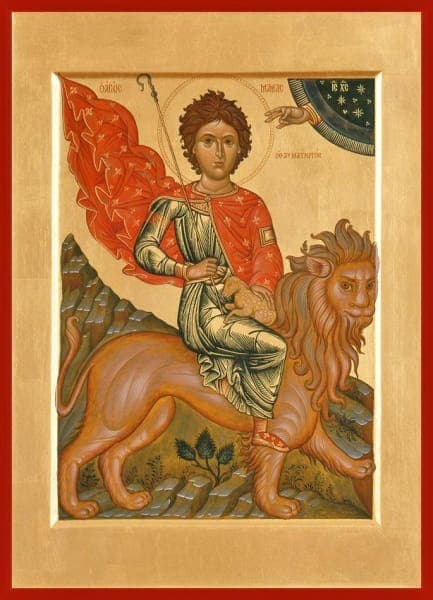
Saint Mamas of Caesarea — Hand-curated icon.
Life
Mamas was born around 259 in the Roman province of Cappadocia, in or near the city of Gangra (modern Çankırı in north-central Turkey), into a wealthy noble Roman-Cappadocian family. His parents, Theodotus and Rufina, were Christians of senatorial rank — Theodotus was a local senator at Gangra, and Rufina was the daughter of a senior provincial official. Both parents had been imprisoned for their faith at the time of his birth; Rufina gave birth to him in the prison cell at Caesarea.
His parents reposed shortly after his birth — Theodotus first, in the prison; Rufina some days later, after a successful but exhausting labor. The infant was rescued from the prison by a wealthy Roman matron of Caesarea named Ammia (the surviving sources sometimes give her name as Hammia), who was also a secret Christian. She adopted the boy, raised him in her household with the customary care of a noble Roman child, and gave him an unusual childhood combination of the standard noble education and the careful catechesis a wealthy Christian household could provide.
He was given the name Mamas — a Cappadocian-Greek nickname rather than a formal Roman name — because the only word he would say in his earliest infancy was "mama" (the universal infant utterance, which in his case was apparently directed at his foster-mother Ammia and which struck the family as remarkable enough to keep). He used the name through his life and was known to his contemporaries by no other.
The decisive event of his early life came when he was about fifteen, around 274. His foster-mother Ammia had reposed earlier in the year; he had inherited her household and her wealth. He gave away the entire estate to the poor of Caesarea, kept only what he needed for the simplest peasant life, and withdrew to the mountains east of Caesarea (the foothills of what is now Mount Erciyes), where he lived in a small cave-hermitage as a shepherd-hermit.
He kept a small flock of wild goats and sheep that he had befriended on the mountain — animals that he found wounded or abandoned, that he nursed back to health, and that returned to him each evening at his cell. The number of animals grew; by his late teens he had a substantial herd. He made cheese and butter from their milk and brought the food down to Caesarea at intervals to give to the poor of the city. He was known across Cappadocia as the shepherd-hermit of the mountains.
His ascetic life was unusual in his combination of strict personal discipline (he was a vegetarian, he kept the standard monastic offices alone in his cave, he refused all hospitality) and active engagement with the wild creatures of the mountain. The records describe him as preaching to the animals — small Christian sermons that he gave to his flock on the hillside, accompanied by the gestures of the standard rhetoric. The animals, the sources say with perfect seriousness, sat quietly to listen. The image of Mamas preaching to his flock has become one of the standard scenes of his iconography.
He was about thirty-five when the Diocletianic persecution reached Cappadocia (around 294). He was denounced to the Roman provincial governor of Cappadocia, Faustus, by some of the pagan local farmers whose folk-religious veneration of the mountain shrines he had publicly criticized. Faustus sent a small squad of soldiers up the mountain to bring him in.
Mamas accepted the arrest peacefully. He came down with the soldiers to Caesarea and stood before the governor's court. The standard examination took place. The standard escalating tortures were applied: he was flogged, his sides burned with torches, his feet pierced with iron pegs. He continued to confess. He was thrown to wild beasts in the local amphitheater; the lions (the sources note) lay down at his feet and would not touch him. He was thrown into a heated oven; the oven cooled and he stepped out unharmed.
Faustus, having exhausted the standard tortures and run out of patience, finally ordered him pierced through with a trident by the executioners of the city. The trident was driven into his belly. Mamas was carried still living to a high place outside the city, where he died of his wounds the next day.
His body was recovered by the local Christian community of Caesarea and was buried at the place of his death. The grave-site became immediately one of the major Christian shrines of Cappadocia. The body, the records say, was found uncorrupted at the subsequent translation forty years later.
His relics rest at the Cathedral of Cyprus at Morphou (modern Güzelyurt in the Turkish-occupied northern part of Cyprus), where they were translated by a Cypriot bishop in the seventh century and have remained continuously since. Substantial portions are at the church of Saint Mamas in Langres in France (a Carolingian translation) and at smaller sites across the Greek east.
He is the patron of shepherds, of farmers who tend sheep and goats, of those who work as solitary outdoor laborers, of children who lose parents in early infancy, and of every Christian who lives alone with their flock and the wild creatures of the wilderness. His feast is September 2.
Traditions
Feast day
September 2
Topics
Works in library