father
St. Mark the Ascetic
A solitary of the Egyptian desert whose two hundred chapters on the spiritual law and on those who think they are justified by works open the Philokalia and have shaped every Orthodox treatment of prayer since.
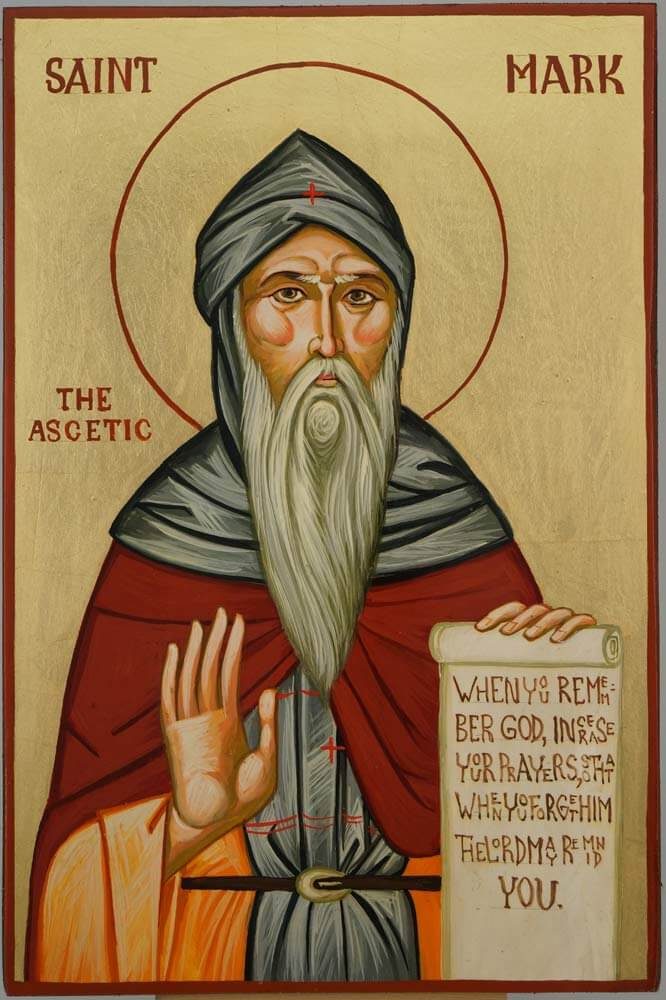
Mark the Ascetic — Hand-curated icon.
Life
Mark was born around 360 in the southwestern provinces of Roman Asia Minor — most likely in the small Phrygian-Pisidian frontier town of Apamea (modern Dinar in western Turkey), into a Greek-speaking family of moderate Christian piety. His parents were free smallholders of moderate means. He was given the standard provincial Greek education through perhaps his fifteenth year — basic literacy in classical Greek, the Septuagint Bible, and the standard catechetical materials of the period.
He entered monastic life around 380 at twenty, traveling on foot south through the long Asian Roman roads to the Egyptian Delta and then up the Nile to the great desert monastic settlements at Scetis, Nitria, and the Cells in the Wadi Natrun — the Egyptian desert west of Alexandria where the second-generation Egyptian monastic communities (after the founding generation of Anthony and Macarius) were at their height. The principal monastic figure of the period was John Chrysostom's elder contemporary John the Cilician at Scetis; Mark was tonsured under him.
He spent his entire monastic career — perhaps forty years (380-430) — at Scetis. He emerged in his middle age as one of the senior elders of the community, with the particular reputation for combining strict ascetic practice with a remarkable theological precision. He was ordained priest around 405 at the age of forty-five (he had refused ordination repeatedly until the demands of the community made it impossible to refuse longer). He served as a counselor of the younger Scetis monks for the last twenty-five years of his life.
His distinctive contribution to the patristic tradition is the body of his ascetical writings — about eight surviving treatises that have been transmitted in the Greek Philokalic tradition as foundational texts of the inner life. The principal works are: "On the Spiritual Law" (two hundred chapters of aphoristic counsel on the regulation of the inner movements of the soul); "On Those Who Imagine They Are Justified by Works" (a sharp critique of the standard monastic temptation to count one's own accomplishments as the basis of one's standing before God); "On Repentance" (his most-read shorter work, on the standard daily practice of penitence as the foundation of the monastic life); "Letter to Nicolaus" (a long pastoral letter to a young monk named Nicolaus on the practical conduct of the spiritual life); "Disputation with a Lawyer" (a dialogue defending the monastic life against the criticism of a secular Christian lawyer).
The two-hundred-chapter format of "On the Spiritual Law" became one of the standard genres of later Byzantine ascetical writing. The format — short numbered paragraphs of one to three sentences each, arranged in a deliberately disconnected sequence to allow for slow meditative reading — was copied by Diadochus of Photike a generation later, by Maximus the Confessor in the seventh century, by Symeon the New Theologian in the eleventh century, and is still in widespread use as a Christian devotional format today.
His theological distinctiveness lies in the rigor with which he holds together two propositions that lesser theologians have often divided: the necessity of practical ascetic effort, and the absolute unmerited gratuity of every spiritual gift. "The Lord is hidden in his own commandments, and he who seeks him will find him in proportion to his obedience" — but "he who imagines that any righteousness of his own is sufficient before God is rejected." The two principles are held in dynamic tension; neither cancels the other.
The Philokalic tradition (the great anthology of Greek patristic ascetical writing compiled at Mount Athos in the 1770s) opens with Mark's writings — his eight major treatises occupy the first volume of the Greek Philokalia. They have shaped every later Orthodox treatment of the inner life. The Russian translation by Paisius Velichkovsky in the late eighteenth century brought them to the Russian-speaking world; the English translation by the Faber and Faber press in the 1970s brought them to the English-speaking world. They are read continuously by serious students of Orthodox spirituality.
He reposed at Scetis around 430, at perhaps seventy. He was buried at the small monastery church of the community. His relics — what could be preserved through the repeated Berber raids of the late fifth and sixth centuries — were carried with the surviving Scetis community to various refuges; substantial portions are now at the Coptic monastery of Saint Macarius in the Wadi Natrun (which is the lineal continuation of the Scetis community) and at the Greek Orthodox monastery of Saint Catherine at Mount Sinai. He is the patron of those engaged in the systematic discipline of the inner life, of writers of short aphoristic spiritual counsel, and of every Christian who has had to hold the apparent tensions of grace and effort together in a single integrated practice. His feast is March 5.
Traditions
Feast day
March 5
Topics
Works in library
Readings and commentaries
Letter to Nicolas the Solitary
St. Mark the Ascetic · Letter to Nicolas the Solitary — as included in the Philokalia.
On the Spiritual Law: Two Hundred Texts
St. Mark the Ascetic · On the Spiritual Law: Two Hundred Texts — as included in the Philokalia.
On Those who Think that they are Made Righteous by Works: Two Hundred and Twenty-Six Texts
St. Mark the Ascetic · On Those who Think that they are Made Righteous by Works: Two Hundred and Twenty-Six Texts — as included in the Philokalia.
St. Mark the Ascetic — Introductory Note (Philokalia)
Editorial introduction to the Philokalic selections of St. Mark the Ascetic.