saint
Sts. Righteous Martha and Mary of Bethany
Sisters of Lazarus and friends of the Lord. Martha served Him in the kitchen at Bethany; Mary sat at His feet and chose the better part. Mary anointed His feet with the costly nard six days before the Pascha. Both followed the women who came to the tomb on the morning of the Resurrection.
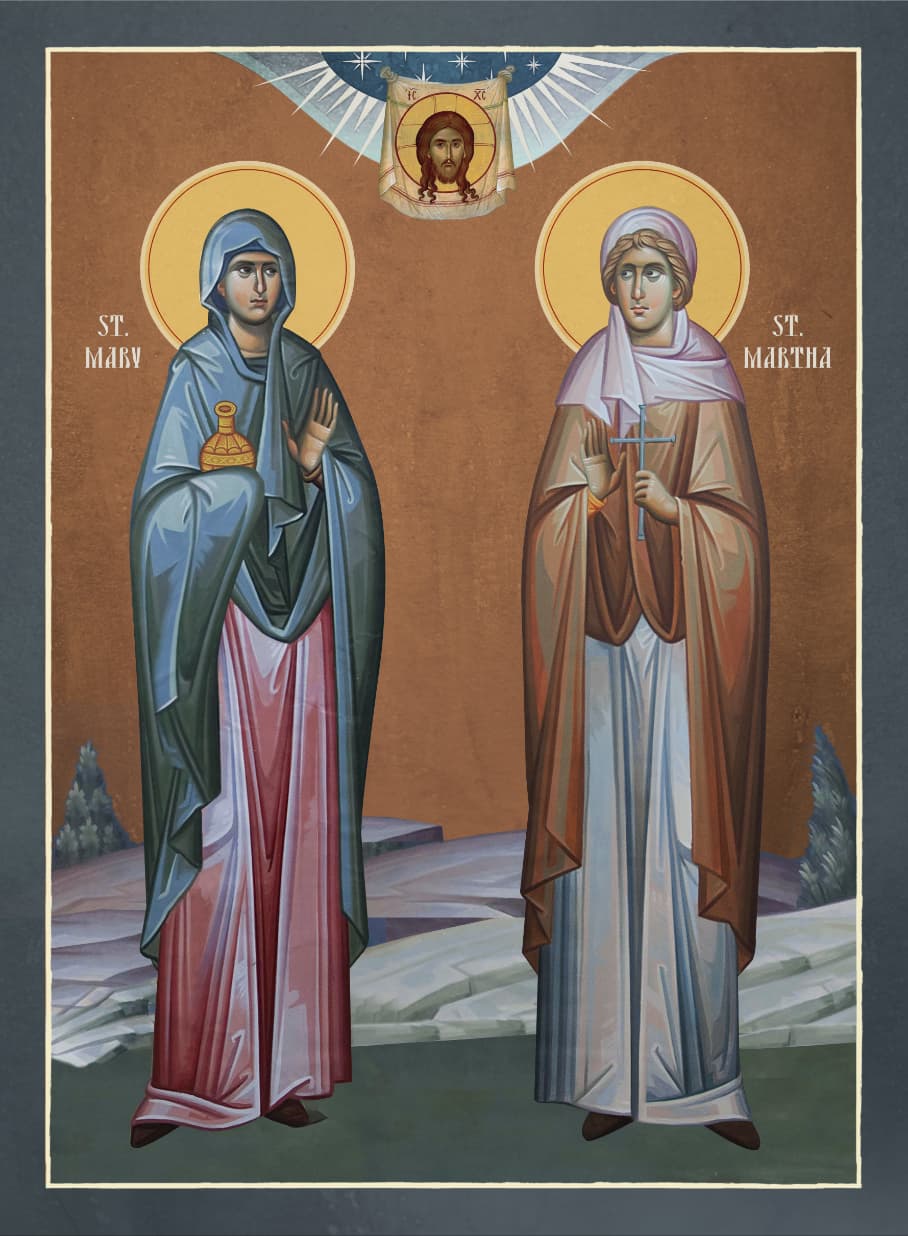
Saints Martha and Mary of Bethany — Hand-curated icon.
Life
Martha and Mary were sisters, born to a moderately prosperous Jewish family of the small village of Bethany on the eastern slope of the Mount of Olives, about two miles east of Jerusalem. The Gospels do not give the names of their parents, though some early traditions name the father Syrus (a Hellenized form, the family was probably partly bilingual). Martha was the elder; Mary was the younger by perhaps three or four years. They had a brother Lazarus, who was younger than either of them and at the events of the Gospels was probably in his twenties. The family was already known in the village before they appear in the Gospels — their house was substantial and they were able to receive guests of a senior rank.
The Lord came to the house at Bethany — by the most common reckoning — perhaps once or twice a year through the three years of His public ministry. Bethany was the standard last stopping-place for pilgrims coming up to Jerusalem from the east; the Lord and the apostles would naturally have come down from Galilee through Samaria, crossed the Jordan at Jericho, and stopped at Bethany before the last short walk up over the Mount of Olives into the city. The friendship between the family and the Lord was deep and personal — the Gospel of John explicitly says, "Jesus loved Martha, and her sister, and Lazarus."
The two famous moments of the sisters in the Gospels are: the visit during which Martha was "cumbered about much serving" while Mary sat at the Lord's feet to hear His word (Luke 10:38-42), and the Lord's coming to Bethany after the death of their brother (John 11). At the first visit Martha came to the Lord and asked Him to bid her sister to help her in the kitchen. The Lord answered: "Martha, Martha, thou art careful and troubled about many things: but one thing is needful: and Mary hath chosen that good part, which shall not be taken away from her." The exchange has been read by the Christian tradition not as a condemnation of Martha but as a teaching on the priority of contemplation over the practical works that should serve it.
The second moment is darker. Lazarus fell ill in the spring of the year of the Passion; the sisters sent to the Lord, who was at the Jordan. He delayed two days. By the time He arrived at Bethany, Lazarus had been four days in the tomb. Martha went out to meet Him in the road and said: "Lord, if Thou hadst been here, my brother had not died: but I know, that even now, whatsoever Thou wilt ask of God, God will give it Thee." Mary, more grieved, would not at first leave the house. The Lord called her; she came out and fell at His feet with the same words: "Lord, if Thou hadst been here, my brother had not died." The Lord wept at the tomb; He commanded the stone to be taken away; He cried "Lazarus, come forth," and the dead man came out alive.
Mary anointed the Lord's feet at a dinner in the family's house six days before the Passion (John 12). The fragrance of the spikenard filled the house. Judas Iscariot rebuked her for the extravagance — three hundred denarii could have been given to the poor — and the Lord defended her: "Let her alone: against the day of my burying hath she kept this." The Latin tradition has often identified this Mary with Mary Magdalene; the Eastern tradition has consistently kept them as distinct persons, two of the several women named Mary who followed the Lord.
The sisters followed Lazarus into the long Passion week, were among the women at the foot of the Cross (the Gospels list "Mary the mother of James and Joses, and the mother of Zebedee's children" with the Magdalene; Mary of Bethany is generally placed in this group), and were among the women who came with the Magdalene to the tomb on the morning of the Resurrection.
They left Judea with Lazarus when the Jerusalem authorities began the plot to put their brother to death a second time after his resurrection. The voyage by sea to Cyprus is the standard early Christian tradition; some later traditions take them on to Marseille (the Latin tradition that conflates them with the Magdalene). They lived out their lives at Larnaca on Cyprus under the bishopric of their brother. Martha reposed first, probably around 70, having been a leading figure in the women's community of the Cypriot church. Mary lived another decade or so and reposed around 80. They were buried beside Lazarus.
Their relics, with portions of Lazarus's, are at the Church of St. Lazarus at Larnaca. Substantial portions of Mary's relics — by way of the medieval translations — are at Vézelay in France and at Saint-Maximin-la-Sainte-Baume in Provence (these are claimed by the Latin tradition as the Magdalene's, but the textual confusion in the West makes the identification uncertain). The sisters are honored together as the patrons of hospitality and the Christian household. Martha is the patroness particularly of cooks, housekeepers, and active service in the Church; Mary of Bethany of contemplative life. Their feasts are the Sunday of the Myrrh-bearing Women (the second Sunday after Pascha) and June 4.
Traditions
Feast day
Sunday of the Myrrh-bearing Women and June 4
Topics
Works in library