saint
St. Great-martyr Christina of Tyre
An eleven-year-old of Tyre whose pagan father shut her up in a tower with golden idols. She broke the idols, gave the gold to the poor, and endured torments under three governors — including her own father — before her death by sword. Type of childhood faith refusing the lie of the world.
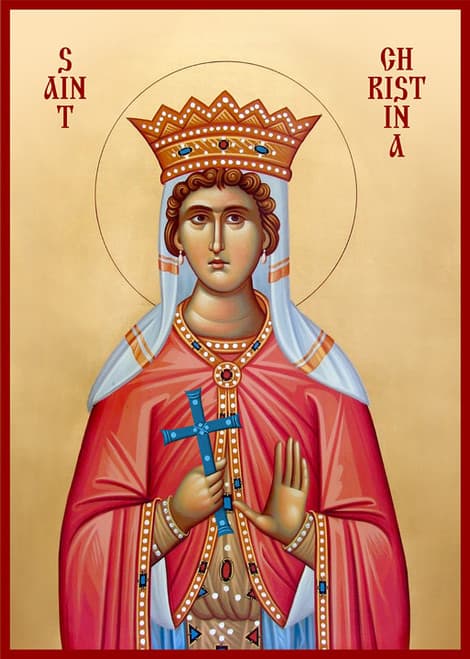
Christina of Tyre — Hand-curated icon.
Life
Christina was born around 287 in the great Phoenician port city of Tyre (modern Sour in southern Lebanon), into a wealthy noble pagan family. Her father, Urban, was the Roman governor of the province of Phoenicia — a senior imperial official with substantial wealth, military authority, and political ambition. Her mother had reposed when she was very young; she was raised under the supervision of nurses and tutors in the family's palace at Tyre. By the age of ten she had received the standard Greek-Roman education of a wealthy provincial girl.
Her father, recognizing her beauty and considerable wealth as an asset to be managed, had her enclosed at the age of eleven in a high tower at the family palace, with eleven female servants, golden idols of the principal Roman gods (Jupiter, Apollo, Diana), and instructions for daily incense-offerings to the idols. He intended her to live in the tower until he had chosen her future husband — a young Roman of suitable senatorial rank.
She lived in the tower for the next three years, unhappy with the daily idol-worship she was required to perform. She had developed (entirely on her own) the conviction that there was a single God behind the visible heavens, and that the idols in her tower were not Him. She received a brief and informal catechesis around her thirteenth birthday from one of her servants, who was a secret Christian; the catechesis took the form of brief whispered conversations during the daily idol-offerings.
On her fourteenth birthday she made a decision. After the servants had gone to bed she took down each of the golden idols, smashed them with a stone, melted them down in the brazier (the gold was substantial — these were major idols of solid gold), and distributed the molten gold piecemeal to the poor of the city through her window over the next several days.
Her father discovered the destruction of the idols some weeks later. He was incandescent. He summoned her down from the tower and demanded an explanation. She told him calmly that she was a Christian, and that she had broken up the idols because they were not gods. He had her flogged in his presence; she did not yield. He had her tied to a frame and beaten with rods; she did not yield. He had her thrown into prison.
The next morning he convened a public examination. The standard escalating tortures were applied. She was hung up by her hair from the courtroom ceiling. She was thrown into a furnace; the furnace was overheated and consumed the executioners but left her unharmed. She was thrown into the sea with a millstone around her neck; the millstone became light, the angel of the Lord lifted her up, and she walked back on the surface of the waves to the city. Her father, watching this last marvel from the dock, fell dead of a heart attack at the spectacle.
His successor as governor — a man named Dion — continued the persecution. He ordered her wrapped in heated iron chains and thrown back into the sea; the chains broke. He ordered her thrown to wild beasts; the beasts lay at her feet. He died of a stroke shortly afterward. His successor Julian, the third governor she would face in succession, was more methodical. He had her tongue cut out (her preaching had become widely effective in the city by this point); the severed tongue, the sources note, continued to speak. He had her breasts cut off; she lay bleeding for some hours in the prison; in the morning the wounds had healed. He finally ordered her pierced through with arrows on July 24, 304. She was seventeen.
Her body was recovered by the Christian community of Tyre and buried in the catacombs. Her relics were translated to Constantinople in the sixth century. Major portions are at the cathedral of Tyre (where the modern Antiochian Orthodox community has continuously venerated her), at the church of Saint Christina on Lake Bolsena in Italy (a sixth-century Western tradition), and at Sant'Agata dei Goti in Rome.
She is the patron of girls of childhood and early adolescence who are pressured by family to participate in religious practices they cannot accept, of those who break with a powerful father over religion, of the unmarried, and of every Christian whose tongue has been cut out for confessing Christ (a remarkably common pattern in the early martyrs' acts). Her feast is July 24 in the East (July 24 also in the West, though some Western traditions move it to July 23 or 25).
Traditions
Feast day
July 24
Topics
Works in library