saint
St. Great-martyr Irene of Macedonia
Daughter of the pagan king of the city of Magedon in Persia, raised in a tower in seclusion, who was instructed in the faith by an angel and brought her parents and city to Christ. She suffered torture and miraculous deliverance under three successive kings and reposed at Ephesus in peace.
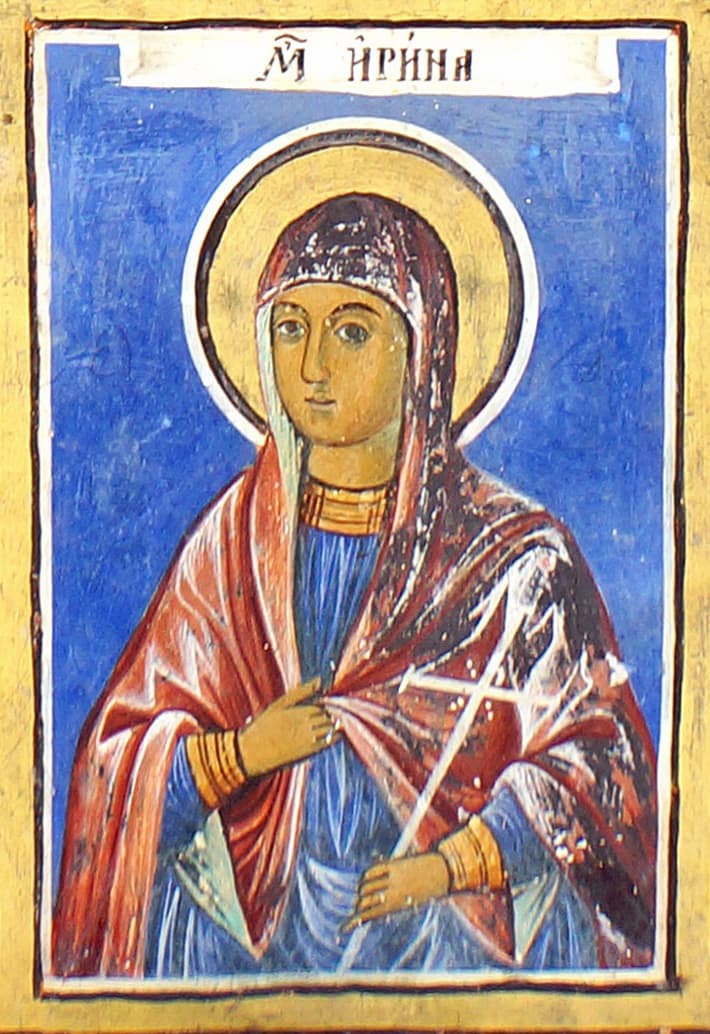
Irene of Macedonia — Public domain. Димитър Христов и Зафир. 1843. Via Wikimedia Commons.
Life
Penelope (the name was later changed to Irene at her baptism) was born around 90 in the small Persian-vassal kingdom of Magedon on the western edge of the Persian Empire (probably in or near the modern Iranian city of Hamadan), the only daughter of the local pagan king Licinius and his wife Licinia. The kingdom was a small client-state of the Sassanid Empire — a Persian-Greek border principality with substantial trade contacts but limited political autonomy. The royal household practiced the standard Persian pagan religion of fire-worship and idol-veneration.
Licinius, foreseeing political danger to his daughter from rival noble families seeking her in marriage, had her placed at six in a high tower at the edge of the royal palace complex. She was to live in the tower with her tutor Apellian and a small entourage of women servants until he should choose her future husband. The tower had a small adjoining chapel of the Persian fire-gods.
She lived in the tower for the next ten years, until she was about sixteen, in the standard noble Persian arrangement of secluded upbringing. The decisive event of her life came over a single twelve-hour period. A dove flew through her window carrying an olive branch (the standard biblical image of Noah's flood and of peace from heaven); a moment later an eagle flew through with a wreath of laurel (the standard pagan image of victory); a moment later a raven flew through carrying a small serpent (the standard biblical image of evil). She asked her tutor what the omens meant. He gave the standard pagan reading; she was unsatisfied. She prayed alone in the tower that night to whichever god could explain the omens to her.
In the morning the angel of the Lord came to her in the form of a tall handsome young man, identified himself as the messenger of the True God, and explained: the dove was God's grace, the olive branch baptism, the eagle the conquest of the demons, the laurel victory, the raven Satan, the serpent the temptation of unbelief. He told her to come down from the tower and seek out a Christian priest named Timothy who was living in the city under disguise. She did. Timothy baptized her with the name Irene ("peace," in Greek) and began her catechesis.
She returned to the tower transformed. She broke up the small Persian shrine in her adjoining chapel and threw the idols out of the window. Her father, when he learned of it, summoned her down from the tower and demanded an explanation. She confessed her faith openly. He ordered her trampled by horses; the horses refused to harm her. He ordered her thrown into a pit of vipers; the vipers slithered around her without striking. He ordered her tied between two posts and set on fire; the fire consumed the posts and the ropes but left her unharmed. After three days of escalating tortures she remained unhurt. The local Persian populace, witnessing the marvels, began to come over to her cause; her father himself, struck by her confession, was eventually converted on his deathbed.
She was about twenty when her father died — having reigned about three years more after his conversion. The new king (a successor from a rival family, who was the principal source of her continuing persecution) reopened the public examination of her faith. He had her shackled, dragged at the tail of a horse through the city, and finally beheaded — but the angel of the Lord intervened at the moment of beheading and she was carried away unharmed. She fled into the Black Sea coast region, eventually settling at Ephesus.
She lived at Ephesus for the next thirty years as a public Christian teacher, in the Pauline tradition that had been established there earlier in the century. The records describe her as a remarkable preacher — among the most effective Christian preachers in the second century. She is credited with the conversion of more than ten thousand pagans during her Ephesian ministry. She had the gift of healing; the records describe her raising the dead on at least two recorded occasions, casting out demons regularly, and confounding the Ephesian philosophers in public debate.
She reposed peacefully at Ephesus around 130, at about forty years of age. The standard accounts vary on the exact circumstances of her end — some have her dying naturally, others have a final martyrdom (a complication of repeated injuries from her earlier persecutions). She was buried at Ephesus near the tomb of John the Theologian.
Her relics were dispersed in late antiquity. The most substantial portions are at the church of Saint Irene at Constantinople (the great cathedral founded by Constantine the Great, second only to Hagia Sophia in the imperial city) and at smaller shrines across the Greek east. She is the patron of those who suffer for refusing arranged pagan marriages, of those who must navigate the gap between aristocratic and Christian commitments, and of every Christian who has been called by a sign from heaven. Her feast is May 5.
Traditions
Feast day
May 5
Topics
Works in library