saint
St. Great-martyr Marina of Antioch in Pisidia
Fifteen-year-old of Antioch in Pisidia who under Diocletian endured a long series of tortures, including a wrestling vision with the devil in the form of a dragon who was crushed by her cross. Known in the West as Margaret. Patron of expectant mothers and young women.
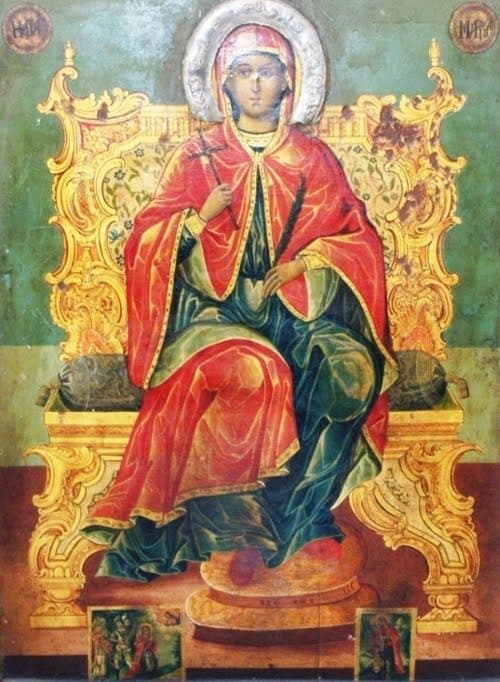
Marina of Antioch in Pisidia — Public domain. Via Wikimedia Commons.
Life
Marina — known in the Western tradition as Margaret (the two are the same saint; the East kept the original Greek name, the West the Latin variant for "pearl," her late translation) — was born around 285 in the city of Antioch in Pisidia (south-central Asia Minor, the small Roman town the apostle Paul evangelized on his first journey in Acts 13). Her father, Aedesius, was a senior pagan priest of one of the temples of the city. Her mother died very young — Marina was perhaps two years old — and her father gave the child to a Christian woman of the neighborhood to raise as a wet-nurse.
The wet-nurse, a widow living quietly in the country outside the city, raised Marina in the Christian faith. By the age of twelve Marina knew the principal teachings of the Church and had been baptized. Her father, when he discovered this on a return visit, was outraged and disowned her — though he allowed her to remain with her foster-mother rather than bring her under his own roof. She was raised through her teens as a shepherd-girl, tending her foster-mother's small flock of sheep.
In the summer of 304, the Diocletianic persecution reached Pisidia. Marina was perhaps fifteen years old. The local prefect of Antioch in Pisidia, a man named Olybrius (probably the Olybrius who later became Praetorian Prefect of the East), was passing through the country on his way to assize court at Antioch and stopped to admire a girl tending sheep in the meadow. He sent his attendants to bring her to him. Marina came willingly, knowing what was likely to happen.
The prefect asked her name and her family. She gave them honestly. He asked her religion. She said she was a Christian. He proposed to take her into his household; he offered to make her his wife if she would renounce Christianity. She refused. He had her taken under guard to the city and lodged with one of the matrons of his court.
The trial took place over several days in Antioch. The prefect ordered her hung up on a rack and beaten with rods. The blood flowed so freely that the executioners and the witnesses turned away. She was thrown into a dungeon with a single small window. In the dungeon she was confronted by a black dragon (the principal element of her iconography) which the sources interpret as the visible appearance of the devil come to terrify her. She made the sign of the Cross. The dragon swallowed her, but the Cross expanded inside the dragon and split it open; she emerged unharmed. A second demon appeared in the form of a man; she struck him with the chain her hands were bound with, and he fled.
The prefect ordered her to be burned with torches. She prayed; the torches went out. He ordered her drowned in a great vat of water; an earthquake shook the vat to pieces and the water flowed away. He had her beheaded. Some four hundred bystanders, witnessing the marvels at her death, came forward to confess Christ — and were beheaded with her on the same day. The total martyrdom is described in the early Greek sources as some four hundred fifty souls together.
Her body was claimed by the local Christian community and buried at Antioch in Pisidia. Her relics were translated to Constantinople in the seventh century and rest at the Pantokrator monastery. A substantial portion of her relics — and her head, more or less complete — has been at Monte Cassino in Italy since the medieval translation by the Lombard king Liutprand; her veneration in the Latin West was extraordinarily widespread in the Middle Ages, and her name (in the form Margaret, Marguerite, Margherita) became one of the most popular Christian women's names in every Latin country.
She is one of the Fourteen Holy Helpers of the Western tradition and one of the great-martyrs of the East. She is the patroness of expectant mothers (the dragon being a particular fear of childbirth in pre-modern thought, and her splitting of the dragon being read as the type of safe delivery), of nurses, and of the women who suffer particular persecution in the new age. She is also a saint of the dying — invoked at the moment of departure for the wisdom and courage she showed at her own end. Her feast is July 17 in the East (July 20 in the West).
Traditions
Feast day
July 17
Topics
Works in library