saint
St. Great-martyr Mercurius
Roman officer of Cappadocian origin under Decius and Valerian, who was beheaded for his confession of Christ. Centuries after his repose, his sword is said to have been used by the appearing of the Theotokos to slay Julian the Apostate at the gates of Caesarea.
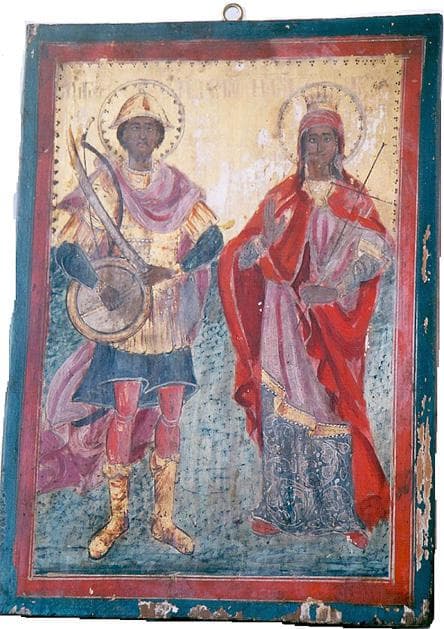
Mercurius — Public domain. Via Wikimedia Commons.
Life
Mercurius was born around 225 in the Roman frontier province of Cappadocia (north-central Asia Minor), to a Scythian Roman officer named Gordian — who served as a senior centurion in the Roman army on the eastern frontier — and a Cappadocian Christian mother whose name has not survived. The mixed Roman-barbarian background was common on the Roman eastern frontier; the family appears to have been Christian on both sides for at least one previous generation, though Gordian himself remained nominally pagan because of his military position.
Mercurius received the standard Roman officer's son education — Greek rhetoric, military drill, the basics of Latin administration — and enlisted in the Roman army at sixteen, around 241. He was assigned to the senior auxiliary regiment of his father's command, the Cohors Martensium, an elite cavalry unit that had served on the eastern frontier for several generations. He rose through the centurion ranks quickly; by his early twenties he was a tribune of cavalry, with a small command of about a hundred horsemen.
In 249 the Emperor Decius was campaigning against a Gothic invasion in the Roman Balkan provinces; the Cohors Martensium was transferred from the eastern frontier to the Danubian front for the major engagement at Beroe (modern Stara Zagora in Bulgaria). The battle of Beroe — a major Roman victory over the Goths — saw the twenty-four-year-old Mercurius distinguish himself in an unusually visible way: he led a cavalry counter-charge that broke the Gothic line and killed the Gothic chieftain Saluradius (or the variant Salvurades, sources differ).
The Emperor Decius personally promoted Mercurius to commander of his own elite bodyguard cavalry after the battle. The young Cappadocian was now a senior officer of the imperial guard, with a future of unlimited military promotion ahead of him.
The decisive event of his life took place at a victory feast at the imperial camp after Beroe. The Emperor ordered all his senior officers to offer sacrifice to the Roman gods of war for the victory. Mercurius — who had received the standard Christian catechesis from his mother as a child but had not yet been baptized — found himself unable to participate. He withdrew quietly from the feast.
That night the archangel Michael (the early Christian sources are explicit about which angel) appeared to him in his tent. The archangel told him that the victory had been God's gift and not the gift of the Roman gods, that Mercurius's withdrawal from the sacrifice had been the right action, and that he was to seek baptism and confess Christ openly. Mercurius found a Christian priest at the camp the next morning, was baptized, and within days had requested an audience with the Emperor to confess his faith publicly.
Decius, when he heard the request, was furious. He had personally promoted Mercurius after Beroe; he had publicly identified the young officer as his favorite. The defection felt to him as a personal political betrayal. He attempted to dissuade Mercurius privately at first, then through threats, then through systematic torture. The standard escalating tortures were applied over the course of about ten days: he was flogged, hung up on a rack, his sides burned with torches, his feet pierced with nails. He continued to confess.
Decius eventually ordered him beheaded. The execution was carried out at Caesarea in Cappadocia (Mercurius's home province, where the Emperor was passing through on his return to the east) on November 25, 250. Mercurius was twenty-five.
His body was recovered by the local Christian community of Caesarea and buried at the cathedral of the city. The cult of the saint spread rapidly across Cappadocia in the years following — partly because of his Cappadocian origin, partly because of the unusually circumstantial documentation of his case.
The most distinctive feature of his later cult is the so-called "death of Julian" tradition. About a century after Mercurius's death, the Emperor Julian the Apostate (361-363) was on the Persian frontier campaigning against the Sassanid Empire. On the night of June 26, 363, Julian was killed in battle by a spear-thrust from an unknown attacker — a strike that the official Roman sources could not satisfactorily explain (the Persians did not claim it; no Roman was identified as the killer). A few weeks later, at the cathedral of Caesarea, the people of the city visited the tomb of Mercurius; his armor and weapons (which had been preserved there as relics) were found wet with blood, and the spear was missing. Local tradition concluded that the saint himself, by divine commission, had returned to slay the Apostate.
His relics rest at the cathedral of Caesarea in Cappadocia (modern Kayseri), with portions at the Cathedral of Saint Mercurius in Coptic Old Cairo, at the monastery of Saint Mercurius at the Wadi Natrun in Egypt, and at a number of medieval Italian and Greek shrines. He is the patron of soldiers, particularly cavalry officers; of converts from pagan and post-Christian backgrounds; and of Christians who face the violent disapproval of secular authority that has previously favored them. His feast is November 24.
Traditions
Feast day
November 24
Topics
Works in library