saint
St. Martyr Sebastian of Rome
A young officer of the Praetorian Guard at the court of Diocletian who used his rank to encourage Christians awaiting martyrdom. Discovered, shot through with arrows, healed by the widow Irene, and at his recovery beaten to death with cudgels. Patron of soldiers and of those struck by plague.
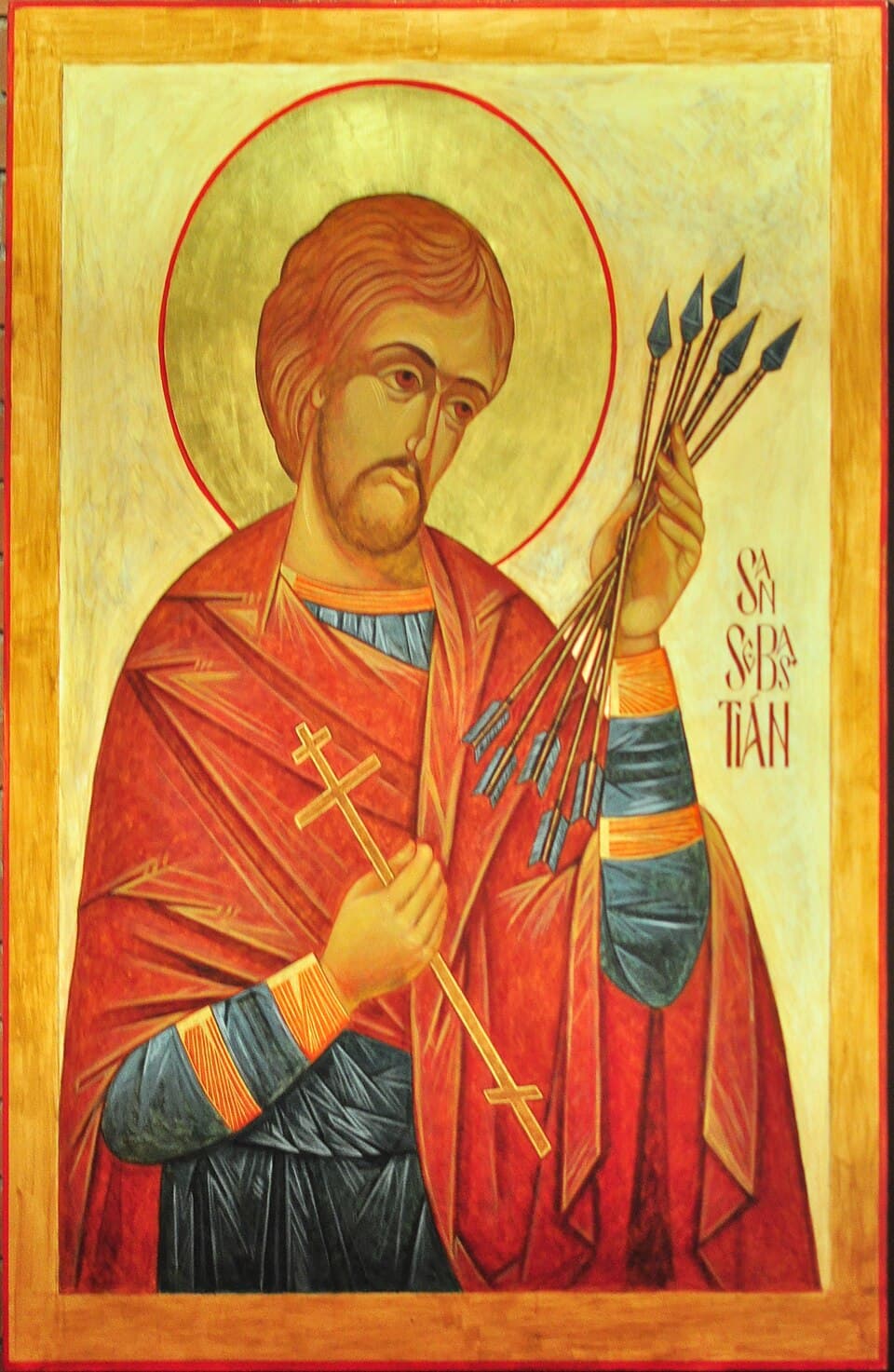
Sebastian of Rome — CC BY-SA 4.0. Joe Mabel. Via Wikimedia Commons.
Life
Sebastian was born around 256 in the southern Gaulish city of Narbonne (modern Narbonne in southern France), into a wealthy Gallo-Roman family of senatorial rank. His father was a Roman senator from Narbonne; his mother was a Milanese Roman noblewoman who had married into the family. The family had been Christian for at least a generation. Sebastian was educated at Milan from the age of about twelve and continued his higher studies at Rome.
He was perhaps twenty when he enlisted in the Roman army around 276 — an unusual choice for a senatorial son of his rank, who would normally have been expected to take up civil rather than military service. He was assigned to the imperial praetorian guard at Rome, the elite household troops of the emperor. He rose quickly through the centurion ranks; by 283, in his late twenties, he was a tribune of the praetorian cohort, one of the senior officers of the imperial guard.
His Christianity was, at this period, well-known to his immediate fellow officers but unknown to the Emperor. The Emperor at his promotion (Carinus, 283-285) and the next two Emperors (Diocletian and Maximian, who took power in 285) preferred to be uninformed of such matters as long as their officers continued the standard public sacrifices. Sebastian had developed a private practice of not participating in the sacrifices that fell to his official duties — he would assign other officers to perform them in his place. The arrangement worked for over a decade.
His distinctive Christian ministry during these years was the support of the prisoners of the Diocletianic persecution. From 287 onward — the early stages of what would become the major persecution of 303-305 — Sebastian visited the Christian prisoners of Rome at the Mamertine and other imperial prisons, brought them food and the consolation of the Liturgy (he had been instructed by the bishop of Rome to bring the consecrated elements to the imprisoned Christians who could not get to the Eucharist), and on occasion bribed the guards for their release. The arrangement worked because Sebastian's rank and his rank gave him access to the prisons that no civilian could match.
The most famous incident of this period is recorded in his late-fourth-century Acts. Sebastian was visiting two Christian prisoners at the Mamertine — the brothers Mark and Marcellinus, twin sons of a wealthy Roman family who had been arrested for refusing the imperial sacrifice — at the moment when the brothers' family had come to plead with them for an apparent compromise. The mother of the brothers was begging them to recant and save their lives; the father was making the same plea in more political terms; the brothers were wavering. Sebastian, entering the prison cell, gave a long extempore exhortation to the brothers (preserved in the surviving Acts as one of the most striking specimens of late-Roman Christian rhetoric) that strengthened them in their confession. They were beheaded.
Sebastian was eventually denounced to the Emperor Diocletian in 286 — perhaps by someone who had recognized him at the Mamertine, perhaps as part of a more general purge of suspected Christians from the imperial guard. Diocletian summoned him and confronted him personally. Sebastian confessed his Christianity openly. Diocletian, who had personally favored him, was outraged by what he saw as personal disloyalty. He ordered Sebastian stripped, tied to a post in the campus Martius (the great drill-field of the Roman army, north of the Roman forum), and shot through with arrows by a squad of Mauretanian archers.
The archers shot him with such thoroughness that the surviving Acts say he looked like a hedgehog. He was left for dead. The Christian widow Irene (wife of one of the martyred Mark and Marcellinus's brothers, who had been killed earlier) came to claim the body for burial that night, and found him still breathing. She took him to her house, nursed him secretly for several weeks, and he recovered.
When he was strong enough to walk, Sebastian sought a second public audience with the Emperor — a deliberate decision to provoke the second martyrdom. He stood at the steps of the imperial palace and called out a public denunciation of Diocletian's persecution. Diocletian, who had believed him dead, took the second appearance as a personal insult; he ordered Sebastian seized on the spot and beaten to death with cudgels in the campus Martius. His body was thrown into the Cloaca Maxima, the great sewer that drained the Roman forum into the Tiber.
His body was recovered by the Christian widow Lucina (a different Lucina than the famous matron of the same name) and buried in the catacombs on the Appian Way (the modern Catacombs of San Sebastiano). The catacomb church built over his tomb in the fourth century became one of the seven major basilicas of medieval Rome.
His relics rest at the Basilica of San Sebastiano fuori le mura on the Appian Way, with substantial portions at Soissons in France (a Carolingian translation), at the cathedral of Ebersberg in Bavaria, and at many smaller Italian and Spanish shrines. He is the patron of soldiers (the praetorian guard was the senior Roman military unit), of archers (for the manner of his first death-attempt), of athletes (the campus Martius was the drill-field of the Roman army), of plague victims (since the arrow-imagery of his iconography was associated with the late medieval understanding of plague as God's arrows), and of every Christian who has continued in dangerous ministry under cover of an official position. His feast is December 18 in the East (and January 20 in the West).
Traditions
Feast day
December 18
Topics
Works in library