saint
St. Mary Magdalene, Equal-to-the-Apostles
She from whom the Lord cast out seven demons, who followed Him from Galilee to the Cross and stood with His mother at the foot of the wood. She came first to the empty tomb in the dim morning and was the first to whom the risen Christ appeared, sent by Him with the word: 'Go to my brethren.' Tradition takes her to Ephesus with the apostle John in her old age.
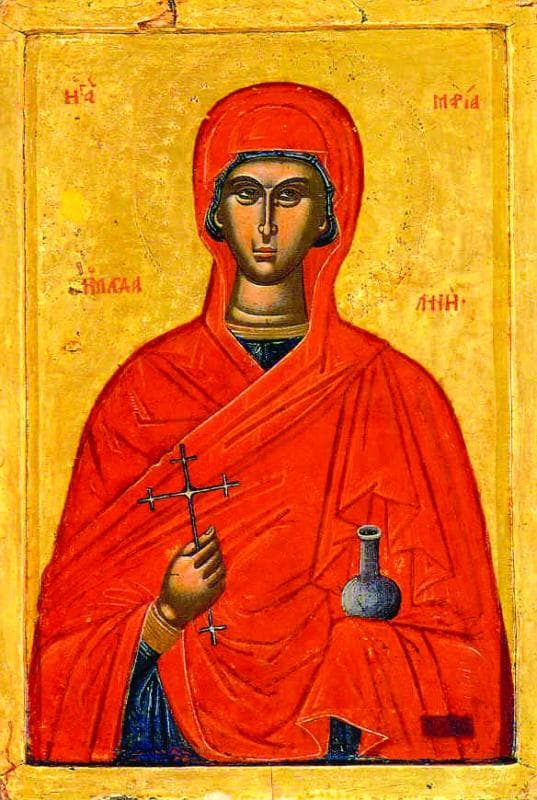
Saint Mary Magdalene — Public domain. Via Wikimedia Commons.
Life
Mary of Magdala was a woman of Galilee from the prosperous fishing town on the western shore of the Sea of Tiberias. The Gospels say the Lord cast out of her seven demons, after which she followed Him with a number of other women who ministered to Him and the Twelve out of their own means.
She stood at the foot of the Cross with the Mother of God and the disciple John, when the rest of the Twelve had scattered. With Joseph of Arimathea and Nicodemus she saw where the body was laid. And on the morning of the Resurrection, while it was yet dark, she came first to the tomb — found the stone rolled away, ran to Peter and John, and afterward returned to weep alone outside. The risen Lord stood beside her there in the garden and called her by name. She mistook Him at first for the gardener; at His "Mary!" she knew Him, and turned to embrace His feet. But He sent her with the message that has earned her the title Equal-to-the-Apostles: "Go to my brethren and say to them, I ascend unto My Father and your Father, and to My God and your God."
She was thus the first witness of the Resurrection and the first to proclaim it to the apostles. Tradition takes her afterward to Ephesus with the Theotokos and the apostle John, where she labored until her repose. Other Western traditions place her later in Gaul, but the Eastern Church reckons Ephesus as her resting place, from which Emperor Leo VI translated her relics to Constantinople in the ninth century.
A persistent later legend attaches to her name: standing before Emperor Tiberius she greeted him with a red egg in her hand as a sign of the Resurrection — the origin of the Paschal custom of dyeing eggs red and of her constant iconographic attribute. The Church remembers her on July 22 and again on the Sunday of the Myrrh-bearing Women, the third Sunday of Pascha.
Traditions
Feast day
July 22
Topics
Works in library