saint
St. Mary of Egypt
An Alexandrian dancer and prostitute who, halted by an invisible hand at the doors of the Holy Sepulchre in Jerusalem, was given the Mother of God for her teacher and went out across the Jordan into the wilderness, where she lived forty-seven years in penitence. Found by the priest Zosimas in her old age, she received communion from him and was buried by a lion at her cell.
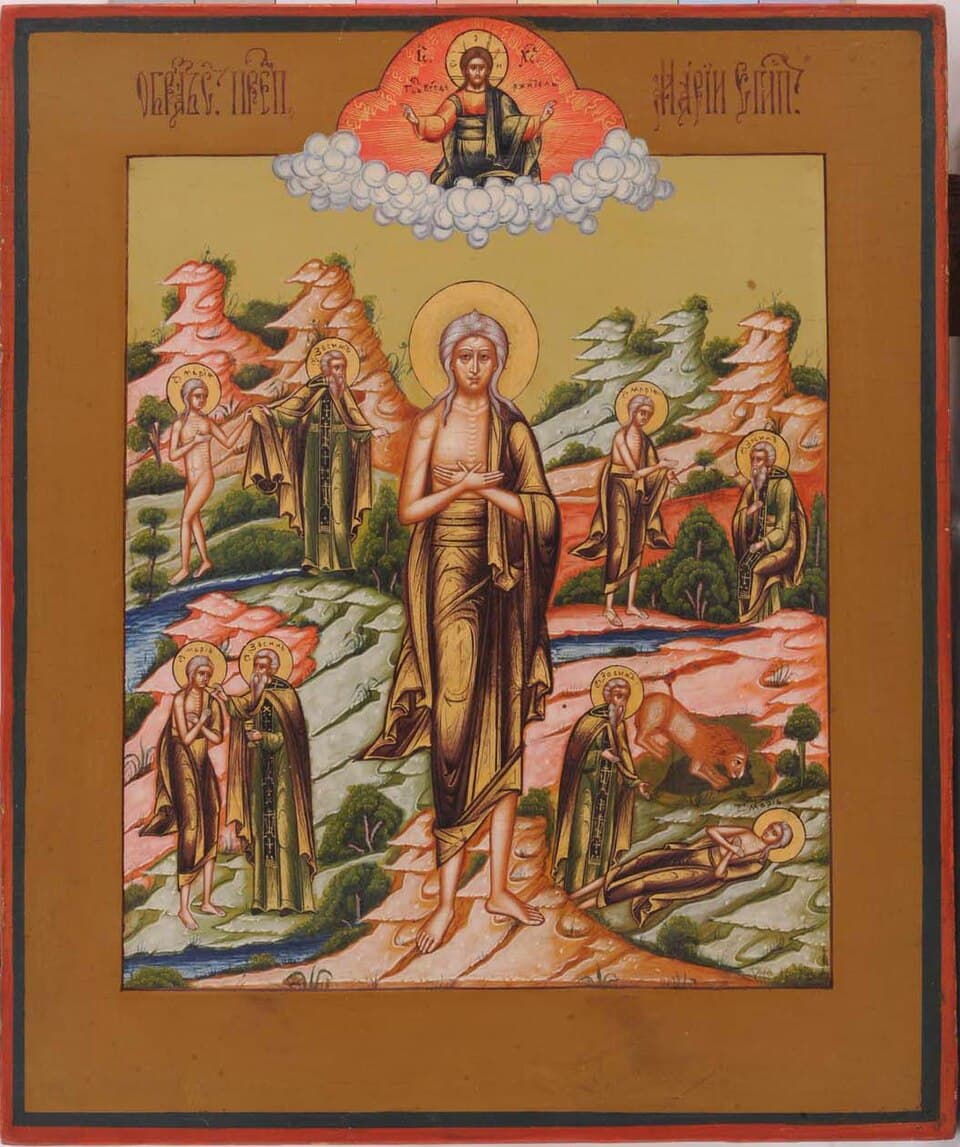
Saint Mary of Egypt — Public domain. Russian (Mstera). Via Wikimedia Commons.
Life
Mary was born in Egypt around 344. At twelve she ran away from home to Alexandria and lived there for the next seventeen years as a public woman. Her own account — the one she gave at the end of her life to the priest Zosimas who found her in the desert — does not soften this. She refused payment because she found pleasure in the trade itself; she lived on the gleanings of others' fields and on what men brought her.
In the seventeenth year of this life she saw at the harbor of Alexandria a great party of pilgrims boarding ship for the feast of the Exaltation of the Cross at Jerusalem. On impulse she went with them. She paid for her passage in the only currency she had: along the voyage, and through the streets of Jerusalem after they landed, she gave herself to as many of the men of the company as wished to receive her.
On the morning of the feast at the Holy Sepulchre she went with the crowd to enter the basilica. At the door an unseen hand stopped her. Three times she pressed forward, and three times she was held back, as if by a wall. The other pilgrims passed her on both sides as she stood there frozen. Suddenly she understood, and looking up at an icon of the Theotokos by the door she made the vow that turned her life: "If I may but enter and venerate the Cross, I will go where you send me." The wall lifted. She venerated the Cross, came out, and obeyed.
She bought three small loaves at the market, walked out of Jerusalem and across the Jordan, and disappeared into the wilderness east of the river. She lived there forty-seven years. The first seventeen, she said, were a constant warfare with the passions of her former life — the songs she could not stop hearing, the foods she could not stop wanting — until grace at last took them from her one by one. The three loaves lasted until they were stones. Afterward she lived on what the desert grew. Her clothes wore away. Her hair grew long.
Toward the end of her life the priest Zosimas of a Palestinian monastery, who had been led by the Holy Spirit to spend the Great Fast in the desert beyond the Jordan, met her. He saw her at a distance — naked, dark from the sun, hair white. He pursued her; she fled, then stopped and asked him to throw her his cloak so they might speak. She knew his name and his life without ever having met him. She made him swear that the next year, on Holy Thursday, he would return with the reserved Body and Blood of the Lord. He did. They met on the Jordan's bank; she walked across the water to him to receive the Mysteries; she sent him away.
A year later, returning at her instruction, he found her body lying on the sand exactly where she had received the Sacrament. The earth refused his shovel; a lion came out of the desert and dug her grave. She had given the year of her own death in her speech to him, and the Lord had revealed it to her: she had died in the night within hours of receiving Communion.
The Church reads her Life in full at the long Matins of the fifth week of Great Lent — the only saint other than the Lord whose life is read in that way during Lent — and gives her two feasts: April 1 (her repose) and the Fifth Sunday of Great Lent, which is named for her. She is the great icon of repentance.
Traditions
Feast day
April 1 and the Fifth Sunday of Great Lent
Topics
Works in library