father
St. Maximus the Confessor
Monk of Chrysopolis and the great theologian of the cosmic Christ, whose long defense of the two wills of Christ against the monothelites cost him his tongue, his right hand, and finally his life in exile in Lazica. His Ambigua and Ad Thalassium are the heart of mature Byzantine theology.
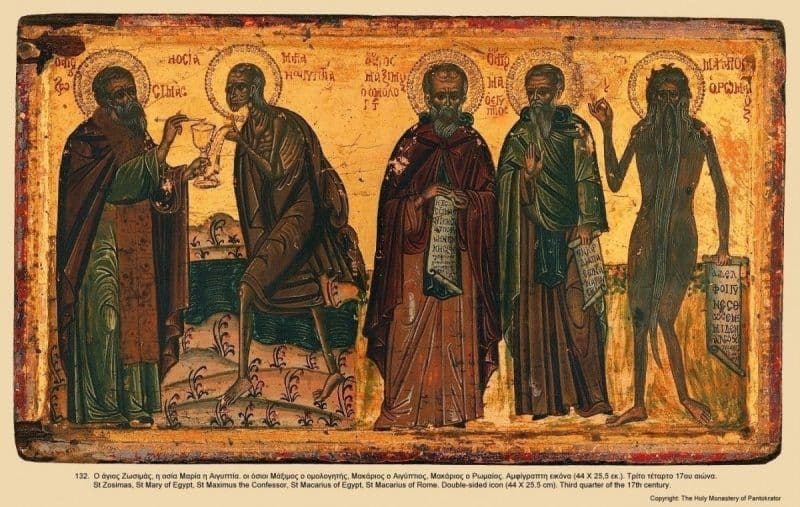
Maximus the Confessor — CC BY-SA 4.0. Hrom.nv. Via Wikimedia Commons.
Life
Maximus was born around 580 in Constantinople, into a noble Greek family of the imperial city. He received the full classical education of an aristocratic Byzantine — rhetoric, philosophy, mathematics, theology — and entered the civil service under Emperor Heraclius. By his early thirties he was first secretary to the emperor himself, one of the highest civilian offices of the empire.
Around 614, at the height of his career, he left it. He took monastic vows at the small monastery of Chrysopolis (across the Bosphorus from the capital) and within a few years was its abbot. The Persian invasions of the 620s drove him out; he wandered as a refugee through Crete, Cyprus, and finally Carthage in North Africa, where he lived for two decades in the monastery of Eucratas near the city.
His writing through these years — the Ambigua, the Ad Thalassium, the Mystagogy, the Capita on Love — built the full Byzantine synthesis of the East's theological inheritance. Maximus reads the cosmos as a vast hierarchy of "logoi," each created being a small word held within the great Logos, the eternal Word who is Christ. The goal of human life is theosis: through the will, freely conformed to the will of Christ, the human person ascends into deifying union with God.
In 645 the doctrine of the single will of Christ — "monothelitism" — was being promoted by the imperial court at Constantinople as a compromise to win back the monophysite churches of Egypt and Syria. Maximus saw in it a denial of Christ's true humanity, since to be human is to will humanly. At a public debate in Carthage in July 645 he confounded the patriarch of Constantinople, Pyrrhus; the African councils of 646 followed him into orthodoxy. He came up to Rome in 649 and persuaded Pope Martin to convene the Lateran council of that year, which formally condemned monothelitism.
For this the imperial police came for them both. Maximus was arrested in 653, brought to Constantinople, tried, and after years of imprisonment and exile, exiled finally to Lazica on the Black Sea. There — at the age of eighty-two — his right hand was struck off and his tongue cut out by order of the emperor, so he could neither write nor speak the truth he had defended. He died in his cell at the fortress of Schemarum on August 13, 662. The doctrine he had given his life for was vindicated at the Sixth Ecumenical Council in 681.
Traditions
Feast day
January 21
Topics
Works in library
Readings and commentaries
Book of Difficulties
Catena
Catena Aurea by Aquinas
Chapters on Knowledge
Questions to Thalassium
The Four Hundred Chapters on Love
The Lord's Prayer
Untitled commentary
Various Texts on Theology, First Century
Ambigua to Thomas and Second Letter to Thomas
Maximus's earliest set of Ambigua — five 'difficulties' (ambigua) addressed to Abba Thomas, treating cruxes in the theology of St. Gregory Nazianzen and St. Dionysius the Areopagite. The Second Letter to Thomas, appended in this edition, returns to the same Christological themes after the Monothelite controversy had begun. Distinguished from the longer and later Ambigua to John (CPG 7705a). The earliest substantial work of Maximus's mature theological synthesis.
Four Hundred Texts on Love
Maximus the Confessor · Four Hundred Texts on Love — as included in the Philokalia.
A Brief Interpretation of the Lord's Prayer Written for a Certain Friend of God (Written for Thalassios)
Maximus the Confessor · A Brief Interpretation of the Lord's Prayer Written for a Certain Friend of God (Written for Thalassios) — as included in the Philokalia.
Two Hundred Texts on Theology and the Incarnate Dispensation of the Son of God
Maximus the Confessor · Two Hundred Texts on Theology and the Incarnate Dispensation of the Son of God — as included in the Philokalia.
Various Texts on Theology, the Divine Economy, and Virtue and Vice (Five Centuries)
Maximus the Confessor · Various Texts on Theology, the Divine Economy, and Virtue and Vice (Five Centuries) — as included in the Philokalia.
Maximus the Confessor — Introductory Note (Philokalia)
Editorial introduction to the Philokalic selections of Maximus the Confessor.