father
St. Maximus the Greek
A Greek humanist of Mount Athos invited to Moscow by Vasili III to correct the Russian liturgical books, who for the rest of his life remained in Russia — much of it in unjust imprisonment — translating, writing, and witnessing to learning. The bridge between the Byzantine and Russian intellectual worlds.
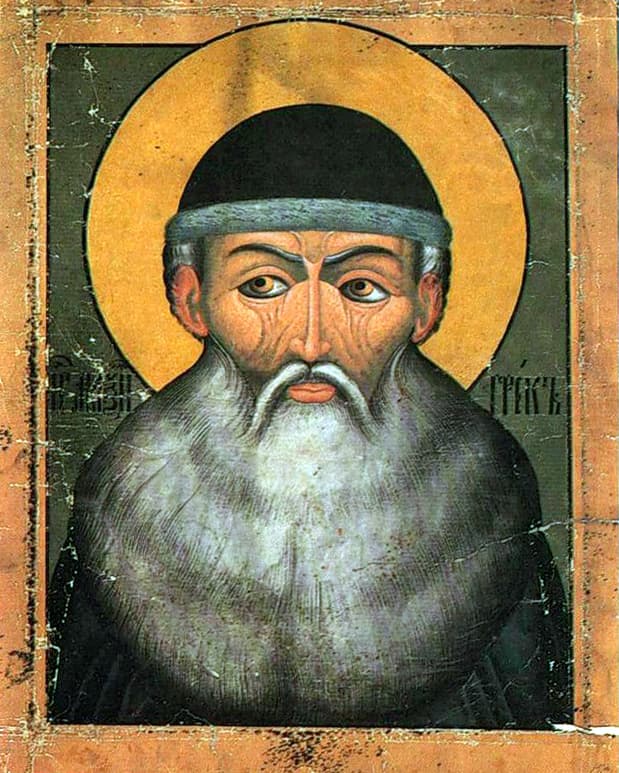
Maximus the Greek — Public domain. Via Wikimedia Commons.
Life
Michael Trivolis was born around 1475 in the small Greek town of Arta in Epirus (northwestern Greece, then under Ottoman rule), into a noble Byzantine Greek family that had relocated to Epirus after the fall of Constantinople in 1453. His father, Manuel Trivolis, was a senior provincial administrator of moderate wealth; the family had served the late Byzantine imperial system and continued to serve in administrative posts under the Ottoman administration. Michael was educated at home in the standard upper-class Greek curriculum, then sent at fifteen to Venice for higher studies in the Greek diaspora schools of the Italian Renaissance.
He spent his next thirteen years in northern Italy (1490-1503). He studied at Padua, Florence, Bologna, Ferrara, and Milan in succession — the standard itinerant pattern of an Italian Renaissance scholar. He learned Latin and Italian to a working facility; he attended the Florence salons of the late Medici period (he saw Savonarola preach in 1497 at age twenty-two — an experience he would refer to in his later Russian writings); he met Aldus Manutius, the great Venetian Greek printer; he became fluent in the Latin and Greek classical poetry and oratory.
He returned to the Greek east in 1503 at twenty-eight and entered monastic life at the Vatopedi Monastery on Mount Athos. He took the monastic name Maximus (after the seventh-century theologian Maximus the Confessor, whose works he had read with particular care in Italy). He spent the next twelve years at Vatopedi (1503-1515) as a monk of the strictest discipline, with extensive scholarly work on the Greek patristic manuscripts of the Vatopedi library — one of the most substantial collections of unpublished Greek patristic texts in the Christian world at the time.
The decisive event of his life came in 1515. The Grand Prince Basil III of Moscow had written to the Patriarch of Constantinople (the Russian Church was still nominally under Constantinopolitan jurisdiction at the time, before the establishment of the Moscow patriarchate in 1589) requesting the dispatch of a senior Greek monk to Moscow for the work of correcting the Russian liturgical books. The Russian liturgical translations from Greek had accumulated errors over the centuries of Russian isolation; the Russian Church wanted them brought back into alignment with the standard Greek versions. The Patriarch chose Maximus.
Maximus arrived at Moscow in 1518 at forty-three. He had been told that the assignment would last perhaps two or three years; he expected to return to Vatopedi. He spent the rest of his life in Russia — forty-eight years more, mostly in various forms of imprisonment, never to return to the Greek lands.
The first six years (1518-1525) were the productive ones. Maximus established a small scholarly workshop at the Chudov Monastery in the Moscow Kremlin, with a team of Russian translators. He directed the systematic comparison of the Russian Slavonic liturgical books with the corresponding Greek originals; he produced corrected versions of the Triodion, the Pentecostarion, and substantial portions of the Menaion and the Apostle. He also wrote a series of original works in his correctly-classical Greek (which was then translated into Russian by his team): commentaries on Scripture, polemical works against the Roman Catholics and against Judaizing tendencies in the Russian Church, pastoral letters, theological treatises.
The trouble began in 1525. The Grand Prince Basil III was attempting to divorce his first wife Solomonia Saburova (who had borne him no children) and remarry the Lithuanian Helena Glinskaya. The Russian Church was deeply divided on the question; the official position was that divorce for childlessness was canonically forbidden. Maximus — when his opinion was solicited — gave the Greek canonical answer firmly: the divorce was not permissible.
Basil's response was swift. Maximus was arrested in 1525 on fabricated charges of heresy (the practical charge was that his translation-corrections had introduced theological errors; the political charge was his opposition to the divorce). He was tried by a synod of compliant Russian hierarchs, condemned, defrocked, and confined to the Volokolamsk Monastery — a strict monastic prison for the rest of his life. He was forty-eight.
He spent the next forty years in confinement. The first decade (1525-1535) was at Volokolamsk under particularly strict conditions: he was forbidden to write, to receive visitors, to attend the public church services of the monastery. He was eventually allowed to continue writing in the 1530s; the restrictions were further relaxed under the regency of Helena Glinskaya (the very woman whose marriage he had opposed, who became surprisingly sympathetic to him in her widowhood) after Basil's death in 1533.
In 1551 he was transferred to the Trinity-Sergius Lavra near Moscow under much improved conditions. The new ruler — the young Ivan IV (the future Ivan the Terrible), then in his more moderate early phase — recognized that the elderly Greek monk was no political threat and could be useful to the Russian Church's scholarly work. Maximus spent his last fifteen years (1551-1566) at the Lavra in a productive scholarly retirement, with access to the great Lavra library and a circle of younger Russian disciples.
He produced through these years a substantial body of original Russian-language theological writing: the "Confession of Faith" (his summary statement of Orthodox doctrine), the long treatises against the Latin Church and against the new astrological-Renaissance tendencies in the Russian noble culture, the pastoral letters to a wide range of Russian correspondents, and the great body of translations of Greek patristic texts that he produced in his final years.
He reposed at the Trinity-Sergius Lavra on January 21, 1556 (he was about eighty-one). He was buried at the Lavra. His relics — which had been continuously venerated at the Lavra as those of a holy elder despite his never having been formally canonized — were finally formally glorified by the Russian Orthodox Church at the Council of 1988 (the millennium of the baptism of Rus'). They rest in a shrine at the Lavra's Dormition Cathedral, where they have been continuously visible to pilgrims since the late sixteenth century.
He is the patron of Greek scholars working in foreign Christian traditions, of monks held in monastic imprisonment, of translators of liturgical texts, of those persecuted for telling religious truths inconvenient to the state, and of every Russian Christian who has carried the Greek patristic tradition into the Russian world. His feast is January 21.
Traditions
Feast day
January 21
Topics
Works in library