saint
Great-martyr Menas of Egypt
Egyptian officer in the Roman army who laid down his rank, withdrew into the desert for years of prayer, and then returned to the festival at Cotyaeum to proclaim Christ before the crowd; beheaded under Diocletian, his shrine in Egypt became one of the most visited healing sanctuaries of the ancient world.
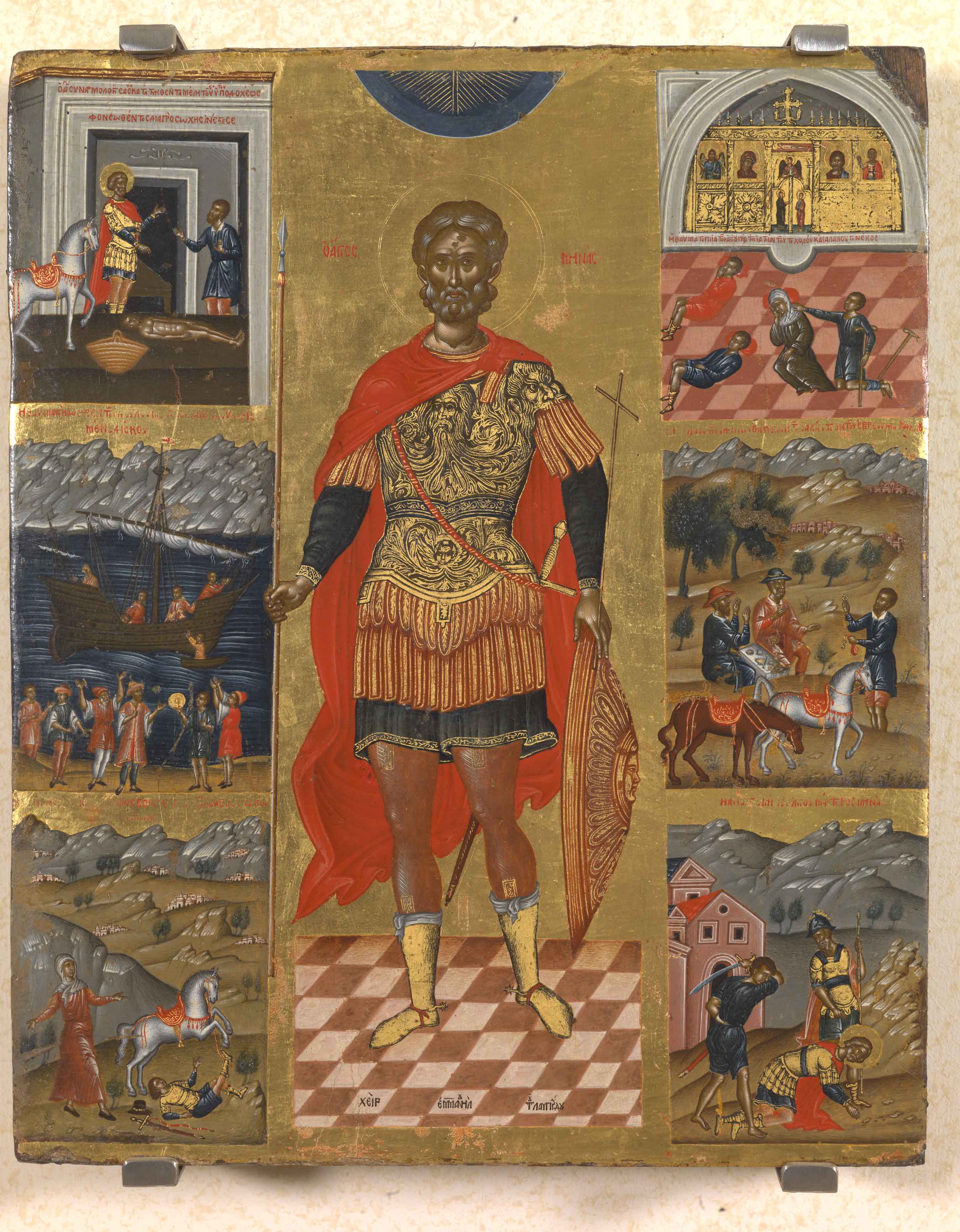
Great-martyr Menas of Egypt — Hand-curated icon.
Life
Menas was a Roman officer of the imperial guard at Cotyaeum in Phrygia (modern Kütahya in Turkey) at the outbreak of the Diocletianic persecution in 303 — an Egyptian Greek by birth, raised in the faith, who had concealed his Christianity during his military service. When the imperial edict went out, Menas left the army, withdrew into the desert to pray and fast, and after a period of solitude came back into the city of Cotyaeum at the height of a great pagan festival and confessed Christ publicly in the marketplace.
He was arrested at once and brought before the governor Pyrrhus. The synaxarion records that the governor offered him every inducement — the restoration of his rank, advancement, wealth — and on his refusal applied a sequence of torments that mounted in severity over the course of many days. Menas was scourged, hung from a wooden rack, his body torn with iron combs, set on fire. At last he was beheaded.
A Christian Egyptian merchant retrieved his body and brought it back to Egypt, burying it in the western desert near Alexandria. The shrine that grew up around the tomb — Abu Mena — became one of the most-visited pilgrimage sites of the Christian East from the fourth through the seventh centuries, famed throughout the Mediterranean for the small terracotta flasks of holy oil that pilgrims carried home as healing tokens. His feast is kept on November 11.
Traditions
Feast day
November 11
Topics
Works in library