saint
St. Methodius, Equal-to-the-Apostles
The elder of the brothers from Thessalonica, monk and bishop, who continued the mission to the Slavs after the early repose of his brother Cyril and completed the translation of the Scriptures. The fruit of his labor is the entire Slavic Orthodox world.
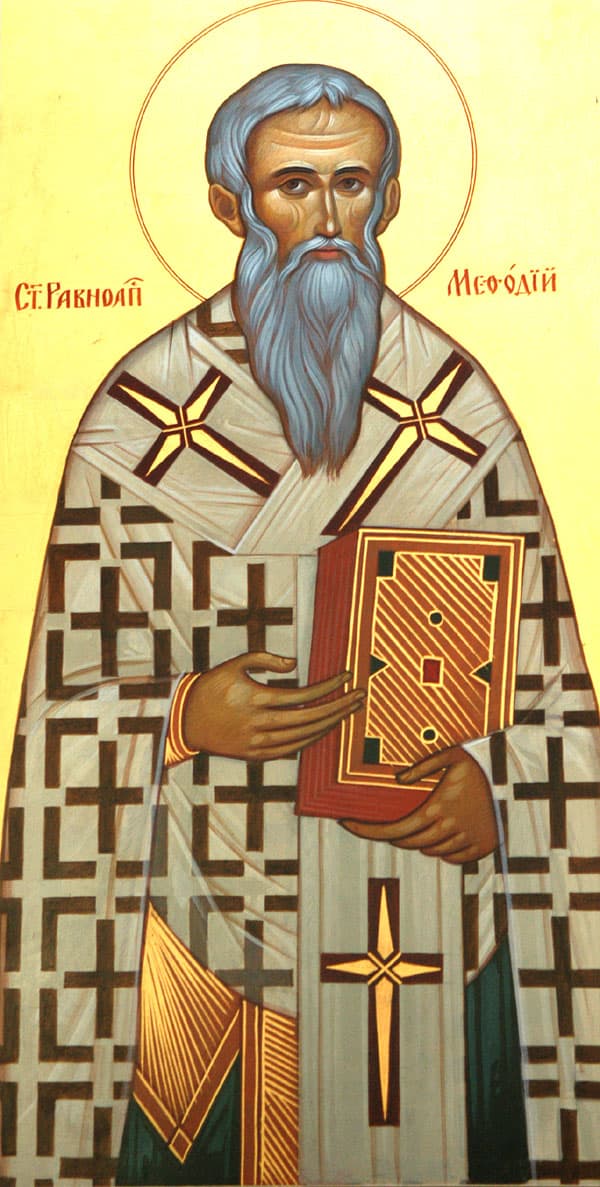
Methodius, Equal-to-the-Apostles — Hand-curated icon.
Life
Methodius was born around 815 in Thessalonica, the eldest son of the seven children of the imperial officer Leo, perhaps drungarios (regional military governor) of the Slavic-Greek border lands. He grew up bilingual in Greek and the Slavic spoken in the city's hinterland, and around 840 entered imperial service as governor of a Slavic principality somewhere in northern Greece — a posting he held for about ten years.
Around 850, weary of administration, he resigned his governorship and entered a monastery on Mount Olympus in Bithynia (across the Sea of Marmara from Constantinople) as a simple monk. His younger brother Cyril joined him there in 856. From the monastery the two of them were sent in 860 by Patriarch Photios on the mission to the Khazars — a Turkic kaganate north of the Caucasus that had adopted Judaism — where Cyril held the famous debate at the khan's court.
In 863 the brothers were sent again together — this time to Great Moravia, where Prince Rastislav had asked Constantinople for missionaries who could preach to his Slavic people in their own tongue. Cyril prepared the Glagolitic alphabet; the two of them translated the Gospels and the principal liturgical services into Slavonic, and arrived in Moravia together. They labored there for three and a half years.
In 868 they went down to Rome to defend their Slavonic liturgy against the German bishops' protests; Pope Adrian II approved it. Cyril fell ill at Rome and died in February 869. Methodius was sent back alone to Pannonia as archbishop of the Slavic mission — but immediately fell into the hands of the German bishops of Salzburg, who tried, deposed, and imprisoned him for two and a half years at the abbey of Ellwangen. Released by direct papal intervention in 873, he returned to Moravia and served as archbishop for another twelve years.
His enemies were unrelenting. When he died in 885 the Slavic liturgy was suppressed in Moravia within months, and his disciples — Clement, Naum, Angelarius, and others — fled south. The mission they founded next, among the Bulgarians, became the seed of all Slavic Orthodox Christianity. The brothers' alphabet was further developed by their disciple Clement of Ohrid into what is now called Cyrillic, after Methodius's younger brother whose name it bears.
Traditions
Feast day
May 11
Topics
Works in library