saint
St. Moses the Hungarian of the Kiev Caves
A Russian taken to Poland after the murder of his master Boris, where a noblewoman tried to force him into marriage. He suffered castration and beating rather than be unchaste, and ended his life as a monk of the Kiev Caves. Patron of those struggling against impurity.
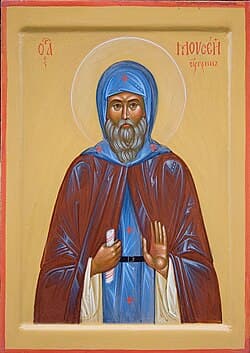
Saint Moses the Hungarian — Hand-curated icon.
Life
Moses was born around 985 in the territory of the Kievan Rus' principality of Polotsk (now in northern Belarus), into a Russian boyar family of moderate means. He was the youngest of three brothers, all destined for the Russian princely service. The eldest brother, George, was the chief steward of the young prince Boris Vladimirovich (son of St. Vladimir of Kiev and brother of Boris and Gleb); the middle brother, Ephraim, served at Boris's court as well; Moses, the youngest, was a member of Boris's bodyguard.
In 1015 the death of St. Vladimir triggered the civil war between his sons. Sviatopolk, the eldest, attempted to seize the throne by murdering his three younger brothers in succession. Boris was the first to fall, ambushed by Sviatopolk's hired killers on the bank of the Alta River south of Kiev on July 24, 1015. Moses's eldest brother George was at Boris's side and was killed alongside him; Sviatopolk's men beheaded George specifically because he refused to give up the gold chain (a gift from Boris) that he wore around his neck. They could not get the chain off without removing the head.
Moses, who had been on a separate errand at the time of the ambush, returned to find the camp slaughtered and his brother dead. He fled north, eventually reaching the territory of King Bolesław I of Poland — then a refuge for Russian noble exiles. He was taken captive almost immediately at the Polish border by Polish royal officials who recognized him as a Russian boyar of value. He spent the next five years as a prisoner-slave at the Polish royal court, where he was held in chains at a country estate.
The decisive event of his life came when he was about thirty-five (around 1020). The noble widow who owned the estate at which Moses was held — a powerful and wealthy Polish noblewoman named Mathilda, related to the royal Piast dynasty — became attached to him. The Russian sources describe her as a woman of "great beauty and high ambition" who decided that Moses should become her husband. The position was actually advantageous for him: he would gain freedom, wealth, royal connections, the standing of a Polish nobleman, and an apparent escape from his Russian disasters.
He refused. He explained to her that he had vowed perpetual chastity at his captivity (the surviving Russian sources are vague about whether this had been a formal monastic-style vow or simply a personal commitment), that he would not abandon his Russian Orthodox faith for a Polish marriage, and that he intended (if he survived) to enter monastic life. She tried persuasion, then offers of wealth, then progressive coercion. The records give a long account of the escalating pressure: confinement to a single room, the withdrawal of food, the systematic application of physical pressure, eventually open beatings.
The breaking point came when Mathilda — having exhausted her own resources — arranged with the local Polish bishop for Moses to be forcibly tonsured a Polish-rite priest (which would have made the marriage canonically possible and politically expedient). At this point Moses learned that an Athonite hieromonk was at the Polish court on some unrelated diplomatic business. He arranged for the hieromonk to tonsure him secretly as an Orthodox monk, with the name Moses (after Moses the Black, the great Egyptian penitent). The tonsure was completed in a single brief ceremony in his locked room.
Mathilda, when she discovered it, was incandescent. She ordered him stripped, tied, and castrated — a deliberate act of revenge for the loss of the marriage. The castration was performed brutally and incompletely; Moses nearly bled to death. He was eventually rescued by a Russian merchant traveling through Poland, who recognized him as the brother of George (whose murder by Sviatopolk's men was widely known) and bought him out of his bondage. The merchant transported him back to Kiev.
He arrived in Kiev around 1020 in very poor health. He went to the Kiev Caves Lavra, then a young community under the elder Anthony, and was received into the monastery to spend the rest of his life in the desert he had been seeking for two decades. He served at the Lavra for the next twenty-three years (1020-1043) as a monk of the strictest discipline. He was particularly attentive to fellow monks struggling against impurity; his own physical state made him, in the Russian tradition, the patron of those wrestling against carnal temptation. He gave away food, clothing, and the few possessions of his old life; he kept the cell-discipline of the Caves; he wrote (or dictated) a brief autobiographical narrative that has been preserved in the Russian Lavra archives.
He reposed at the Kiev Caves Lavra on July 26, 1043, at fifty-eight. He was buried in the Far Caves of the Lavra, where his relics still rest (the Caves having survived intact through all subsequent occupations of Kiev). He was glorified locally at the Lavra almost immediately and was canonized by the Russian Church as a saint of the entire Russian metropolitanate in 1163. He is the patron of those struggling against impurity, of those held under physical or political coercion, and of every Russian who has been broken by the violence of foreign captivity. His feast is July 26.
Traditions
Feast day
July 26
Topics
Works in library