saint
St. Moses the Black of Scetis
A formerly Ethiopian highway robber who in repentance fled to the Scetis desert, struggled long under the guidance of Macarius, and became a priest whose meekness drew his own former companions to Christ. The icon of every late conversion.
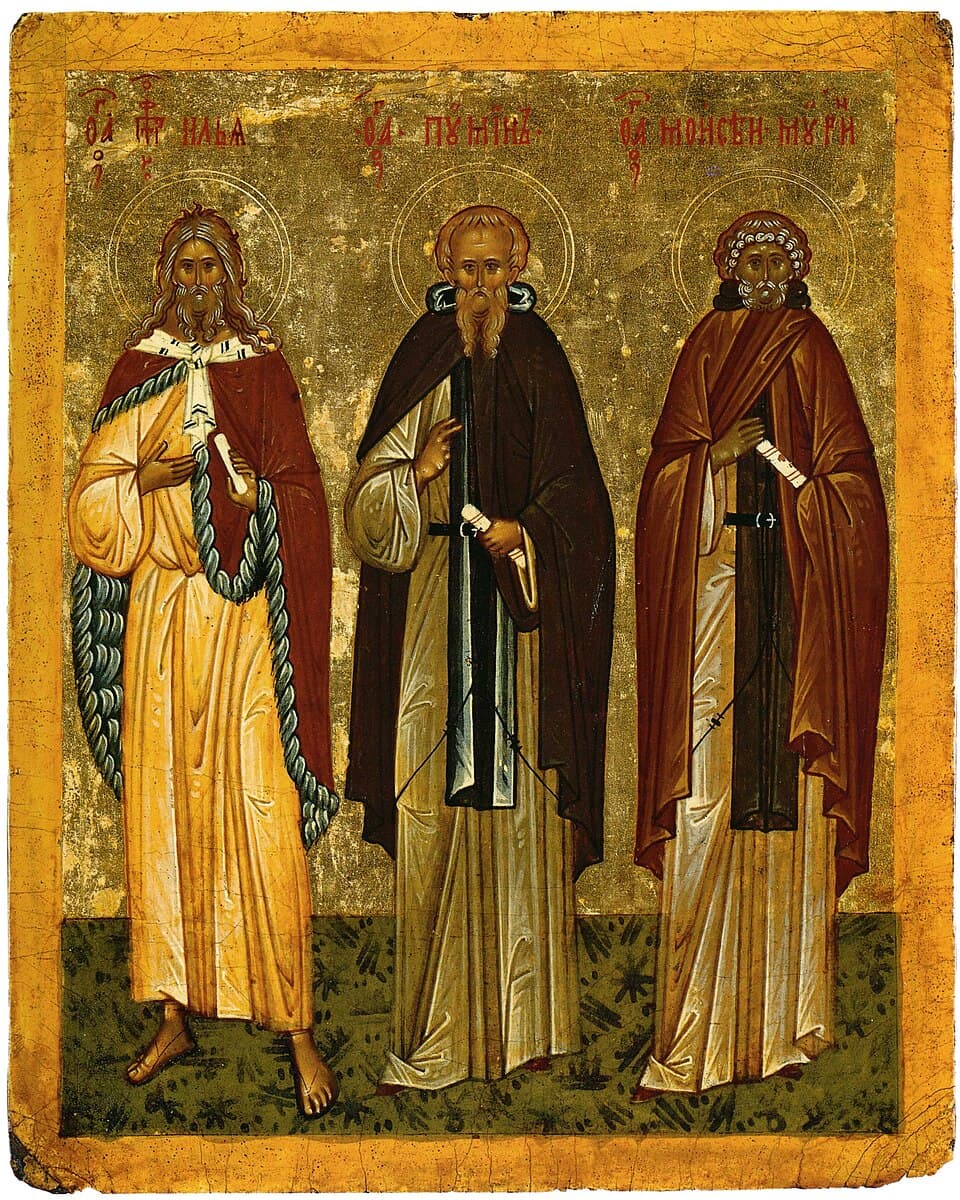
Saint Moses the Black — Public domain. Via Wikimedia Commons.
Life
Moses was born around 330 in the country of the Ethiopians — by which the late Roman sources mean the region of modern Sudan and the upper Nile, the lands south of the Roman frontier of Egypt. He was a man of remarkable physical strength and great height, and was sold into slavery in his youth in Lower Egypt. He served as a household slave to a magistrate in the Egyptian Delta but was dismissed (the sources say expelled) for theft and probably for a more serious crime — perhaps murder.
He became the leader of a gang of robbers operating along the western edge of the Nile Delta. The gang numbered seventy-six men by some accounts; Moses was their captain through perhaps twenty years. He was infamous across the province for the cruelty of his raids and the size of the ransoms he demanded. Several attempts by the local Roman authorities to capture him failed; he killed the soldiers sent against him with little difficulty. Once, hearing a watchdog warn his band of an approaching threat, he swam across the Nile with a knife in his teeth and slaughtered the dog's owner in retaliation.
The decisive turn came when the band was scattered after an unsuccessful raid; Moses, fleeing alone, took refuge with a community of monks in the desert of Scetis. He had heard of the elder Macarius the Great and of the holiness of the place. Macarius received him in silence. The Lord of the desert had a gift for reading the souls of those who came to Him, and he treated Moses with the gentleness one would offer a sick child. Moses stayed.
His novitiate took longer than was usual: the violence of his past — the demonic passions he had cultivated through twenty years of brigandage — did not leave him quietly. He was tormented by the appearances of the men he had killed; he had no rest in his prayer. He went to Macarius repeatedly to ask whether he should give up. Macarius gave him the standing rule of the desert fathers: "Sit in your cell, and your cell will teach you all things." Moses sat in his cell. He prayed at night and worked at making ropes and baskets by day, and after about seven years the demons left him.
The change in him was so profound that the desert community elected him a presbyter — which he protested against because of his sins, but was prevailed upon to accept. He gave the rest of his life to receiving those who came to the desert with consciences burdened by the kinds of sins that he himself had committed and could understand. He had a particular gift with violent men; many of his old gang came to him in penitence and entered the monastery under his guidance. He became one of the principal elders of Scetis and one of the most-quoted of the desert fathers in the Apophthegmata.
His most famous saying — given when a council of elders had condemned a brother for some fault and Moses had been summoned to confirm the sentence — is the standard moral measure of monastic communities ever since. He came to the meeting carrying a leaking basket of sand on his back. The elders asked him what he was doing. "My sins are pouring out behind me," he answered, "and I do not see them; and today I come to judge the sins of another." The verdict was reversed.
He reposed around 405, at perhaps seventy-five years of age. The end came when the Mazikae — a Berber raiding force from the western desert — attacked the Scetis community in retaliation for some dispute with the local Roman authorities. Moses had received warning of the attack and had time to escape; he refused, on the grounds that he had himself once been a murderer and would not now defend himself against murderers. He gathered six of his disciples in his church and waited; the raiders broke in and killed all seven of them at the altar. The whole community of Scetis was destroyed in the same raid, and many of the elders died.
Moses's relics, never preserved as a body, are venerated at the monastery of Paromeos (Baramous) in the Wadi Natrun, on the site of the cave he had lived in. He is one of the patron saints of every late convert, of every penitent who has begun the spiritual life in middle age, and especially of the African and Ethiopian Christian peoples who count him their first father in the monastic life. His feast is August 28.
Traditions
Feast day
August 28
Topics
Works in library