saint
St. Nektarios of Aegina
Metropolitan of Pentapolis who in his lifetime endured slander and rejection from the Greek hierarchy, ending his days as the humble director of a small girls' school on the island of Aegina. Since his repose in 1920, one of the most-loved miracle-workers of the modern Orthodox world.
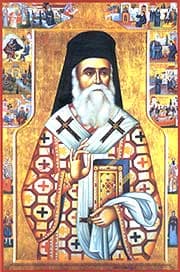
Nektarios of Aegina — Public domain. Via Wikimedia Commons.
Life
Anastasios Kephalas was born on October 1, 1846, in Selybria, a Greek village in Eastern Thrace then under Ottoman rule. He was the fifth of six children in a poor and pious family that fed itself on what his father grew. From early childhood his mother taught him to chant the Psalter; at fourteen he set out for Constantinople to find work, sleeping at the cathedral and supporting himself first as a shop assistant and later as a teacher in a Christian school on the island of Chios.
In 1876, at thirty, he received the monastic tonsure at the Nea Moni monastery on Chios with the name Lazaros. He was sent at his abbot's recommendation to Athens to complete a theology degree, then on to Alexandria, where the Patriarch Sophronios IV — recognizing the brilliance and the holiness of the young monk — ordained him deacon (with the new name Nektarios), then priest, then in 1889, at forty-three, consecrated him bishop with the title of Metropolitan of Pentapolis (a vacant ancient African see).
His clear gifts and the Patriarch's evident favor stirred up such intense jealousy among the senior clergy of the patriarchate that they brought charges of moral and administrative misconduct against him. The charges were fabricated; Nektarios refused, characteristically, to defend himself. Sophronios was forced — under what kind of pressure no one knows — to depose him and send him back to Greece in 1890. He arrived in Athens at forty-four, in disgrace, with the title of Metropolitan and the name of a saint, but no see, no funds, and no welcome at the Church of Greece.
He worked as a traveling preacher in obscure provincial parishes for several years, then was appointed director of the Rizareios Ecclesiastical School in Athens — the small seminary that prepared young men for the lower orders of the Greek clergy. He served as director for fifteen years (1894-1908), wrote a dozen books of theology and history, lived with extreme simplicity, and was the secret confessor of an increasing number of Athenians who recognized in him something they could find nowhere else.
In 1904 he was given the use of an abandoned monastery on the small island of Aegina, the Convent of the Holy Trinity, which he restored and into which he received as superior a group of women under his spiritual direction. He retired there in 1908 — by then sixty-two — and served the convent and the people of the island for the last twelve years of his life. The island doctor reported him a remarkably gentle and self-effacing old bishop; the islanders began to bring him their sick; cures multiplied. Pilgrims came from the mainland in increasing numbers.
He reposed at the Athens hospital on November 8, 1920, of cancer — at the age of seventy-four. He had refused all morphine, asking only to keep his mind clear for the moment of death. A young man in the next bed, paralyzed for life, was instantly healed when the saint's body was laid out and his clothes touched. Within days reports of healings began from his grave on Aegina; they have not stopped since. He was glorified by the Ecumenical Patriarchate in 1961, the first Greek saint of the modern era. His feast is November 9.
He is invoked particularly against cancer, and the small bottle of fragrant oil from his grave is in countless Greek and Russian homes. The convent on Aegina is one of the great living pilgrimage sites of the Greek Orthodox world.
Traditions
Feast day
November 9
Topics
Works in library