saint
St. Nicholas the Wonderworker
Archbishop of Myra in Lycia whose secret almsgiving saved three sisters from sale and whose presence at the Council of Nicaea was marked by zeal against Arius. After his repose his relics streamed myrrh at Myra and continued to do so when translated to Bari in 1087. The patron of children, sailors, and the poor — beloved across the whole Orthodox world.
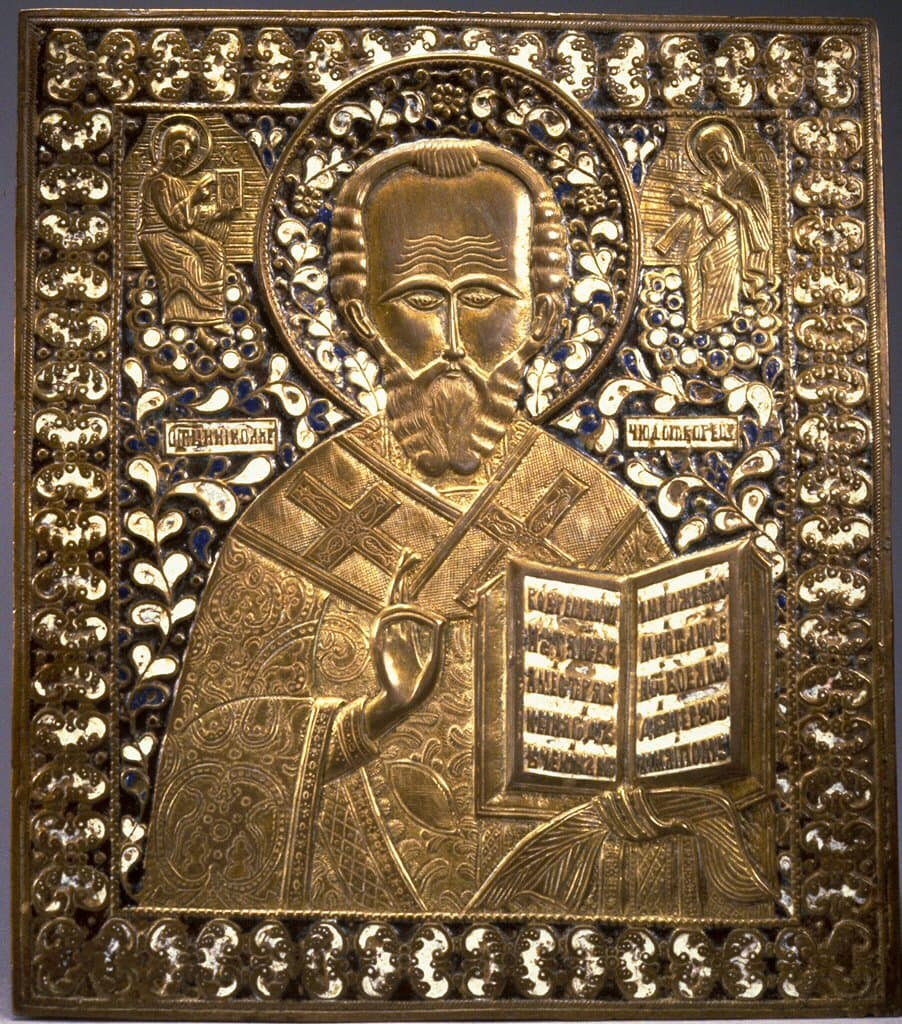
Saint Nicholas of Myra — Public domain. Via Wikimedia Commons.
Life
Nicholas was born around the year 270 in the Lycian city of Patara on the southern coast of Asia Minor, the only child of pious and well-to-do Greek parents who had longed for him through years of barrenness. Orphaned in his youth by the plague, he inherited a considerable estate and from the beginning gave it away in secret. The most famous of his early acts is the rescue of three sisters whose impoverished father was about to sell them into prostitution: in three nights Nicholas threw bags of gold through their window — the origin of every later gift-bringer named for him.
He went up to Jerusalem as a young pilgrim, and on his return was chosen by the priests of Myra in Lycia to be their archbishop. He served his city through the last and most savage of the Roman persecutions under Diocletian and Maximin, suffering imprisonment and beatings, and emerged with the peace of Constantine bearing the marks of confession on his body.
He attended the First Ecumenical Council at Nicaea in 325. The most-told story of the council places him there striking the heretic Arius across the face for his blasphemies against the Son of God — for which he was deposed and imprisoned by the other bishops, until the Mother of God and the Lord Himself appeared to them in the night to restore him. The story is late, but its theological substance is right: Nicholas was a man whose meekness coexisted with an unshakable zeal.
His miracles fill the synaxaria: he calmed storms at sea, ransomed three innocent men from imminent execution, fed his people through famine, restored to life three boys an evil innkeeper had murdered. He reposed at Myra on December 6, around the year 343, and his tomb began at once to stream a fragrant myrrh. In 1087, with Lycia under Saracen control, Italian sailors carried his relics to the Italian city of Bari, where they continue to issue myrrh today; the Russian Church keeps the translation feast on May 9.
He is the patron of children, of sailors and travelers, of repentant thieves, of pawnbrokers, of the falsely accused, of the city of Bari, and of all of Russia. Of all the saints after the apostles, none has more churches dedicated to him.
Traditions
Feast day
December 6 and May 9
Topics
Works in library