saint
St. Nikolai (Velimirovic) of Žiča and Ohrid
Bishop of Žiča and Ohrid, theologian-poet and confessor, imprisoned in Dachau by the Nazis for his witness. Author of the Prologue of Ohrid and many spiritual writings. Ended his days teaching in America.
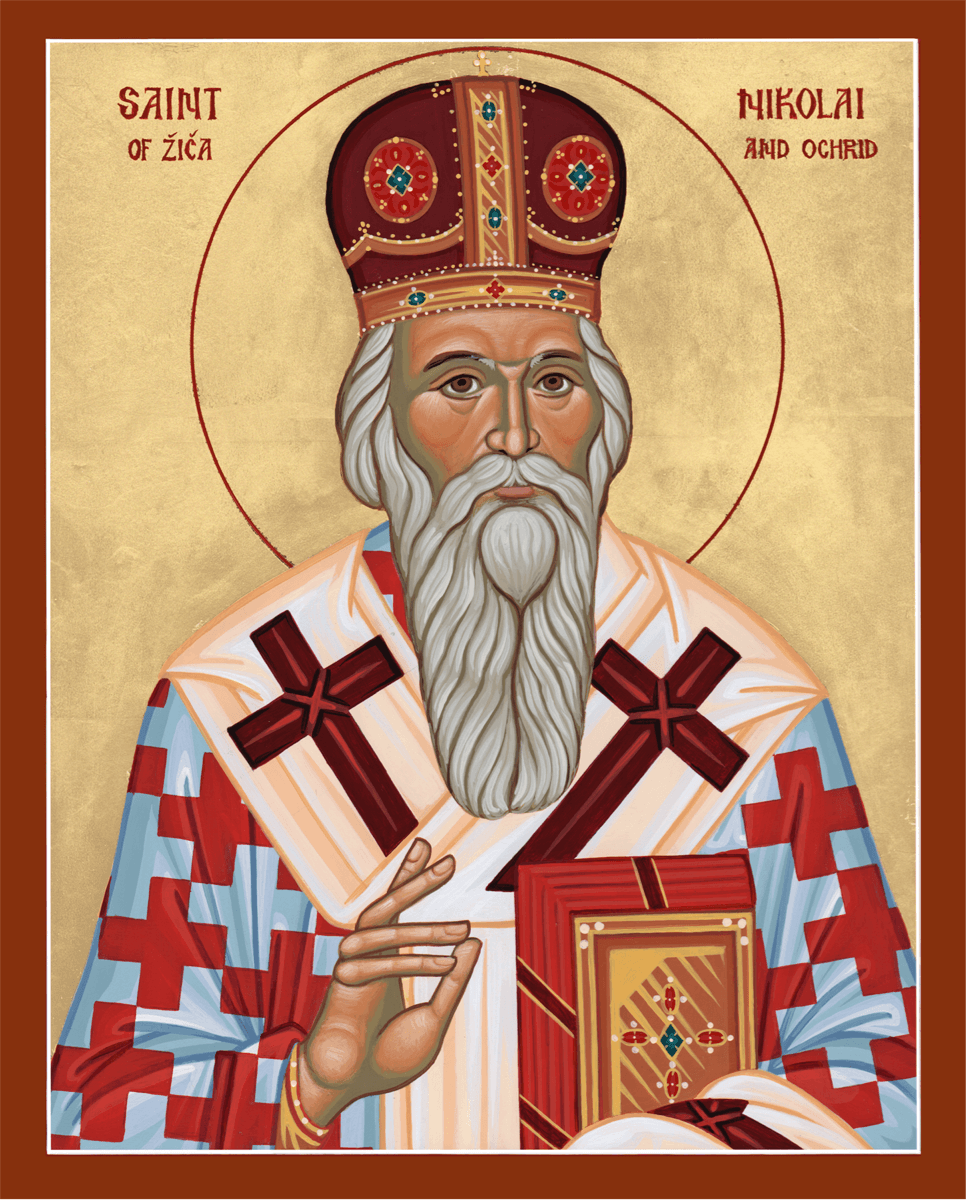
Saint Nikolai of Žiča — Hand-curated icon.
Life
Nikola Velimirović was born on January 4, 1881, in the small village of Lelić in central Serbia, into a poor peasant family of nine children. His father was a village schoolmaster of small means; his mother was deeply pious. Nikola — Nikolai in the Slavic spelling that the Church has preserved — was a clever child marked from his earliest years for the priesthood by the village priest. He was sent at twelve to the seminary at Belgrade, then took his theological studies abroad: doctorates from the University of Bern in 1908 and from Oxford in 1909, with intermediate years at Halle and Geneva. He came back to Serbia with a thorough Western theological education, of a kind unusual for Serbian clergy of his generation.
He was ordained a monk and priest in 1909, took the monastic name Nikolai, and served from 1909 to 1915 as a teacher and lecturer at the Belgrade theological school. During the First Balkan War (1912) and the First World War (1914-1918) he was attached to the Serbian army as a chaplain, accompanying the army through the catastrophic retreat across the mountains of Albania in 1915 and the long exile of the Serbian government at Corfu. He was deeply affected by the war — he had seen mass death up close, had ministered to thousands of dying soldiers, and had emerged with the strong conviction that European secular civilization was failing morally as well as politically.
After the war he served as Bishop of Žiča in central Serbia (1919-1920), then briefly as Bishop of Ohrid in southwestern Macedonia (then part of Yugoslavia, today the Republic of North Macedonia), where he spent a decade (1920-1934) rebuilding the local Serbian Church among the heavily Orthodox Macedonian population. The decade at Ohrid produced his most famous work, the Prologue from Ohrid — a daily synaxarion (lives of the saints for each day) with brief homilies, prayers, and theological reflections, written for the simple use of the Macedonian peasantry. The Prologue has become the most widely read modern Serbian spiritual text and has been translated into a dozen languages.
In 1934 he was returned to the see of Žiča, the senior bishopric of Serbia. He served there for the next decade — the period of the Yugoslav royal dictatorship, the rising threat of Nazi Germany, the German invasion of April 1941, and the Croatian Ustaša massacres of Serbs in 1941-1944. He was an outspoken opponent of Hitler from the early 1930s; he wrote a series of essays in those years on the spiritual collapse of modern Europe (later collected as Words to the Serbian People Through the Dungeon Window).
In 1941, after the German conquest of Yugoslavia, Nikolai and the senior patriarch of the Serbian Church, Gavrilo Dožić, were placed under house arrest by the Germans at the monastery of Žiča. They were held there until 1944, when in retaliation for what the Germans saw as continued resistance, they were transferred to the concentration camp at Dachau in Bavaria. The two were among only a few senior Christian hierarchs imprisoned at Dachau (the camp's principal Christian prisoners were Polish Catholic clergy). They were held there for about a year — Nikolai later reported that he saw the systematic killing of Polish priests in the camp and used the time to pray for the Serbian people.
They were liberated by American troops on April 29, 1945. Nikolai was sixty-four and in poor health. The new Yugoslav government of Marshal Tito refused them re-entry to Serbia (the patriarch was eventually allowed back after great pressure; Nikolai never returned). He went first to England, then to America, where he lived out his last fifteen years at a series of small Orthodox seminaries: St. Sava in Libertyville, Illinois; St. Vladimir's in New York; and finally St. Tikhon's in South Canaan, Pennsylvania.
He lectured at the seminaries, served the small Serbian-American parishes, and wrote constantly — pastoral letters, hymns, sermons, theological essays. His writings of the American period were marked by deep meditation on the meaning of the Serbian catastrophe of the Second World War and on the spiritual condition of America, which he saw clearly: with admiration for its religious liberty and personal energy, with foreboding at its consumerism and its materialism. He had a circle of disciples — Russian, Greek, Serbian, and convert Americans — who learned much of their faith from him.
He reposed at St. Tikhon's Monastery on March 18, 1956, at the age of seventy-five. He was buried first in the seminary cemetery there; his relics were translated to his native village of Lelić in 1991, after the fall of communism in Yugoslavia. They rest now in the Holy Trinity Cathedral at Lelić, which has become one of the principal Serbian pilgrimage sites. He was glorified by the Serbian Orthodox Church on May 19, 2003, jointly with the patriarchs Pavle and Gavrilo who had been at his side. His feasts are March 18 (repose) and May 3 (translation of his relics).
Traditions
Feast day
March 18 (repose) and May 3 (translation)
Topics
Works in library