saint
St. Holy Equal-to-the-Apostles Nina of Georgia
A young woman of Cappadocia who in the early fourth century brought the Gospel to Georgia by way of Armenia, healing the Iberian queen Nana and converting King Mirian. With her cross made of vine wood bound by her own hair, she is the apostle of the Georgians.
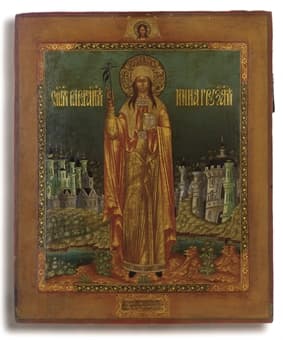
Saint Nina of Georgia — Public domain. Via Wikimedia Commons.
Life
Nina (or Nino, as the Georgians say) was born around the year 280 in the Roman province of Cappadocia, into a noble Christian family. Her father, Zabulon, was a kinsman of the great-martyr George; her mother Susanna was a sister of the patriarch of Jerusalem. Both parents took the religious life: Zabulon retired into the desert as a hermit, and Susanna became a deaconess at the Holy Sepulchre. Nina was placed in Jerusalem under the care of the patriarch and the deaconess Niophora, an elderly Armenian woman, who taught her the faith.
The story Niophora told her — of the tunic of the Lord that had been brought from Jerusalem to the Iberian (Georgian) country and buried there, of a nation living in a great mountainous land at the edge of Christendom that had never heard the Gospel — set Nina on fire. She prayed for years before the Mother of God's Cross of vine wood for permission to go and preach there. In a vision the Theotokos at last appeared to her, gave her a cross of vine wood bound by the saint's own hair, and sent her to the Iberian country.
She arrived in Georgia around 320 — the same generation that saw Constantine and Helena baptized at Rome. Settling on the edge of the royal city of Mtskheta, she lived in a small hut of branches and began to teach. Through her healing of a noble Iberian woman she came to the notice of the royal house. Queen Nana, who suffered from a long illness no doctor could cure, came to her and was healed; she became Nina's first royal convert. The pagan king Mirian III refused for some time to follow his wife, even threatening Nina with death.
In the year 327 the king set out for a hunt on Mount Thoti and was overtaken on the mountain by a sudden total darkness. Calling upon his pagan gods, he received no answer; then he prayed to the Christian God Nina had spoken of, and the light returned. He descended the mountain weeping and at once submitted to baptism — and through him the whole nation. Nina then went into the high mountains to evangelize the wilder Caucasian tribes.
She reposed in eastern Georgia in the village of Bodbe around 338, having lived long enough to see her work bear fruit. King Mirian wished to translate her body to the cathedral at Mtskheta, but the team of oxen carrying the casket would not move past her chosen burial place. There a great convent rose. Bodbe remains today a Georgian women's monastery and the principal pilgrimage shrine of all the Caucasus.
She is the patroness of Georgia and one of the very few women of the Christian centuries to bear the title Equal-to-the-Apostles. Her cross of vine wood is preserved in the cathedral at Tbilisi.
Traditions
Feast day
January 14
Topics
Works in library