saint
St. Onuphrius the Great
Desert father of the Egyptian Thebaid who withdrew from every human society for sixty years, living clothed only in his own long hair and nourished by God alone, until the monk Paphnutius found him in his final days.
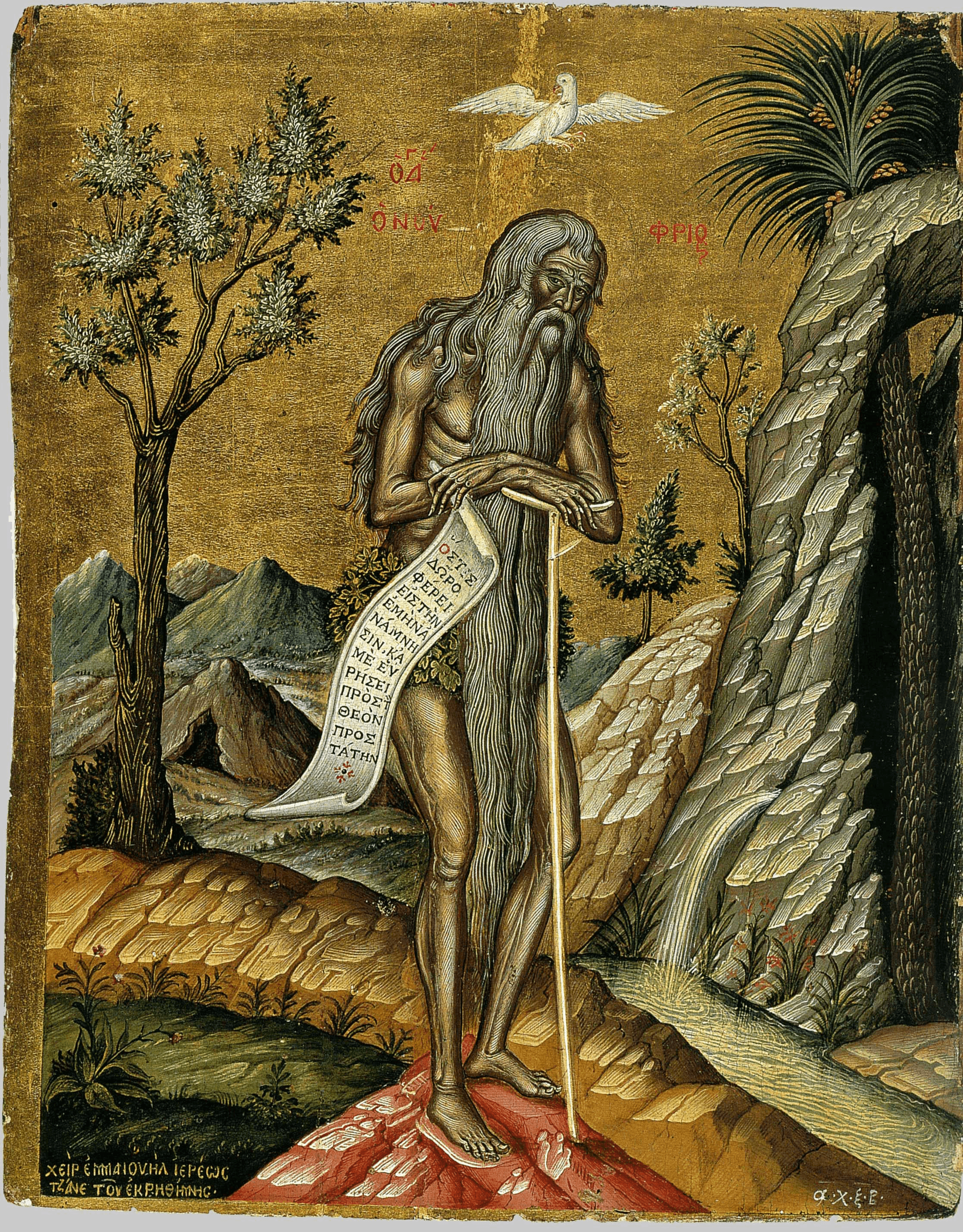
Saint Onuphrius the Great — Hand-curated icon.
Life
Onuphrius was a fourth-century Egyptian hermit who lived sixty years in absolute solitude in the wilderness of the Thebaid, far from any inhabited place. His story is preserved in the account of Paphnutius of Egypt, a younger desert father who set out into the inner wilderness to discover whether holy men were still living in the unexplored places, and after many days of journeying came upon Onuphrius near the small spring and the date-palm by which he had lived for decades.
Onuphrius told Paphnutius his story: that he had been raised in a monastery in the Thebaid, had read of the great solitaries before him, and had set out at last to imitate them. For sixty years he had lived alone — clothed only in his own hair which had grown long enough to cover him, eating only the dates from the palm tree and the wild herbs of the desert, drinking from the spring, conversing only with God. He had not seen a human face. He prayed continually and was sustained, the synaxarion records, by Communion brought to him at intervals by an angel.
When Paphnutius came, Onuphrius knew that his death was near and welcomed the disciple as the one God had sent to bury him. After their conversation — which Paphnutius preserved and which became one of the foundational texts of desert spirituality — Onuphrius gave up his spirit, and Paphnutius buried him beneath the palm. He returned to inhabited Egypt to tell what he had seen.
Onuphrius is one of the most beloved figures of Eastern monasticism. His feast is kept on June 12, and his iconography — the long-haired hermit at the spring beneath the palm — has been a fixture of Orthodox visual tradition for fifteen centuries.
Traditions
Feast day
June 12
Topics
Works in library