saint
St. Paisios the Athonite
Twentieth-century elder of the Holy Mountain whose hermitage at Panagouda became a place of pilgrimage for thousands. His simple counsels, recorded in the volumes of Spiritual Counsels, have shaped contemporary Orthodox spirituality across the world.
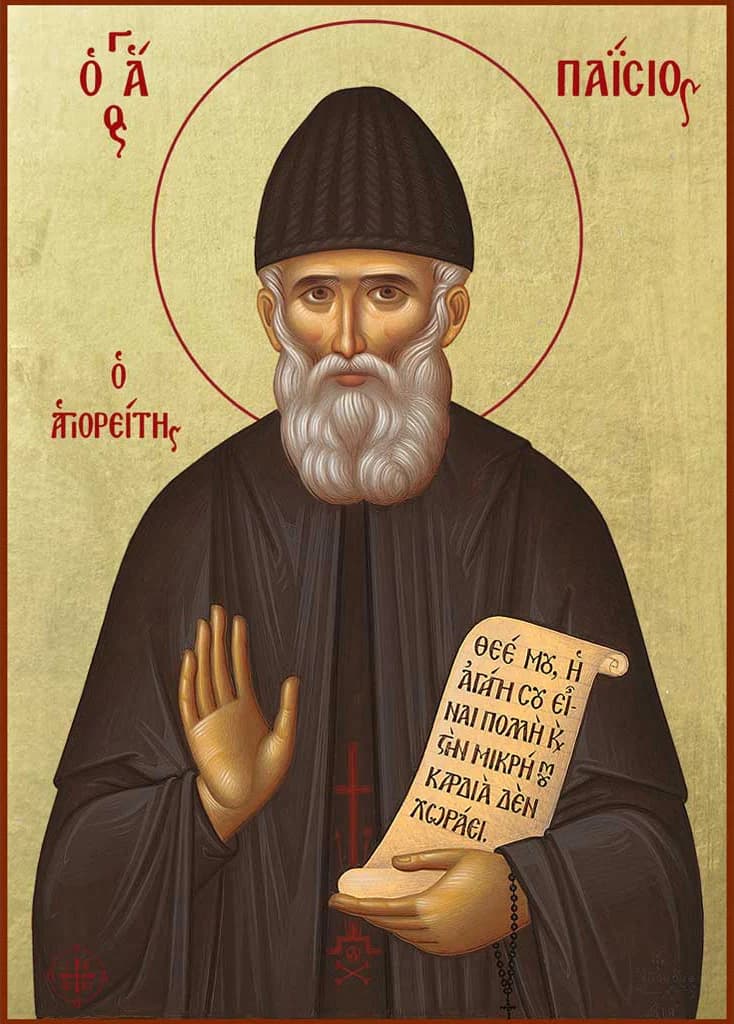
Saint Paisios the Athonite — Hand-curated icon.
Life
Arsenios Eznepidis was born on July 25, 1924, in the Greek village of Farasa in Cappadocia (now in central Turkey) — one of the last cohorts of Greeks born in their ancestral Anatolia before the population exchange of 1923. He was baptized by the great elder of his village, St. Arsenios of Cappadocia (who would later become his spiritual father from beyond the grave). The Greek population of Farasa was driven into exile within a few weeks of Arsenios's baptism; the family settled at Konitsa in Epirus on the Albanian border, where Arsenios grew up.
He was a quiet, devout boy, given as a child to long visits to the church and to the patient making of small objects with his hands. He worked as a carpenter through his teens. At sixteen he was caught up in the Greek-Italian war (1940-1941) and then in the German occupation; later, during the Greek Civil War (1946-1949), he served in the army as a radio operator and is said to have asked God repeatedly to take him in the place of fellow soldiers with families. He survived.
In 1950 he set out for Mount Athos. He spent a number of years at various monasteries and skites — Esphigmenou, Philotheou, the Stomion monastery near Konitsa (where he served for some years as a hieromonk), and various sites of stricter solitude. He was tonsured Paisios in 1954, after the great elder of Athos of the previous generation. By the 1960s he had returned permanently to Athos and settled, after several moves, at the small hermitage of Panagouda at Karyes — a stone hut with a sheet-metal roof, a few peach trees, and a courtyard.
There he lived for the next twenty-five years and there he became famous across the Greek-speaking world. He kept no schedule and saw whoever came; in the summer months, a thousand pilgrims a day climbed the path to his cell. He gave them whatever they needed in a few minutes — counsel, a sweet, a prayer rope, a clear word about the state of their soul. He had the gift of clairvoyance and used it sparingly. He was known for laughter, for the directness of his Greek peasant speech, for his refusal of pious airs.
His health, never strong, broke in the last years; he was diagnosed with cancer in 1993 and reposed at the Convent of St. John the Theologian at Souroti, near Thessalonica, on July 12, 1994. The number of pilgrims at his funeral was extraordinary. His grave at the convent has become one of the great pilgrimage sites of contemporary Greek Christianity.
His teaching was preserved by the sisters of Souroti and by his disciples in a series of books — Spiritual Counsels in six volumes, Letters, Words to a Hesychast, others — which have been translated into many languages. They are not systematic; they are a record of his counsels on prayer, on family life, on the times, on the love of enemies, on the small acts of charity that make a Christian. He was canonized by the Ecumenical Patriarchate in 2015. His feast is July 12.
Traditions
Feast day
July 12
Topics
Works in library